

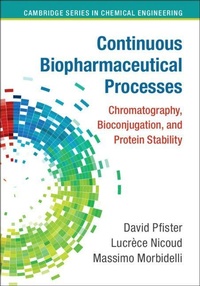
Continuous Biopharmaceutical Processes
Chromatography, Bioconjugation, and Protein Stability
Published on 11. October 2018
Book
Hardback
346 pages
978-1-108-42022-8 (ISBN)
Description
This innovative reference provides a coherent and critical view on the potential benefits of a transition from batch to continuous processes in the biopharmaceutical industry, with the main focus on chromatography. It also covers the key topics of protein stability and protein conjugation, addressing the chemical reaction and purification aspects together with their integration. This book offers a fine balance between theoretical modelling and illustrative case studies, between fundamental concepts and applied examples from the academic and industrial literature. Scientists interested in the design of biopharmaceutical processes will find useful practical methodologies, in particular for single-column and multi-column chromatographic processes.
More details
Series
Language
English
Place of publication
Cambridge
United Kingdom
Target group
Professional and scholarly
Product notice
Laminated cover
Illustrations
Worked examples or Exercises; 29 Tables, black and white; 11 Plates, color; 142 Line drawings, black and white
Dimensions
Height: 250 mm
Width: 175 mm
Thickness: 23 mm
Weight
780 gr
ISBN-13
978-1-108-42022-8 (9781108420228)
Copyright in bibliographic data and cover images is held by Nielsen Book Services Limited or by the publishers or by their respective licensors: all rights reserved.
Schweitzer Classification
Other editions
Additional editions
David Pfister
Continuous Biopharmaceutical Processes
Chromatography, Bioconjugation, and Protein Stability
E-Book
10/2018
Cambridge University Press
€103.99
Available for download
David Pfister | Lucrece Nicoud | Massimo Morbidelli
Continuous Biopharmaceutical Processes
Chromatography, Bioconjugation, and Protein Stability
E-Book
09/2018
Cambridge University Press
€124.99
Available for download
Persons
David Pfister is project manager at Ypso Facto (Nancy, France), where he is developing the software ChromWorks, which has been used to perform the large majority of the simulations of chromatographic processes shown in this book. He was a doctorate student of Professor Morbidelli at Eidgenoessische Technische Hochschule Zuerich (ETH Zurich) and graduated in 2015. His Ph.D. thesis focused on protein conjugation, and his research also dealt with the fundamental understanding of protein chromatography. Before joining ETH Zurich, he obtained a master degree in chemical engineering from Ecole Nationale Superieure des Industries Chimiques (Nancy, France). Lucrece Nicoud is the recipient of a fellowship from the Swiss National Foundation financing her current research on the crystallization of pharmaceutical ingredients at the Massachusetts Institute of Technology. She was a doctorate student of Professor Morbidelli at Eidgenoessische Technische Hochschule Zuerich (ETH Zurich) and graduated in 2015. Her Ph.D. focused on protein aggregation, and her research also dealt with the fundamental understanding of protein chromatography. Before joining ETH Zurich, she obtained a master degree in chemical engineering from Ecole Nationale Superieure des Industries Chimiques (Nancy, France). Massimo Morbidelli is Professor at Eidgenoessische Technische Hochschule Zuerich (ETH Zurich) since 1996 and at Politecnico di Milano (Italy) since 1991. His research focuses on the production, purification, conjugation and aggregation of therapeutic proteins. Other research activities carried out in his group deal with polymer and colloid science. Professor Morbidelli received the Excellence in Process Development Research Award from the American Institute of Chemical Engineers in 2017 and the Separation Science and Technology Award from the American Chemical Society in 2018 for his work on the continuous production and purification of monoclonal antibodies.
Content
Preface; 1. Introduction to biopharmaceutical processes; 2. Fundamentals of protein chromatography; 3. Counter-current separation processes; 4. Counter-current chromatography for the capture step; 5. Counter-current chromatography for the polishing steps; 6. Protein conjugation; 7. Protein aggregation in biopharmaceutical processes; 8. Conclusion; References; Notation; Index.