

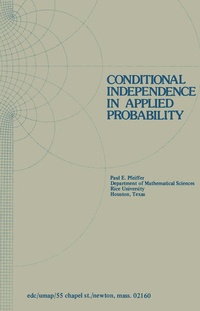
Conditional Independence in Applied Probability
Published on 9. November 2011
Book
Paperback/Softback
IX, 158 pages
978-1-4612-6337-1 (ISBN)
Description
It would be difficult to overestimate the importance of stochastic independence in both the theoretical development and the practical appli cations of mathematical probability. The concept is grounded in the idea that one event does not "condition" another, in the sense that occurrence of one does not affect the likelihood of the occurrence of the other. This leads to a formulation of the independence condition in terms of a simple "product rule," which is amazingly successful in capturing the essential ideas of independence. However, there are many patterns of "conditioning" encountered in practice which give rise to quasi independence conditions. Explicit and precise incorporation of these into the theory is needed in order to make the most effective use of probability as a model for behavioral and physical systems. We examine two concepts of conditional independence. The first concept is quite simple, utilizing very elementary aspects of probability theory. Only algebraic operations are required to obtain quite important and useful new results, and to clear up many ambiguities and obscurities in the literature.
More details
Series
Language
English
Place of publication
Boston
United States
Target group
Professional and scholarly
Research
Illustrations
IX, 158 p.
Dimensions
Height: 216 mm
Width: 140 mm
Thickness: 10 mm
Weight
220 gr
ISBN-13
978-1-4612-6337-1 (9781461263371)
DOI
10.1007/978-1-4612-6335-7
Schweitzer Classification
Other editions
Additional editions
P.E. Pfeiffer
Conditional Independence in Applied Probability
Book
01/1978
Birkhauser Boston Inc
€96.00
Article not available at the moment
Content
A. Preliminaries.- 1. Probability Spaces and Random Vectors.- 2. Mathematical Expectation.- 3. Problems.- B. Conditional Independence of Events.- 1. The Concept.- 2. Some Patterns of Probable Inference.- 3. A Classification Problem.- 4. Problems.- C. Conditional Expectation.- 1. Conditioning by an Event.- 2. Conditioning by a Random Vector-Special Cases.- 3. Conditioning by a Random Vector-General Case.- 4. Properties of Conditional Expectation.- 5. Conditional Distributions.- 6. Conditional Distributions and Bayes' Theorem.- 7. Proofs of Properties of Conditional Expectation.- 8. Problems.- D. Conditional Independence, Given a Random Vector.- 1. The Concept and Some Basic Properties.- 2. Some Elements of Bayesian Analysis.- 3. A One-Stage Bayesian Decision Model.- 4. A Dynamic-Programming Example.- 5. Proofs of the Basic Properties.- 6. Problems.- E. Markov Processes and Conditional Independence.- 1. Discrete-Parameter Markov Processes.- 2. Markov Chains with Costs and Rewards.- 3. Continuous-Parameter Markov Processes.- 4. The Chapman-Kolmogorov Equation.- 5. Proof of a Basic Theorem on Markov Processes.- 6. Problems.- Appendices.- Appendix I. Properties of Mathematical Expectation.- Appendix II. Properties of Conditional Expectation, Given a Random Vector.- Appendix III. Properties of Conditional Independence, Given a Random Vector.- References.- Selected Answers, Hints, and Key Steps.