


Queering Families
The Postmodern Partnerships of Cisgender Women and Transgender Men
Published on 5. January 2017
Book
Paperback/Softback
288 pages
978-0-19-990805-9 (ISBN)
Description
Ozzie and Harriet, move over. A new couple is moving into the neighborhood. In the postmodern era, advances in medical technologies allow some individuals categorized female at birth to live in accordance with their gender identities, as men. While a growing body of literature on transgender men's experiences has come to the forefront, relatively little exists to document the experiences of their partners. In Queering Families: The Postmodern Partnerships of Cisgender Women and Transgender Men, Carla A. Pfeffer brings these experiences to light through interviews with the group most likely to partner and form families with transgender men: non-transgender (cisgender) women.
Drawing upon in-depth interviews with fifty cisgender women partners of transgender men from across the United States and Canada, Pfeffer details the experiences of a community that often seems unremarkable and ordinary on its surface. Cisgender women who partner with transgender men who are socially "read" as male are often (mis)perceived as part of a heterosexual couple or family. Yet not all cisgender women who partner with transgender men are comfortable with this invisible existence and comfortable normativity. Instead, many of the cisgender women Pfeffer interviews hold deeply-valued queer identities that may be erased in their partnerships with transgender men.
Queering Families details the struggles and strengths of these postmodern "Harriets" as they work to build identities, partnerships, families, and communities. Pfeffer's interviewees discuss the implications of visibility and invisibilty in their everyday lives as they face barriers or pathways to legal and social inclusion. They carve out new lexicons for partners' bodies and their own sexualities, transformed through gender-affirming hormones and surgeries. They plan and construct families with and without children, some drawing upon alternative reproductive technologies to bear the biological offspring of their transgender partners.
With remarkable depth and insight, Queering Families explores a shifting social landscape that challenges the very notion of what constitutes a "same-sex" or an "opposite-sex" relationship, marriage, or family.
Drawing upon in-depth interviews with fifty cisgender women partners of transgender men from across the United States and Canada, Pfeffer details the experiences of a community that often seems unremarkable and ordinary on its surface. Cisgender women who partner with transgender men who are socially "read" as male are often (mis)perceived as part of a heterosexual couple or family. Yet not all cisgender women who partner with transgender men are comfortable with this invisible existence and comfortable normativity. Instead, many of the cisgender women Pfeffer interviews hold deeply-valued queer identities that may be erased in their partnerships with transgender men.
Queering Families details the struggles and strengths of these postmodern "Harriets" as they work to build identities, partnerships, families, and communities. Pfeffer's interviewees discuss the implications of visibility and invisibilty in their everyday lives as they face barriers or pathways to legal and social inclusion. They carve out new lexicons for partners' bodies and their own sexualities, transformed through gender-affirming hormones and surgeries. They plan and construct families with and without children, some drawing upon alternative reproductive technologies to bear the biological offspring of their transgender partners.
With remarkable depth and insight, Queering Families explores a shifting social landscape that challenges the very notion of what constitutes a "same-sex" or an "opposite-sex" relationship, marriage, or family.
Reviews / Votes
Queering Families is a wonderfully in-depth and refreshing look at the often-misunderstood relationships of trans individuals. * Aleander Young, MA, APA - Society for the Psychology of Sexual Orientation and Gender Diversity * Overall, Queering Families is a welcome addition to the literature on family, gender, and sexualities and would fit well in upper-level undergraduate and graduate courses in sociology andwomen, gender, and sexuality studies. The writing is accessible and not bogged down with academic jargon. The book even includes a glossary for readers less familiar with trans and queer terminology. Notably, cis partners of transmen will likely celebrate this book as an important resource for navigating their own relationships. Queering Families furthers knowledge about postmodern partnerships and paves theway for greater understandings of family configurations that defy the boundaries of normativity. * Elroi J. Windsor, Salem College, American Journal of Sociology *More details
Series
Language
English
Place of publication
New York
United States
Target group
College/higher education
Professional and scholarly
Dimensions
Height: 234 mm
Width: 156 mm
Thickness: 16 mm
Weight
445 gr
ISBN-13
978-0-19-990805-9 (9780199908059)
Copyright in bibliographic data and cover images is held by Nielsen Book Services Limited or by the publishers or by their respective licensors: all rights reserved.
Schweitzer Classification
Other editions
Additional editions
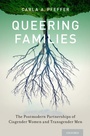
Carla A. Pfeffer
Queering Families
The Postmodern Partnerships of Cisgender Women and Transgender Men
E-Book
11/2016
1st Edition
OUP eBook
€48.49
Available for download
Carla A. Pfeffer
Queering Families
The Postmodern Partnerships of Cisgender Women and Transgender Men
E-Book
11/2016
1st Edition
OUP eBook
€48.49
Available for download
Person
Carla A. Pfeffer completed her doctoral work at the University of Michigan. She currently holds a joint appointment in Sociology and Women's and Gender Studies at the University of South Carolina. Her research, employing qualitative and mixed-methods approaches, considers thorny intersections between social stigma, identity, resistance, and structure.
Content
Series Foreword by Phil Hammack
Introduction: Queer Families and the Development of the Sociological Imagination
1: Trans Partnerships and Families: Historical Traces and Contemporary Representations
2: Identity Shifts, Recognition, and Intersectionality in Trans Partnerships and Families
3: Queering Family Labor: Managing Households, Relationships, and Transitions
4: Bodies, Sexuality, and Intimacy in Trans Partnerships and Families
5: (Re)producing Trans Families: Accessing Social, Legal, and Medical Recognition and Technologies
6: It Takes a Village, People: Social Strain and Support for Trans Partnerships and Families
Conclusion: Toward Broader and More Inclusive Notions of Family in the Twenty-First Century
Introduction: Queer Families and the Development of the Sociological Imagination
1: Trans Partnerships and Families: Historical Traces and Contemporary Representations
2: Identity Shifts, Recognition, and Intersectionality in Trans Partnerships and Families
3: Queering Family Labor: Managing Households, Relationships, and Transitions
4: Bodies, Sexuality, and Intimacy in Trans Partnerships and Families
5: (Re)producing Trans Families: Accessing Social, Legal, and Medical Recognition and Technologies
6: It Takes a Village, People: Social Strain and Support for Trans Partnerships and Families
Conclusion: Toward Broader and More Inclusive Notions of Family in the Twenty-First Century