

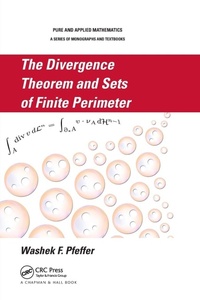
The Divergence Theorem and Sets of Finite Perimeter
1st Edition
Published on 5. September 2019
Book
Paperback/Softback
259 pages
978-0-367-38151-6 (ISBN)
Description
This book is devoted to a detailed development of the divergence theorem. The framework is that of Lebesgue integration - no generalized Riemann integrals of Henstock-Kurzweil variety are involved.
In Part I the divergence theorem is established by a combinatorial argument involving dyadic cubes. Only elementary properties of the Lebesgue integral and Hausdorff measures are used. The resulting integration by parts is sufficiently general for many applications. As an example, it is applied to removable singularities of Cauchy-Riemann, Laplace, and minimal surface equations.
The sets of finite perimeter are introduced in Part II. Both the geometric and analytic points of view are presented. The equivalence of these viewpoints is obtained via the functions of bounded variation. These functions are studied in a self-contained manner with no references to Sobolev's spaces. The coarea theorem provides a link between the sets of finite perimeter and functions of bounded variation.
The general divergence theorem for bounded vector fields is proved in Part III. The proof consists of adapting the combinatorial argument of Part I to sets of finite perimeter. The unbounded vector fields and mean divergence are also discussed. The final chapter contains a characterization of the distributions that are equal to the flux of a continuous vector field.
In Part I the divergence theorem is established by a combinatorial argument involving dyadic cubes. Only elementary properties of the Lebesgue integral and Hausdorff measures are used. The resulting integration by parts is sufficiently general for many applications. As an example, it is applied to removable singularities of Cauchy-Riemann, Laplace, and minimal surface equations.
The sets of finite perimeter are introduced in Part II. Both the geometric and analytic points of view are presented. The equivalence of these viewpoints is obtained via the functions of bounded variation. These functions are studied in a self-contained manner with no references to Sobolev's spaces. The coarea theorem provides a link between the sets of finite perimeter and functions of bounded variation.
The general divergence theorem for bounded vector fields is proved in Part III. The proof consists of adapting the combinatorial argument of Part I to sets of finite perimeter. The unbounded vector fields and mean divergence are also discussed. The final chapter contains a characterization of the distributions that are equal to the flux of a continuous vector field.
More details
Language
English
Place of publication
Oxford
United Kingdom
Publishing group
Taylor & Francis Ltd
Target group
Professional and scholarly
Professional Practice & Development
Dimensions
Height: 234 mm
Width: 156 mm
Thickness: 14 mm
Weight
401 gr
ISBN-13
978-0-367-38151-6 (9780367381516)
Copyright in bibliographic data and cover images is held by Nielsen Book Services Limited or by the publishers or by their respective licensors: all rights reserved.
Schweitzer Classification
Other editions
Additional editions
Washek F. Pfeffer
The Divergence Theorem and Sets of Finite Perimeter
E-Book
02/2016
1st Edition
Chapman & Hall/CRC
€89.99
Available for download

Washek F. Pfeffer
The Divergence Theorem and Sets of Finite Perimeter
Book
04/2012
1st Edition
CRC Press
€282.53
Article not available at the moment
Person
Pfeffer, Washek F.
Content
DYADIC FIGURES: Preliminaries. Divergence Theorem for Dyadic Figures. Removable Singularities. SETS OF FINITE PERIMETER: Perimeter. BV Functions. Locally BV Sets. THE DIVERGENCE THEOREM: Bounded Vector Fields. Unbounded Vector Fields. Mean Divergence. Charges. The Divergence Equation.