

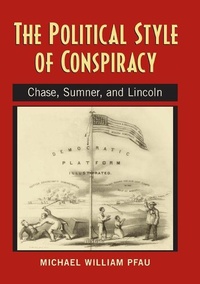
The Political Style of Conspiracy
Chase, Sumner, and Lincoln
Will be published approx. on 2. November 2005
Book
Hardback
256 pages
978-0-87013-760-0 (ISBN)
Description
The turbulent history of the United States has provided a fertile ground for conspiracies, both real and imagined. From the American Revolution to the present day, conspiracy discourse-linguistic and symbolic practices and artifacts revolving around themes, claims, or accusations of conspiracy-has been a staple of political rhetoric. Some conspiracy theories never catch on with the public, while others achieve widespread popularity. Whether successful or not, the means by which particular conspiracy theories spread is a rhetorical process, a process in which persuasive language, symbolism, and arguments act upon individual minds within concrete historical and political settings.
Conspiracy rhetoric was a driving force in the evolution of antebellum political culture, contributing to the rise and fall of the great parties in the nineteenth century. One conspiracy theory in particular-the "slave power" conspiracy-was instrumental in facilitating the growth of the young Republican Party's membership and ideology. The Political Style of Conspiracy analyzes the concept and reality of the "slave power" in the rhetorical discourse of the mid-nineteenth-century, in particular the speeches and writing of politicians Salmon P. Chase, Charles Sumner, and Abraham Lincoln. By examining their mainstream texts, Pfau reveals that, in addition to the "paranoid style" of conspiracy rhetoric that inhabits the margins of political life, Lincoln, Chase, and Sumner also engaged in a distinctive form of conspiracy rhetoric that is often found at the center of mainstream American society and politics.
Conspiracy rhetoric was a driving force in the evolution of antebellum political culture, contributing to the rise and fall of the great parties in the nineteenth century. One conspiracy theory in particular-the "slave power" conspiracy-was instrumental in facilitating the growth of the young Republican Party's membership and ideology. The Political Style of Conspiracy analyzes the concept and reality of the "slave power" in the rhetorical discourse of the mid-nineteenth-century, in particular the speeches and writing of politicians Salmon P. Chase, Charles Sumner, and Abraham Lincoln. By examining their mainstream texts, Pfau reveals that, in addition to the "paranoid style" of conspiracy rhetoric that inhabits the margins of political life, Lincoln, Chase, and Sumner also engaged in a distinctive form of conspiracy rhetoric that is often found at the center of mainstream American society and politics.
More details
Series
Language
English
Place of publication
East Lansing, MI
United States
Target group
College/higher education
Product notice
sewn/stitched
Cloth over boards
With dust jacket
Dimensions
Height: 236 mm
Width: 160 mm
Thickness: 21 mm
Weight
494 gr
ISBN-13
978-0-87013-760-0 (9780870137600)
Copyright in bibliographic data and cover images is held by Nielsen Book Services Limited or by the publishers or by their respective licensors: all rights reserved.
Schweitzer Classification
Person
Michael William Pfau is Associate Professor of Communication at the University of Minnesota-Duluth.
Content
Contents
Acknowledgments
Chapter One. Problems of Interpretation: Approaching Conspiracy in Text and Discourse
Chapter Two. The Slave Power According to Salmon P. Chase: Entering the Mainstream of Partisan Rhetoric, 1845-1854
Chapter Three. Charles Sumner's "Crime against Kansas": Conspiracy Rhetoric in the Oratorical Mold
Chapter Four. Lincoln, Conspiracy Rhetoric, and the "House Divided": Assessing the Judgment of History
Chapter Five. Lessons of the Slave Power Conspiracy: Conspiracy Rhetoric at the Center and Fringe
Notes
Bibliography
Index
Acknowledgments
Chapter One. Problems of Interpretation: Approaching Conspiracy in Text and Discourse
Chapter Two. The Slave Power According to Salmon P. Chase: Entering the Mainstream of Partisan Rhetoric, 1845-1854
Chapter Three. Charles Sumner's "Crime against Kansas": Conspiracy Rhetoric in the Oratorical Mold
Chapter Four. Lincoln, Conspiracy Rhetoric, and the "House Divided": Assessing the Judgment of History
Chapter Five. Lessons of the Slave Power Conspiracy: Conspiracy Rhetoric at the Center and Fringe
Notes
Bibliography
Index