

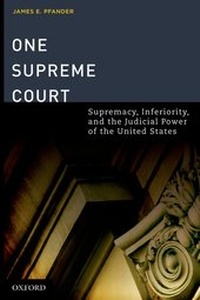
One Supreme Court
Supremacy, Inferiority, and the Judicial Department of the United States
Published on 4. June 2009
Book
Hardback
328 pages
978-0-19-534033-4 (ISBN)
Description
Despite over two hundred years of experience with constitutional government, much remains unclear about the power of the political branches to curtail or re-define the judicial power of the United States. Uncertainty persists about the basis on which state courts and federal agencies may hear federal claims and the degree to which federal courts must review their decisions. Scholars approach these questions from a range of vantage points and have arrived at widely varying conclusions about the relationship between congressional and judicial power.
Deploying familiar forms of legal analysis, and relying upon a new account of the Court's supremacy in relation to lower courts and tribunals, James Pfander advances a departmental conception of the judiciary. He argues that Congress can enlist the state courts, lower federal courts, and administrative agencies to hear federal claims in the first instance, but all of these tribunals must operate within a hierarchical framework over which the "one supreme Court" identified in the Constitution exercises ultimate supervisory authority. In offering the first general account of the Court as department head, Pfander takes up such important debates in the federal courts' literature as Congress's power to strip the federal courts of jurisdiction to review state court decisions, its authority to assign decision-making authority to state courts and non-Article III tribunals, its control over the doctrine of vertical stare decisis, and its ability to craft rules of practice for the federal system.
Deploying familiar forms of legal analysis, and relying upon a new account of the Court's supremacy in relation to lower courts and tribunals, James Pfander advances a departmental conception of the judiciary. He argues that Congress can enlist the state courts, lower federal courts, and administrative agencies to hear federal claims in the first instance, but all of these tribunals must operate within a hierarchical framework over which the "one supreme Court" identified in the Constitution exercises ultimate supervisory authority. In offering the first general account of the Court as department head, Pfander takes up such important debates in the federal courts' literature as Congress's power to strip the federal courts of jurisdiction to review state court decisions, its authority to assign decision-making authority to state courts and non-Article III tribunals, its control over the doctrine of vertical stare decisis, and its ability to craft rules of practice for the federal system.
Reviews / Votes
This is a sophisticated and important study of the federal courts, * Richard A. Paschal, The Journal of Politics *More details
Language
English
Place of publication
New York
United States
Target group
Professional and scholarly
Dimensions
Height: 155 mm
Width: 236 mm
Thickness: 30 mm
Weight
615 gr
ISBN-13
978-0-19-534033-4 (9780195340334)
Copyright in bibliographic data and cover images is held by Nielsen Book Services Limited or by the publishers or by their respective licensors: all rights reserved.
Schweitzer Classification
Other editions
Additional editions
James E. Pfander
One Supreme Court
Supremacy, Inferiority, and the Judicial Department of the United States
E-Book
05/2009
1st Edition
OUP eBook
€56.99
Available for download
James E. Pfander
One Supreme Court
Supremacy, Inferiority, and the Judicial Department of the United States
E-Book
05/2009
1st Edition
OUP eBook
€44.99
Available for download
Person
James Pfander is the Prentice H. Marshall Professor of Law at the University of Illinois College of Law. Since 1998, Professor Pfander has served as a consultant to the Federal-State Jurisdiction Committee of the Judicial Conference of the United States, in which capacity he considers the impact of proposed legislation on the jurisdiction of the federal courts. A member of the American Law Institute, he has chaired both the Federal Courts and Civil Procedure Sections of the Association of American Law Schools.