

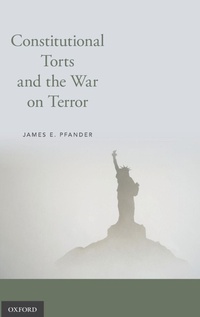
Constitutional Torts and the War on Terror
Published on 23. February 2017
Book
Hardback
274 pages
978-0-19-049528-2 (ISBN)
Description
Constitutional Torts and the War on Terror examines the judicial response to human rights claims arising from the Bush Administration's war on terror. Despite widespread agreement that the Administration's program of extraordinary rendition, prolonged detention, and "enhanced" interrogation was torture by another name, not a single federal appellate court has confirmed an award of damages to the program's victims. The silence of the federal courts leaves victims without redress and the constitutional limits on government action undefined.
Many of the suits seeking redress have been based on the landmark 1971 Supreme Court decision in Bivens v. Six Unknown Named Agents of the Federal Bureau of Narcotics. This book traces the history of common law accountability, the rise of Bivens claims, and the post-Bivens history of constitutional tort litigation. After evaluating the failure of Bivens litigation arising from the war on terror, the book considers and rejects the arguments that have been put forward to explain and justify judicial silence.
The book provides the Supreme Court with the tools needed to rethink its Bivens jurisprudence. Rather than treating the overseas national security context as disabling, modern federal courts should take a page from the nineteenth century, presume the viability of tort litigation, and proceed to the merits. Only by doing so can the federal courts ensure redress for victims and prevent future Administrations from using torture as an instrument of official policy.
Many of the suits seeking redress have been based on the landmark 1971 Supreme Court decision in Bivens v. Six Unknown Named Agents of the Federal Bureau of Narcotics. This book traces the history of common law accountability, the rise of Bivens claims, and the post-Bivens history of constitutional tort litigation. After evaluating the failure of Bivens litigation arising from the war on terror, the book considers and rejects the arguments that have been put forward to explain and justify judicial silence.
The book provides the Supreme Court with the tools needed to rethink its Bivens jurisprudence. Rather than treating the overseas national security context as disabling, modern federal courts should take a page from the nineteenth century, presume the viability of tort litigation, and proceed to the merits. Only by doing so can the federal courts ensure redress for victims and prevent future Administrations from using torture as an instrument of official policy.
Reviews / Votes
From William Blackstone to William Brennan, from John Marshall to the younger John Marshall Harlan, many of our greatest jurists have championed the remedial imperative-the need for robust judicial remedies to vindicate basic legal rights. In this wise and careful book, one of the best legal minds of the current generation, James Pfander, reinvigorates this grand legal tradition, explaining how ancient legal principles must be refreshed to meet modern challenges."Akhil Reed Amar, Sterling Professor of Law and Political Science, Yale University Not a single U.S. official who participated in torture in the wake of 9/11 has been held accountable for his actions; many victims have sued, but not a single one has received compensation. James Pfander offers a bracing account of judicial abdication in the face of brutal illegality, and a cogent and persuasive argument for the resurrection of the judiciary's role in holding government wrongdoers accountable for unconstitutional national security initiatives in the future."
David Cole, Professor, Georgetown University Law Center But the juxtaposition of Jim Pfanderas erudite and magisterial new monograph, Constitutional Torts and the War on Terror, and the Supreme Courtas June 19 decision in Ziglar v. Abbasi, suggests a different (and more alarming) possibility: The problem is not that law professors are failing to produce scholarship of utility to contemporary judges; the problem is that the scholarship that is out there just is not getting read. How else to explain both the result and the reasoning in Abbasiaa decision deeply hostile to judge-made damages remedies for constitutional violations by federal officers, and one that is shamelessly indifferent and stunningly oblivious to the rich history and tradition of such remedies that has been well- and long-documented in the academic literature, most powerfully in Pfanderas book. * Steve Vladeck, JOTWELL *
More details
Language
English
Place of publication
New York
United States
Target group
Professional and scholarly
Product notice
sewn/stitched
Cloth over boards
Dimensions
Height: 239 mm
Width: 155 mm
Thickness: 25 mm
Weight
499 gr
ISBN-13
978-0-19-049528-2 (9780190495282)
Copyright in bibliographic data and cover images is held by Nielsen Book Services Limited or by the publishers or by their respective licensors: all rights reserved.
Schweitzer Classification
Other editions
Additional editions
James E. Pfander
Constitutional Torts and the War on Terror
E-Book
12/2016
1st Edition
OUP eBook
€56.99
Available for download
James E. Pfander
Constitutional Torts and the War on Terror
E-Book
12/2016
1st Edition
OUP eBook
€44.99
Available for download
Person
James E. Pfander, the Owen L. Coon Professor of Law at the Northwestern Pritzker School of Law, teaches civil procedure, conflicts of law, federal jurisdiction, and constitutional law. A member of the American Law Institute, Pfander has served as chair of the procedure and jurisdiction sections of the Association of American Law Schools. His books and monographs include textbooks in procedure and jurisdiction, a forthcoming third edition of the book, Principles of Federal Jurisdiction (2017), and a book on the structure of the federal judiciary: One Supreme Court: Supremacy, Inferiority and the Judicial Power of the United States (Oxford 2009). He has published dozens of scholarly articles and essays in such journals as the Harvard Law Review, the Yale Law Journal, and the Columbia Law Review.
Content
Acknowledgments
Introduction
Part I: The Common Law Origins of Government Accountability
Chapter One: Government Accountability in the Nineteenth Century
Chapter Two: Bivens and Government Accountability in the Twentieth Century
Part II: Evaluating Human Rights Litigation in War-on-Terror Cases
Chapter Three: Human Rights and War on Terror Litigation
Chapter Four: Evaluating the Effectiveness of Bivens Litigation
Chapter Five: Evaluating Justifications for Judicial Silence
Part III: Reviving the Bivens Action
Chapter Six: Congressional Ratification of the Bivens Action
Chapter Seven: Applying Bivens to Conduct Overseas
Chapter Eight: Overcoming Qualified Immunity
Chapter Nine: Common Law Solutions to Judge-Made Problems
Appendix: An Empirical Assessment of Bivens Claims / by Ross J. Corbett and James E. Pfander
Table of Authorities
Bibliography
Index
Introduction
Part I: The Common Law Origins of Government Accountability
Chapter One: Government Accountability in the Nineteenth Century
Chapter Two: Bivens and Government Accountability in the Twentieth Century
Part II: Evaluating Human Rights Litigation in War-on-Terror Cases
Chapter Three: Human Rights and War on Terror Litigation
Chapter Four: Evaluating the Effectiveness of Bivens Litigation
Chapter Five: Evaluating Justifications for Judicial Silence
Part III: Reviving the Bivens Action
Chapter Six: Congressional Ratification of the Bivens Action
Chapter Seven: Applying Bivens to Conduct Overseas
Chapter Eight: Overcoming Qualified Immunity
Chapter Nine: Common Law Solutions to Judge-Made Problems
Appendix: An Empirical Assessment of Bivens Claims / by Ross J. Corbett and James E. Pfander
Table of Authorities
Bibliography
Index