

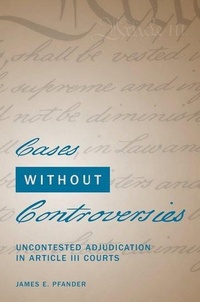
Cases Without Controversies
Uncontested Adjudication in Article III Courts
Published on 21. September 2021
Book
Hardback
280 pages
978-0-19-757140-8 (ISBN)
Description
This book offers a new account of the power of federal courts in the United States to hear and determine uncontested applications to assert or register a claim of right. Familiar to lawyers in civil law countries as forms of voluntary or non-contentious jurisdiction, these uncontested applications fit uneasily with the commitment to adversary legalism in the United States. Indeed, modern accounts of federal judicial power often urge that the language of the Article III of the U.S. Constitution limits federal courts to the adjudication of concrete disputes between adverse parties, thereby ruling out all forms of non-contentious jurisdiction. Said to rest on the so-called "case-or-controversy" requirement of Article III, this requirement of party contestation threatens the power of federal courts to conduct a range of familiar proceedings, such as the oversight of bankruptcy proceedings, the issuance of warrants, and the adjudication of applications for mandamus and habeas corpus relief. By recounting the tradition of naturalization and other uncontested litigation in antebellum America and coupling that tradition with an account of the important difference between cases and controversies, this book challenges the prevailing understanding of Article III. In addition to defending the power of federal courts to hear uncontested matters of federal law, the book examines the way the Constitution's meaning has changed over time and suggests a constructive interpretive methodology that would allow the Supreme Court to take account of the old and the new in defining the contours of federal judicial power.
Reviews / Votes
Overall, Jim Pfander's book is legal history at its finest. He has done thorough research, drawn reasonable conclusions from the primary sources, fairly acknowledged possible competing interpretations, and explained complex legal and historical ideas clearly. No one has a better understanding of the historical meaning of Article III. * Robert Pushaw, Balkinization Symposium *More details
Language
English
Place of publication
New York
United States
Target group
Professional and scholarly
Product notice
sewn/stitched
Cloth over boards
Dimensions
Height: 236 mm
Width: 155 mm
Thickness: 23 mm
Weight
612 gr
ISBN-13
978-0-19-757140-8 (9780197571408)
Copyright in bibliographic data and cover images is held by Nielsen Book Services Limited or by the publishers or by their respective licensors: all rights reserved.
Schweitzer Classification
Other editions
Additional editions
E-Book
04/2021
OUP eBook
€67.49
Available for download
E-Book
03/2021
OUP eBook
€67.49
Available for download
Person
James Pfander, author of dozens of articles and books, has served as the Owen L. Coon Professor of Law at Northwestern University Pritzker School of Law for more than a decade. Pfander's scholarship explores the nature of federal judicial power, the law of government accountability in modern America, and the history of the federal judicial system. A member of the American Law Institute, Pfander recently concluded his work as reporter/consultant to the Federal-State Jurisdiction Committee of the Judicial Conference of the United States. He has served as chair of both the federal courts and civil procedure sections of the Association of American Law Schools.
Content
Foreword
Introduction
Part One: Thesis: Uncontested Adjudication in the Federal Courts
1. Chapter One: The Origins of Uncontested Adjudication
2. Chapter Two: Uncontested Proceedings on Federal Dockets in the Early Republic
3. Chapter Three: Probate and Domestic Relations Proceedings
4. Chapter Four: The Nineteenth-Century Perspective on Federal Judicial Power
Part Two: Antithesis: The Progressive Restatement of an Emerging Case-or-Controversy Requirement
5. Chapter Five: The Judicial Response to the Administrative State
6. Chapter Six: The Progressive Response to Lochner: Limiting Justiciability
7. Chapter Seven: The New Adverse-Party Rule Confronts Judicial Practice
Part Three: Synthesis: Cases, Controversies, and Litigable Interests
8. Chapter Eight: Uncontested Adjudication and the Modern Case-or-Controversy Rule
9. Chapter Nine: Evaluating Defenses of a Requirement of Adverse Interests
10. Chapter Ten: Uncontested Adjudication and Standing to Sue
11. Chapter Eleven: A Practical Guide to Uncontested Adjudication
12. Chapter Twelve: Toward a Constructive Constitutional History
Part Four: Conclusion
Introduction
Part One: Thesis: Uncontested Adjudication in the Federal Courts
1. Chapter One: The Origins of Uncontested Adjudication
2. Chapter Two: Uncontested Proceedings on Federal Dockets in the Early Republic
3. Chapter Three: Probate and Domestic Relations Proceedings
4. Chapter Four: The Nineteenth-Century Perspective on Federal Judicial Power
Part Two: Antithesis: The Progressive Restatement of an Emerging Case-or-Controversy Requirement
5. Chapter Five: The Judicial Response to the Administrative State
6. Chapter Six: The Progressive Response to Lochner: Limiting Justiciability
7. Chapter Seven: The New Adverse-Party Rule Confronts Judicial Practice
Part Three: Synthesis: Cases, Controversies, and Litigable Interests
8. Chapter Eight: Uncontested Adjudication and the Modern Case-or-Controversy Rule
9. Chapter Nine: Evaluating Defenses of a Requirement of Adverse Interests
10. Chapter Ten: Uncontested Adjudication and Standing to Sue
11. Chapter Eleven: A Practical Guide to Uncontested Adjudication
12. Chapter Twelve: Toward a Constructive Constitutional History
Part Four: Conclusion