

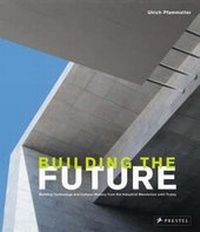
Building the Future
Building Technology and Cultural History from the Industrial Revolution until Today
Published on 10. March 2008
Book
Hardback
336 pages
978-3-7913-3926-9 (ISBN)
Description
Spanning the last two centuries and offering cogent analyses of how we will build in the future this volume presents over one hundred case studies of built structures that illustrate the marriage of building technology and culture. Including color photographs, drawings, and architectural plans, this book profiles some of the world's most interesting public spaces, commercial buildings, stadiums, and transport stations to reveal how prevailing social mores helped determine these structures' materials, appearance, and function. The innovative concepts these buildings signify and the integration of these ideas into the common lexicon are presented in chapters on the evolution of the greenhouse, artistic buildings, pioneering techniques in materials' use, the development of the building facade, and the future of sustainable building design. This book uniquely blends a societal perspective with the latest technology, and is an essential reference for anyone interested in the crucial roles structural engineering and culture play in architecture.
More details
Content
In the 200 years since the Industrial Revolution, or more precisely since the erection in 1775 of the Iron Bridge in Coalbrookdale in the English Midlands (which was its first built manifestation), architecture, civil engineering and their worlds of images have changed radically.
Since the building of the Pantheon in Rome, in which the load-bearing structure marked the limits of concrete technology at that time, architecture has shown a tendency to dissolve mass: space has moved towards 'liberated space', towards 'transparency'; load-bearing walls tend to be metamorphosed into partitions or a skin; increasingly and with ever-growing speed new materials and technologies are borrowed from areas such as motor car, ship and airplane building and space travel technology and 'translated' into building techniques. At the same time there is a growing attempt to visualise and understand - intellectually, emotionally or with senses not usually employed - material technologies that cannot be directly understood, such as prestressed concrete, or glass structures, composite materials with concealed qualities and functions, transformed traditional building materials or 'bionically' oriented composites.
The history of important, model buildings since the Hanging Gardens of Semiramis in Babylon can also be read as a history of 'brands'. The protagonists in building have always attempted to leave behind traces. Only anonymous building, what is known as 'vernacular architecture', refuses to include a conscious language of images in its view of itself, although it has exerted and continues to exert a strong influence on architettura maggiore. This is shown by the 'primitive huts' that regularly occur in the relevant literature or by Gottfried Semper's meaningful reference to the Caribbean Hut, which he discovered on the occasion of the first World's Fair, in the Crystal Palace in London in 1851, and used to illustrate his theory in his magnum opus, Der Stil (1863). Here Semper pointed out the tendency towards the stoffliche (textile), towards dematerialisation and lightness in the culture of building. Two thousand years after the Pantheon, Richard Buckminster Fuller made the dream of lightweight building reality with his 'geodesic dome', 1,000 times lighter but with the same span as the domed Roman building. Since Fuller's time this development has continued unabated (ill. 3). The tendency towards the dissolution of mass even reached concrete technology, which in projects by Heinz Ilser, Eladio Dieste, Eduardo Torroja, among others, approached borderline areas in which this material becomes a 'membrane'.
Pioneering changes in building occurred in glass technology: in their palm house in Bicton Gardens in Devonshire, the Bailey Brothers combined an essentially unstable web of iron bars with small glass panes to create a structurally stable 'blob', thus using glass to help transfer the loads. Schwedler's invention in 1865 of the structural joint in ironwork revolutionised architecture in iron and steel construction, while in the field of concrete the design possibilities for architects and engineers were expanded in a previously unimaginable way when, in 1892, with his forward-looking patent, François Hennebique introduced reinforced concrete as a sculptural-spatial and constructive-structural method of building.
The skeleton or frame building which developed from the constraints, necessities and simplifications required by industrial production first established itself in the textile industry in the English Midlands, and led step by step to a way of seeing things that made the traditional brick-built massive façade superfluous, and allowed it to be 'liberated' from its load-bearing role. This set in motion the development of the front-hung building envelope that today still offers architects and engineers unrestricted design opportunities.
The growing possibilities offered by industrial production form a permanent motor of development that repeatedly influences the world of building. The replacement of handmade production methods by industrial techniques led, early on, from production based on immediate need to market-oriented and mass production, while the transfer of computer-operated component or system production from mechanical engineering technology to the planning, production and assembly processes in building simplified, in a later phase, the transition from mass to made-to-measure production by means of computer programmes. However, the purely technical, machine-made or mechanical processing of 'bespoke' building elements removes the possibility of any emotional approach to the perception and understanding of their function or meaning. To recreate a sensitivity to materials, attempts are being made to employ hybrid techniques which, in the case of English engineer Peter Rice, was a key aspect in building the Centre Georges Pompidou in Paris: the explanation of large building elements that are difficult to understand in the overall context of the building is achieved by the use of classic cast elements and hand-finishing.
The culture of work, the instruments and tools, and office structures, have also changed. Since the Industrial Revolution, a tendency has developed to separate the professional disciplines of architect and engineer, even though a school of thought inspired by Saint-Simon in the framework of a new kind of multidiscilinary educational institution, the École Centrale des Arts et Manufactures (founded in Paris in 1829/30), was able to delay this split until the mid-19th century, that is, until the age of iron and glass, and indeed produced an entire series of prominent 'engineer-architects'. This educational system, which has entered history under the name 'method school', contrasted with the 'style school' of the École des Beaux-Arts, which was more anchored in tradition.
Whereas until well into the 20th century numerous architects practices were run as 'Beaux-Arts studios', under the influence of the ingénieurs centraliens, as well as of industrialisation, a new type of office organisation grew up that was first introduced in a comprehensive form as the 'industrial office' by Albert Kahn in the motor car town Detroit.
Since the building of the Pantheon in Rome, in which the load-bearing structure marked the limits of concrete technology at that time, architecture has shown a tendency to dissolve mass: space has moved towards 'liberated space', towards 'transparency'; load-bearing walls tend to be metamorphosed into partitions or a skin; increasingly and with ever-growing speed new materials and technologies are borrowed from areas such as motor car, ship and airplane building and space travel technology and 'translated' into building techniques. At the same time there is a growing attempt to visualise and understand - intellectually, emotionally or with senses not usually employed - material technologies that cannot be directly understood, such as prestressed concrete, or glass structures, composite materials with concealed qualities and functions, transformed traditional building materials or 'bionically' oriented composites.
The history of important, model buildings since the Hanging Gardens of Semiramis in Babylon can also be read as a history of 'brands'. The protagonists in building have always attempted to leave behind traces. Only anonymous building, what is known as 'vernacular architecture', refuses to include a conscious language of images in its view of itself, although it has exerted and continues to exert a strong influence on architettura maggiore. This is shown by the 'primitive huts' that regularly occur in the relevant literature or by Gottfried Semper's meaningful reference to the Caribbean Hut, which he discovered on the occasion of the first World's Fair, in the Crystal Palace in London in 1851, and used to illustrate his theory in his magnum opus, Der Stil (1863). Here Semper pointed out the tendency towards the stoffliche (textile), towards dematerialisation and lightness in the culture of building. Two thousand years after the Pantheon, Richard Buckminster Fuller made the dream of lightweight building reality with his 'geodesic dome', 1,000 times lighter but with the same span as the domed Roman building. Since Fuller's time this development has continued unabated (ill. 3). The tendency towards the dissolution of mass even reached concrete technology, which in projects by Heinz Ilser, Eladio Dieste, Eduardo Torroja, among others, approached borderline areas in which this material becomes a 'membrane'.
Pioneering changes in building occurred in glass technology: in their palm house in Bicton Gardens in Devonshire, the Bailey Brothers combined an essentially unstable web of iron bars with small glass panes to create a structurally stable 'blob', thus using glass to help transfer the loads. Schwedler's invention in 1865 of the structural joint in ironwork revolutionised architecture in iron and steel construction, while in the field of concrete the design possibilities for architects and engineers were expanded in a previously unimaginable way when, in 1892, with his forward-looking patent, François Hennebique introduced reinforced concrete as a sculptural-spatial and constructive-structural method of building.
The skeleton or frame building which developed from the constraints, necessities and simplifications required by industrial production first established itself in the textile industry in the English Midlands, and led step by step to a way of seeing things that made the traditional brick-built massive façade superfluous, and allowed it to be 'liberated' from its load-bearing role. This set in motion the development of the front-hung building envelope that today still offers architects and engineers unrestricted design opportunities.
The growing possibilities offered by industrial production form a permanent motor of development that repeatedly influences the world of building. The replacement of handmade production methods by industrial techniques led, early on, from production based on immediate need to market-oriented and mass production, while the transfer of computer-operated component or system production from mechanical engineering technology to the planning, production and assembly processes in building simplified, in a later phase, the transition from mass to made-to-measure production by means of computer programmes. However, the purely technical, machine-made or mechanical processing of 'bespoke' building elements removes the possibility of any emotional approach to the perception and understanding of their function or meaning. To recreate a sensitivity to materials, attempts are being made to employ hybrid techniques which, in the case of English engineer Peter Rice, was a key aspect in building the Centre Georges Pompidou in Paris: the explanation of large building elements that are difficult to understand in the overall context of the building is achieved by the use of classic cast elements and hand-finishing.
The culture of work, the instruments and tools, and office structures, have also changed. Since the Industrial Revolution, a tendency has developed to separate the professional disciplines of architect and engineer, even though a school of thought inspired by Saint-Simon in the framework of a new kind of multidiscilinary educational institution, the École Centrale des Arts et Manufactures (founded in Paris in 1829/30), was able to delay this split until the mid-19th century, that is, until the age of iron and glass, and indeed produced an entire series of prominent 'engineer-architects'. This educational system, which has entered history under the name 'method school', contrasted with the 'style school' of the École des Beaux-Arts, which was more anchored in tradition.
Whereas until well into the 20th century numerous architects practices were run as 'Beaux-Arts studios', under the influence of the ingénieurs centraliens, as well as of industrialisation, a new type of office organisation grew up that was first introduced in a comprehensive form as the 'industrial office' by Albert Kahn in the motor car town Detroit.