

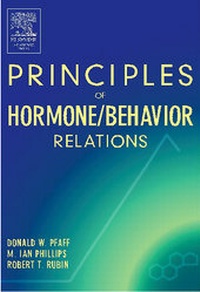
Principles of Hormone/Behavior Relations
Published on 22. October 2004
Book
Hardback
360 pages
978-0-12-553149-8 (ISBN)
Description
This text introduces underlying principles of the endocrine regulation of behavior in animals and humans. Every chapter begins by stating a principle, followed by specific examples of hormone actions derived from scientific experiments and clinical observations, and concludes with a few challenging unanswered questions. The reference source Hormones, Brain & Behavior identified this field as rapidly expanding within neurobiology and endocrinology. Now, this well-illustrated and referenced text will serve students from undergraduate school to medical school as they learn this new discipline.
Reviews / Votes
"The text is a pleasure to read. The authors adopt an informal conversational style for their discussion that evokes the comfortable air of a seminar course with a favorite professor. ...It invites and excites the reader to dig deeper into the many uncertain and unexplained areas of neuroendocrinology. It shows the reader that this is a field ready for exciting advances and a worthy arena in which to spend one's career." --William J. Kovacs, The University of Texas Southwestern Medical Center, Dallas in BRAIN, BEHAVIOR AND IMMUNITY (July 2005) "This is an exceptional text that provides an up-to-date and comprehensive review of topical material in endocrinology, neuroscience, and behavior...The emphasize on research approaches, balanced with integration of findings from such approaches, enables the text to be used by a broad range of student populations. It would be suitable for use in an advanced undergraduate class, as well as by graduate and medial students, alike.? --Cheryl Frye, University of AlbanyMore details
Language
English
Place of publication
San Diego
United States
Publishing group
Elsevier Science Publishing Co Inc
Target group
College/higher education
Neuroscientists and endocrinologists, as well as upper level undergraduates and graduate students.
Dimensions
Height: 229 mm
Width: 152 mm
Weight
700 gr
ISBN-13
978-0-12-553149-8 (9780125531498)
Copyright in bibliographic data and cover images is held by Nielsen Book Services Limited or by the publishers or by their respective licensors: all rights reserved.
Schweitzer Classification
Other editions
New editions
Donald W. Pfaff | Robert T. Rubin | Jill E. Schneider
Principles of Hormone/Behavior Relations
Book
01/2018
2nd Edition
Academic Press
€75.51
Shipment within 15-20 days
Additional editions
Donald W. Pfaff | Robert T. Rubin | M. Ian Phillips
Principles of Hormone/Behavior Relations
E-Book
10/2004
1st Edition
Academic Press
€38.99
Available for download
Persons
Donald W. Pfaff heads the Laboratory of Neurobiology and Behavior at The Rockefeller University. He received his scientific training at Harvard College and MIT. He is a Member of the U.S. National Academy of Sciences and a Fellow of the American Academy of Arts and Sciences. Pfaff's laboratory focuses on steroid hormones and brain function, genes influencing neuronal functions, and generalized CNS arousal. He is the author or coauthor of over 10 books and more than 900 research publications. VA Greater Los Angeles Healthcare System, Los Angeles, CA, USA
Content
Section I.Characterizing the Phenomena: Hormone Effects are Strong and ReliableSection II. History: Hormone Effects can Depend on Family, Gender, and DevelopmentSection III.Time: Hormonal Effects on Behavior Depend on Temporal ParametersSection IV.Space: Spatial Aspects of Hormone Administration and Impact are ImportantSection V.Mechanisms: Molecular and Biophysical Mechanisms of Hormone Actions Give Clues to Future Therapeutic StrategiesSection VI.Environment: Environmental Variables Influence Hormone/Behavior RelationsSection VII.Evolution