


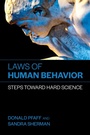
Laws of Human Behavior
Steps Toward Hard Science
Published on 4. March 2025
Book
Paperback/Softback
304 pages
978-0-262-55089-5 (ISBN)
Description
"Laws of Human Behavior demonstrates that areas of the behavioral sciences have achieved a degree of rigor in execution & interpretation that approaches the reliability of the physical sciences"--
More details
Language
English
Place of publication
Cambridge (Massachusetts)
United States
Publishing group
MIT Press Ltd
Illustrations
19 BLACK AND WHITE ILLUS.
Dimensions
Height: 224 mm
Width: 151 mm
Thickness: 23 mm
Weight
380 gr
ISBN-13
978-0-262-55089-5 (9780262550895)
Copyright in bibliographic data and cover images is held by Nielsen Book Services Limited or by the publishers or by their respective licensors: all rights reserved.
Schweitzer Classification
Other editions
Additional editions
E-Book
03/2025
MIT Press
€78.49
Available for download
Persons
Donald Pfaff is Professor Emeritus of Neurobiology and Behavior at Rockefeller University. His books include Hormonal Factors in Brain Function (MIT Press), Drive (MIT Press), and The Altruistic Brain.
Sandra Sherman is a former Senior Attorney for the US government and a retired Professor of English. She is a coauthor of several books in neuroscience.
Sandra Sherman is a former Senior Attorney for the US government and a retired Professor of English. She is a coauthor of several books in neuroscience.
Content
Dedication Acknowledgments Introduction
Part I: Sensation, Perception
1. Psychophysics
2. Stimulus Generalization
3. Signal Detection is a Function of Stimulus and Criterion for Positive Responses
4. Perception is Selective
Part II: Movement
5. Motor Responsiveness
6. Principle of Least Effort
7. Habituation
Part III: Conditioning
8. Pavlovian (“Classical”) Conditioning
9. Operant (Instrumental) Conditioning
10. Delay of Reinforcement Gradient
Part IV: Cognition
11. Information Load Determines Retention of that Information
12. We Forget
13. Slow Deliberative Decision Making Uses Different Cortical Mechanisms Compared to Fast Perceptual Decision Making
14. We Reduce Cognitive Dissonance
Part V: Changes of State
15. Hormones Change Behavioral States
16. Human Behavior is Regulated by a Circadian Rhythm 17. Optimum Level of Arousal (Yerkes-Dodson Law)
Part VI: Social Behaviors
18. Humans Seek Social Contact
19. In Groups, Humans Form Hierarchies
20. Humans Behave Altruistically
Conclusion and Perspective
Further Reading
Part I: Sensation, Perception
1. Psychophysics
2. Stimulus Generalization
3. Signal Detection is a Function of Stimulus and Criterion for Positive Responses
4. Perception is Selective
Part II: Movement
5. Motor Responsiveness
6. Principle of Least Effort
7. Habituation
Part III: Conditioning
8. Pavlovian (“Classical”) Conditioning
9. Operant (Instrumental) Conditioning
10. Delay of Reinforcement Gradient
Part IV: Cognition
11. Information Load Determines Retention of that Information
12. We Forget
13. Slow Deliberative Decision Making Uses Different Cortical Mechanisms Compared to Fast Perceptual Decision Making
14. We Reduce Cognitive Dissonance
Part V: Changes of State
15. Hormones Change Behavioral States
16. Human Behavior is Regulated by a Circadian Rhythm 17. Optimum Level of Arousal (Yerkes-Dodson Law)
Part VI: Social Behaviors
18. Humans Seek Social Contact
19. In Groups, Humans Form Hierarchies
20. Humans Behave Altruistically
Conclusion and Perspective
Further Reading