

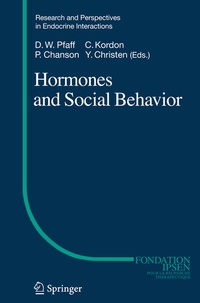
Hormones and Social Behavior
Published on 24. June 2008
Book
Hardback
XII, 199 pages
978-3-540-79286-4 (ISBN)
Description
SocialBonding,aProductofEvolution: anIntroductiontotheVolume Mechanisms underlying reproductive and maternal functions or coping represent the initialstructuringforcebehindmanysocialbehaviors.Theyareaccompaniedbysel- tivehormonalenvironmentsaimedatfacilitatingor stabilizingthem.Sexandadrenal steroids are major players in the regulation of reproductive functions and coping challenges, but other hormones also participate in a variety of social behaviors (in particular,oxytocinandvasopressin,twophylogeneticallyveryoldmoietiesoriginally associated with maternal care and water balance) and are receiving increasing att- tion. Their role is highlighted in the present volume, which gathers contributions to theColloqueMedicineetRecherche"HormonesandSocialBehavior"organizedbythe FondationIPSENinDecember 2007. Whatisthekeytounderstandingtherationaleofhormonalsubstratesofbehavior? Evolution, of course. Higher manifestations of social behavior have evolved from - productivebehavior,characterizedbyErnstMayras"theleadingedgeofevolutionary change." As formulated by one contributor to thisvolume, however, "the evolutionary increase in neocortex seen in primates has induced a signi?cant emancipation of - havior from hormonal determinants, and in parallel, an increasing role for intelligent socialstrategies"(Keverne 2008).
In so-called "lower" mammalian animals, many social behaviors are closely - pendent upon the olfactory system, a component of autonomous regulation of such importancethatitexpressesalargeproportionofallreceptorgenespresentinthebrain. Whenonelooksat"higher"mammalssuchasprimates,olfactorycontrolbecomesless stringent. Olfactory structures exhibit the same number of receptor genes, but a large number are transformed into non-coding "pseudogenes." In parallel, hormones i- tially targeted on physiological functions become increasingly associated with more diversi?edcognitivefunctions.
In so-called "lower" mammalian animals, many social behaviors are closely - pendent upon the olfactory system, a component of autonomous regulation of such importancethatitexpressesalargeproportionofallreceptorgenespresentinthebrain. Whenonelooksat"higher"mammalssuchasprimates,olfactorycontrolbecomesless stringent. Olfactory structures exhibit the same number of receptor genes, but a large number are transformed into non-coding "pseudogenes." In parallel, hormones i- tially targeted on physiological functions become increasingly associated with more diversi?edcognitivefunctions.
More details
Series
Edition
2008 ed.
Language
English
Place of publication
Berlin
Germany
Publishing group
Springer Berlin
Target group
Professional and scholarly
Research
Illustrations
14 s/w Abbildungen, 13 farbige Abbildungen
XII, 199 p. 27 illus., 13 illus. in color.
Dimensions
Height: 241 mm
Width: 160 mm
Thickness: 17 mm
Weight
489 gr
ISBN-13
978-3-540-79286-4 (9783540792864)
DOI
10.1007/978-3-540-79288-8
Schweitzer Classification
Other editions
Additional editions
Book
06/2008
1st Edition
Springer
€0.01
Article exhausted; check different version
Donald W. Pfaff | Claude Kordon | Philippe Chanson
Hormones and Social Behavior
E-Book
05/2008
1st Edition
Springer
€213.99
Available for download
Content
Modules, Minds and Morality.- Brain Mechanisms Theoretically Underlying Extremes of Social Behaviors: The Best and the Worst.- Serotonergic Modulation of Sex and Aggression.- The Effect of Neuropeptides on Human Trust and Altruism: A Neuroeconomic Perspective.- Molecular Neurobiology of the Social Brain.- Impact of Brain Evolution on Hormones and Social Behaviour.- Brain Oxytocin Mediates Beneficial Consequences of Close Social Interactions: From Maternal Love and Sex.- Hormones, Brain Plasticity and Reproductive Functions.- Neuroendocrine Mechanisms Underlying the Intergenerational Transmission of Maternal Behavior and Infant Abuse in Rhesus Macaques.- Brain Corticosteroid Receptor Function in Response to Psychosocial Stressors.- Aspects of Behavior in Pedophillic Sex Offenders Treated with Leuprolide Acetate.- The Brain, Androgens, and Pedophilia.- Role of Alcohol and Sex Hormones on Human Aggressive Behavior.- Social Neuroscience: Complexities to Be Unravelled.