

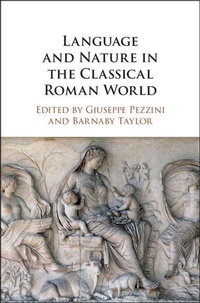
Language and Nature in the Classical Roman World
Will be published approx. on 20. June 2019
Book
Hardback
252 pages
978-1-108-48066-6 (ISBN)
Description
A familiar theme in Greek philosophy, largely due to the influence of Plato's Cratylus, linguistic naturalism (the notion that linguistic facts, structures or behaviour are in some significant sense determined by nature) constitutes a major but under-studied area of Roman linguistic thought. Indeed, it holds significance not only for the history of linguistics but also for philosophy, stylistics, rhetoric and more. The chapters in this volume deal with a range of naturalist theories in a variety of authors including Cicero, Varro, Nigidius Figulus, Posidonius, and Dionysius of Halicarnassus. The result is a complex and multi-faceted picture of how language and nature were believed to interrelate in the classical Roman world.
More details
Language
English
Place of publication
Cambridge
United Kingdom
Target group
Professional and scholarly
College/higher education
Illustrations
Worked examples or Exercises; 1 Tables, black and white
Dimensions
Height: 235 mm
Width: 157 mm
Thickness: 18 mm
Weight
524 gr
ISBN-13
978-1-108-48066-6 (9781108480666)
Copyright in bibliographic data and cover images is held by Nielsen Book Services Limited or by the publishers or by their respective licensors: all rights reserved.
Schweitzer Classification
Other editions
Additional editions
Giuseppe Pezzini | Barnaby Taylor
Language and Nature in the Classical Roman World
Book
04/2023
Cambridge University Press
€39.50
Shipment within 15-20 days
Giuseppe Pezzini
Language and Nature in the Classical Roman World
E-Book
06/2019
Cambridge University Press
€73.99
Available for download
Giuseppe Pezzini | Barnaby Taylor
Language and Nature in the Classical Roman World
E-Book
06/2019
Cambridge University Press
€88.99
Available for download
Persons
Giuseppe Pezzini is a lecturer in Latin at the University of St Andrews, Scotland. He was an assistant editor for The Oxford Dictionary of Medieval Latin from British Sources (2012, 2013), and is working on an edition of Terence's Heauton Timorumenos for the Cambridge Classical Texts and Commentaries series. Barnaby Taylor is Fellow and Tutor in Classics at Exeter College, Oxford, and Associate Professor of Classics at the University of Oxford. His interests lie in Latin language and literature, particularly the language and linguistic thought of Lucretius.
Content
Introduction: first thoughts on language and nature Giuseppe Pezzini and Barnaby Taylor; 1. Posidonius' linguistic naturalism and its philosophical pedigree Alexander Verlinsky; 2. Lucilius on Latin spelling, grammar and usage Anna Chahoud; 3. Nigidius Figulus' naturalism: between grammar and philosophy Alessandro Garcea; 4. Naturalism in morphology: Varro on derivation and inflection Wolfgang D. C. De Melo; 5. What's Hecuba to him? Varro on the natural kinship of things and of words David Blank; 6. Linguistic naturalism in Cicero's Academica Tobias Reinhardt; 7. Linguistic naturalism and natural style: from Varro and Cicero to Dionysius of Halicarnassus Casper C. de Jonge; 8. Natural law and natural language in the first century BCE James Zetzel.