

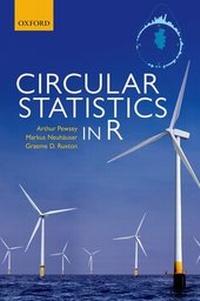
Circular Statistics in R
Published on 26. September 2013
Book
Paperback/Softback
208 pages
978-0-19-967113-7 (ISBN)
Description
Circular Statistics in R provides the most comprehensive guide to the analysis of circular data in over a decade. Circular data arise in many scientific contexts whether it be angular directions such as: observed compass directions of departure of radio-collared migratory birds from a release point; bond angles measured in different molecules; wind directions at different times of year at a wind farm; direction of stress-fractures in concrete bridge supports; longitudes of earthquake epicentres or seasonal and daily activity patterns, for example: data on the times of day at which animals are caught in a camera trap, or in 911 calls in New York, or in internet traffic; variation throughout the year in measles incidence, global energy requirements, TV viewing figures or injuries to athletes. The natural way of representing such data graphically is as points located around the circumference of a circle, hence their name. Importantly, circular variables are periodic in nature and the origin, or zero point, such as the beginning of a new year, is defined arbitrarily rather than necessarily emerging naturally from the system.
This book will be of value both to those new to circular data analysis as well as those more familiar with the field. For beginners, the authors start by considering the fundamental graphical and numerical summaries used to represent circular data before introducing distributions that might be used to model them. They go on to discuss basic forms of inference such as point and interval estimation, as well as formal significance tests for hypotheses that will often be of scientific interest. When discussing model fitting, the authors advocate reduced reliance on the classical von Mises distribution; showcasing distributions that are capable of modelling features such as asymmetry and varying levels of kurtosis that are often exhibited by circular data.
The use of likelihood-based and computer-intensive approaches to inference and modelling are stressed throughout the book. The R programming language is used to implement the methodology, particularly its "circular" package. Also provided are over 150 new functions for techniques not already covered within R.
This concise but authoritative guide is accessible to the diverse range of scientists who have circular data to analyse and want to do so as easily and as effectively as possible.
This book will be of value both to those new to circular data analysis as well as those more familiar with the field. For beginners, the authors start by considering the fundamental graphical and numerical summaries used to represent circular data before introducing distributions that might be used to model them. They go on to discuss basic forms of inference such as point and interval estimation, as well as formal significance tests for hypotheses that will often be of scientific interest. When discussing model fitting, the authors advocate reduced reliance on the classical von Mises distribution; showcasing distributions that are capable of modelling features such as asymmetry and varying levels of kurtosis that are often exhibited by circular data.
The use of likelihood-based and computer-intensive approaches to inference and modelling are stressed throughout the book. The R programming language is used to implement the methodology, particularly its "circular" package. Also provided are over 150 new functions for techniques not already covered within R.
This concise but authoritative guide is accessible to the diverse range of scientists who have circular data to analyse and want to do so as easily and as effectively as possible.
Reviews / Votes
It's amazing how often I'm asked for advice about circular statistics. Even simple questions such as 'what's the mean direction?' or 'are species active at different times of day?' require circular statistics and they are rarely catered for in statistical texts. What Pewsey et al. have produced is a long-awaited guide to both the theory and practice of circular statistics with a focus on R. It's a book I'll be consulting frequently and recommending to students and colleagues alike * Calvin Dytham, University of York *More details
Language
English
Place of publication
Oxford
United Kingdom
Target group
College/higher education
Professional and scholarly
Graduate students, researchers and professionals across biological, social, physical, medical and earth sciences.
Dimensions
Height: 236 mm
Width: 160 mm
Thickness: 13 mm
Weight
326 gr
ISBN-13
978-0-19-967113-7 (9780199671137)
Copyright in bibliographic data and cover images is held by Nielsen Book Services Limited or by the publishers or by their respective licensors: all rights reserved.
Schweitzer Classification
Other editions
Additional editions
Arthur Pewsey | Markus Neuhäuser | Graeme D. Ruxton
Circular Statistics in R
E-Book
09/2013
1st Edition
OUP eBook
€41.99
Available for download
Arthur Pewsey | Markus Neuhäuser | Graeme D. Ruxton
Circular Statistics in R
E-Book
09/2013
1st Edition
OUP eBook
€41.99
Available for download
Persons
Arthur Pewsey is Professor of Statistics at the University of Extremadura, Spain. He has devoted much of the last fifteen years of his life to research in the field of circular statistics. Arthur is Associate Editor of Communications in Statistics: Theory and Methods and Communications in Statistics: Simulation and Computation
Markus Neuhaeuser is Professor of Statistics at the RheinAhrCampus Remagen, Germany. He is an expert in computer-intensive statistical methods. Markus is Associate Editor of Journal of Statistical Computation and Simulation , Communications in Statistics: Theory and Methods and Communications in Statistics: Simulation and Computation
Graeme D Ruxton is Professor of Ecology at the University of St Andrews. He is a biologist with particular interest in making modern statistical techniques accessible to broad user groups.
Markus Neuhaeuser is Professor of Statistics at the RheinAhrCampus Remagen, Germany. He is an expert in computer-intensive statistical methods. Markus is Associate Editor of Journal of Statistical Computation and Simulation , Communications in Statistics: Theory and Methods and Communications in Statistics: Simulation and Computation
Graeme D Ruxton is Professor of Ecology at the University of St Andrews. He is a biologist with particular interest in making modern statistical techniques accessible to broad user groups.
Content
1. Introduction ; 2. Graphical representation of circular data ; 3. Circular summary statistics ; 4. Distribution theory and models for circular random variables ; 5. Basic inference for a single sample ; 6. Model fitting for a single sample ; 7. Comparing two or more samples of circular data ; 8. Correlation and regression