

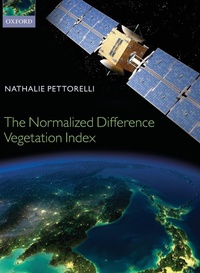
The Normalized Difference Vegetation Index
Published on 10. October 2013
Book
Hardback
206 pages
978-0-19-969316-0 (ISBN)
Description
There has been a recent surge of interest in remote sensing and its use in ecology and conservation but this is the first book to focus explicitly on the NDVI (Normalised Difference Vegetation Index), a simple numerical indicator and powerful tool that can be used to assess spatio-temporal changes in green vegetation. The NDVI opens the possibility of addressing questions on scales inaccessible to ground-based methods alone; it is mostly freely available with global coverage over several decades.
This novel text provides an authoritative overview of the principles and possible applications of the NDVI in ecology, environmental and wildlife management, and conservation. NDVI data can provide valuable information about temporal and spatial changes in vegetation distribution, productivity, and dynamics; allowing monitoring of habitat degradation and fragmentation, or assessment of the ecological effects of climatic disasters such as drought or fire. The NDVI has also provided ecologists with a promising way to couple vegetation with animal distribution, abundance, movement, survival and reproductive parameters. Over the last few decades, numerous studies have highlighted the potential key role of satellite data and the NDVI in macroecology, plant ecology, animal population dynamics, environmental monitoring, habitat selection and habitat use studies, and paleoecology. The chapters are organised around two sections: the first detailing vegetation indices and the NDVI, the principles behind the NDVI, its correlation with climate, the available NDVI datasets, and the possible complications and errors associated with the use of this satellite-based vegetation index. The second section discusses the possible applications of the NDVI in ecology, environmental and wildlife management, and conservation.
This practical handbook is suitable for terrestrial ecologists and conservation biologists working with remote sensing tools. It will also be of relevance and use to both graduate students in the biological and ecological sciences and specialists in the fields of conservation biology, biodiversity monitoring, and natural resource management.
This novel text provides an authoritative overview of the principles and possible applications of the NDVI in ecology, environmental and wildlife management, and conservation. NDVI data can provide valuable information about temporal and spatial changes in vegetation distribution, productivity, and dynamics; allowing monitoring of habitat degradation and fragmentation, or assessment of the ecological effects of climatic disasters such as drought or fire. The NDVI has also provided ecologists with a promising way to couple vegetation with animal distribution, abundance, movement, survival and reproductive parameters. Over the last few decades, numerous studies have highlighted the potential key role of satellite data and the NDVI in macroecology, plant ecology, animal population dynamics, environmental monitoring, habitat selection and habitat use studies, and paleoecology. The chapters are organised around two sections: the first detailing vegetation indices and the NDVI, the principles behind the NDVI, its correlation with climate, the available NDVI datasets, and the possible complications and errors associated with the use of this satellite-based vegetation index. The second section discusses the possible applications of the NDVI in ecology, environmental and wildlife management, and conservation.
This practical handbook is suitable for terrestrial ecologists and conservation biologists working with remote sensing tools. It will also be of relevance and use to both graduate students in the biological and ecological sciences and specialists in the fields of conservation biology, biodiversity monitoring, and natural resource management.
Reviews / Votes
It is clearly a system with enormous potential, and a tool that needs to be taken into account with other data sets in monitoring vegetation changes from the local to a global scale. * Biodiversity and Conservation *More details
Language
English
Place of publication
Oxford
United Kingdom
Target group
College/higher education
Professional and scholarly
Product notice
sewn/stitched
Cloth over boards
Dimensions
Height: 246 mm
Width: 188 mm
Thickness: 18 mm
Weight
658 gr
ISBN-13
978-0-19-969316-0 (9780199693160)
Copyright in bibliographic data and cover images is held by Nielsen Book Services Limited or by the publishers or by their respective licensors: all rights reserved.
Schweitzer Classification
Other editions
Additional editions
Nathalie Pettorelli
The Normalized Difference Vegetation Index
E-Book
10/2013
1st Edition
OUP eBook
€90.99
Available for download
Nathalie Pettorelli
The Normalized Difference Vegetation Index
E-Book
10/2013
1st Edition
OUP eBook
€90.99
Available for download
Person
Nathalie Pettorelli is a research fellow working at the Institute of Zoology, Zoological Society of London. Her research is focused on the impact of climate change on ecosystem functioning and mammalian population dynamics in alpine, arctic, and tropical environments. She has published 47 peer-reviewed articles and is on the editorial boards of Journal of Applied Ecology (Associate Editor since 2007) and Animal Conservation (Associate editor since 2008, Editor since 2011). Since 2002 her research has focused on satellite-based data, and in particular on its role in understanding the impact of global environmental change on wildlife. For this work, she was awarded a L'Oreal UNESCO Fellowship in 2010.
Content
1. Proxy-based approaches in ecology and the importance of remote sensing ; 2. Vegetation Indices ; 3. NDVI from A to Z ; 4. Climate and the NDVI: a complex story ; 5. NDVI and environmental monitoring ; 6. NDVI and plant ecology ; 7. NDVI and wildlife management ; 8. Exploring the potential for the NDVI to inform conservation biology ; 9. NDVI falls down: exploring situations where it does not work ; 10. Ecosystem services, NDVI and national reporting: matches and mismatches ; 11. Future directions and challenges ahead