

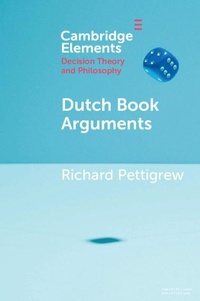
Dutch Book Arguments
Published on 17. September 2020
Book
Paperback/Softback
106 pages
978-1-108-71344-3 (ISBN)
Description
Our beliefs come in degrees. I'm 70% confident it will rain tomorrow, and 0.001% sure my lottery ticket will win. What's more, we think these degrees of belief should abide by certain principles if they are to be rational. For instance, you shouldn't believe that a person's taller than 6ft more strongly than you believe that they're taller than 5ft, since the former entails the latter. In Dutch Book arguments, we try to establish the principles of rationality for degrees of belief by appealing to their role in guiding decisions. In particular, we show that degrees of belief that don't satisfy the principles will always guide action in some way that is bad or undesirable. In this Element, we present Dutch Book arguments for the principles of Probabilism, Conditionalization, and the Reflection Principle, among others, and we formulate and consider the most serious objections to them.
Reviews / Votes
'If the book is of interest to academics across disciplines, it may also serve well those who enjoy leisurely gambling, and possibly future bookies.' Luc Lichtsteiner, Erasmus Journal for Philosophy and EconomicsMore details
Series
Language
English
Place of publication
Cambridge
United Kingdom
Target group
Professional and scholarly
Product notice
Paperback (trade)
Illustrations
Worked examples or Exercises; 6 Line drawings, black and white
Dimensions
Height: 223 mm
Width: 150 mm
Thickness: 7 mm
Weight
164 gr
ISBN-13
978-1-108-71344-3 (9781108713443)
Copyright in bibliographic data and cover images is held by Nielsen Book Services Limited or by the publishers or by their respective licensors: all rights reserved.
Schweitzer Classification
Other editions
Additional editions
Richard Pettigrew
Dutch Book Arguments
E-Book
09/2020
Cambridge University Press
€15.49
Available for download
Person
Content
1. Overview; 2. Introducing Dutch Book arguments; 3. Rewriting the Dutch Book; 4. Updating and evidence; 5. The choices credences rationally require; 6. The alleged irrationality of being exploitable; 7. Generalizing the Dutch Book arguments; 8. The mathematics of the Dutch Book arguments.