

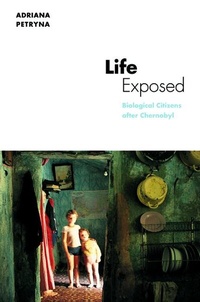
Life Exposed
Biological Citizens after Chernobyl
Published on 17. November 2002
Book
Paperback/Softback
288 pages
978-0-691-09019-1 (ISBN)
Description
On April 26, 1986, Unit Four of the Chernobyl nuclear reactor exploded in then Soviet Ukraine. More than 3.5 million people in Ukraine alone, not to mention many citizens of surrounding countries, are still suffering the effects. "Life Exposed" is the first book to comprehensively examine the vexed political, scientific, and social circumstances that followed the disaster. Tracing the story from an initial lack of disclosure to post-Soviet democratizing attempts to compensate sufferers, Adriana Petryna uses anthropological tools to take us into a world whose social realities are far more immediate and stark than those described by policymakers and scientists. She asks: What happens to politics when state officials fail to inform their fellow citizens of real threats to life? What are the moral and political consequences of remedies available in the wake of technological disasters?Through extensive research in state institutions, clinics, laboratories, and with affected families and workers of the so-called Zone, Petryna illustrates how the event and its aftermath have not only shaped the course of an independent nation but have made health a negotiated realm of entitlement.
She tracks the emergence of a "biological citizenship" in which assaults on health become the coinage through which sufferers stake claims for biomedical resources, social equity, and human rights. "Life Exposed" provides an anthropological framework for understanding the politics of emergent democracies, the nature of citizenship claims, and everyday forms of survival as they are interwoven with the profound changes that accompanied the collapse of the Soviet Union.
She tracks the emergence of a "biological citizenship" in which assaults on health become the coinage through which sufferers stake claims for biomedical resources, social equity, and human rights. "Life Exposed" provides an anthropological framework for understanding the politics of emergent democracies, the nature of citizenship claims, and everyday forms of survival as they are interwoven with the profound changes that accompanied the collapse of the Soviet Union.
Reviews / Votes
Petryna's ethnographic approach consciously shapes her account and illuminates it with detail that historians of the future will treasure. -- Jeanne Guillemin Medical Humanities Review The book presents exceptionally rich anthropological material generated through observations and interviews... The true scope of the human tragedy caused by this man-made catastrophe comes to the fore via biological stories of Petryna's informants... Most of the book's heroes were directly affected by radioactive fallout and often paid a terrible price, losing their physical and mental health. -- Larissa Remennick Journal of the American Medical Association [Chernobyl] is a dramatic and important story, and Life Exposed is a compelling book... [A]n important study that will interest a wide anthropological audience. -- Jonathan P. Parry Journal of the Royal Anthropological InstituteMore details
Series
Language
English
Place of publication
New Jersey
United States
Target group
Professional and scholarly
College/higher education
Product notice
Paperback (trade)
Illustrations
2 line illus. 2 tables. 2 maps.
Dimensions
Height: 229 mm
Width: 152 mm
Weight
397 gr
ISBN-13
978-0-691-09019-1 (9780691090191)
Copyright in bibliographic data and cover images is held by Nielsen Book Services Limited or by the publishers or by their respective licensors: all rights reserved.
Schweitzer Classification
Other editions
New editions
Book
02/2013
Princeton University Press
€35.00
Shipment within 10-20 days
Additional editions
E-Book
09/2011
Princeton University Press
€47.49
Available for download
Person
Adriana Petryna is Assistant Professor in the Department of Anthropology at the New School.
Content
List of Figures and Tables xi Acknowledgments xiii Note on Transliteration xvii Chapter 1: Life Politics after Chernobyl 1 Time Lapse 1 A Technogenic Catastrophe 9 Nation Building 20 Experimental Systems 25 Docta Ignorantia 27 The Unstoppable Course of Radiation Illness 32 Chapter 2: Technical Error: Measures of Life and Risk 34 A Foreign Burden 34 Saturated Grid 36 Institute of Biophysics, Moscow 39 Soviet-American Cooperation 41 Safe Living Politics 49 Life Sciences 55 Risk In Vivo 59 Chapter 3: Chernobyl in Historical Light 63 How to Remember Then 64 New City of Bila-Skala 66 Vitalii 67 Contracts of Truth 69 Oksana 70 Anna 72 Requiem for Storytelling 76 Chapter 4: Illness as Work: Human Market Transition 82 City of Sufferers 82 Capitalist Transition 92 Nothing to Buy and Nothing to Sell 94 Medical-Labor Committees 102 Disability Claims 107 Illness for Life113 Chapter 5: Biological Citizenship 115 Remediation Models 115 Normalizing Catastrophe119 Suffering and Medical Signs 121 Domestic Neurology 126 Disability Groups 130 Law, Medicine, and Corruption 138 Material Basis of Health 143 Chapter 6: Local Science and Organic Processes 149 Social Rebuilding 149 Radiation Research 151 Between the Lesional and the Psychosocial 156 New Sociality 165 Doctor-Patient Relations 174 No One Is Hiding Anything Anymore 176 In the Middle of the Experiment 181 Chapter 7: Self and Social Identity in Transition 191 Anton and Halia 191 Beyond the Family: Kvartyra and Public Voice 194 Medicalized Selves 201 Everyday Violence 206 Lifetime 212 Chapter 8: Conclusion 215 Notes 221 Bibliography 239 Index 253