

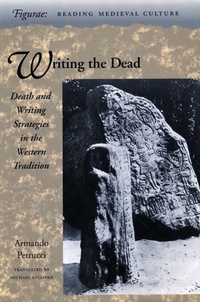
Writing the Dead
Death and Writing Strategies in the Western Tradition
Published on 1. March 1998
Book
Hardback
184 pages
978-0-8047-2859-1 (ISBN)
Description
Written by one of the world's leading paleographers, this book poses two fundamental questions: When did human beings begin-and why have they continued-to decide that a certain number of their dead had a right to a "written death"? What differences have existed in the practice of writing death from age to age and culture to culture? Drawing principally on testimonials intended for public display, such as monuments, tombstones, and grave markings, as well as on scrolls, books, manuscripts, newspapers, and posters, the author reconstructs the ways Western cultures have used writing to commemorate the dead, from the tombs of ancient Egypt to the Vietnam Memorial in Washington, D.C.
The author argues that the relation between funereal remains and inscription is a profoundly political one. The recurring question-Who merits a written death?-demands a multifaceted reply, one that intersects such "modes" of human cultural history as the relation between the living and the dead, the control of territory, the formation and maintenance of power, the preservation of wealth, the right to individuality, and the symbolic and signifying value of written culture.
Apart from examining funerary writing in the light of this analytical model, the author also studies the quality of commemorative writing, the length and physical arrangement of the text, and its link to any representational elements, such as a likeness of the deceased, the techniques involved in executing the testimonial, the number of people who participate in creating it, and its outward appearance. Under the author's careful and informed scrutiny, such developments as unidirectional script, the separation of writing into horizontal lines, and the even spacing of individual letters are revealed as indices of social and technological change.
The author argues that the relation between funereal remains and inscription is a profoundly political one. The recurring question-Who merits a written death?-demands a multifaceted reply, one that intersects such "modes" of human cultural history as the relation between the living and the dead, the control of territory, the formation and maintenance of power, the preservation of wealth, the right to individuality, and the symbolic and signifying value of written culture.
Apart from examining funerary writing in the light of this analytical model, the author also studies the quality of commemorative writing, the length and physical arrangement of the text, and its link to any representational elements, such as a likeness of the deceased, the techniques involved in executing the testimonial, the number of people who participate in creating it, and its outward appearance. Under the author's careful and informed scrutiny, such developments as unidirectional script, the separation of writing into horizontal lines, and the even spacing of individual letters are revealed as indices of social and technological change.
More details
Series
Edition
New edition
Language
English
Place of publication
Palo Alto
United States
Target group
College/higher education
Professional and scholarly
Edition type
New edition
Product notice
Cloth
Illustrations
64 illus
Dimensions
Height: 237 mm
Width: 159 mm
Thickness: 20 mm
Weight
522 gr
ISBN-13
978-0-8047-2859-1 (9780804728591)
Copyright in bibliographic data and cover images is held by Nielsen Book Services Limited or by the publishers or by their respective licensors: all rights reserved.
Schweitzer Classification
Persons
Armando Petrucci occupies the chair in Latin paleography at the Scuola Normale Superiore in Pisa. His Public Lettering: Script, Power, and Culture appeared in English translation in 1993.
Content
1. The tomb and its signs 2. From the sign to the text 3. The order of the text 4. The order of memory 5. The names and the crosses 6. Writing the great 7. The books and the stones 8. Monument and document 9. The body, knowledge, and money 10. Florence and Rome 11. From the stone to the page 12. The theaters of pain 13. Anglo-Americana 14. Ordering the corpses, ordering the writing 15. The middle class and its writing Notes Index of names.