

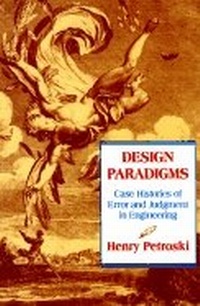
Design Paradigms
Case Histories of Error and Judgment in Engineering
Published on 27. May 1994
Book
Hardback
221 pages
978-0-521-46108-5 (ISBN)
Description
From ancient Greek temples to twentieth-century towers, engineers have learned more about design from failure than success. The concept of error, according to the author, is central to the design process. As a way of explaining the enduring aspects of engineering design, he relates stories of some of the greatest engineering successes and failures of all time. These case studies, drawn from a wide range of times and places, serve as paradigms of error and judgment in engineering design. By showing how errors were introduced in the design process and how they might be avoided, the book suggests how better quality and reliability might be achieved in designed devices, structures, and systems of all kinds. Clearly written, with striking illustrations, the book will appeal to engineering students, practising engineers, historians of science and technology, and all those interested in learning about the process of design.
Reviews / Votes
'The reader will be well served, especially because the case histories are so interesting and well presented in themselves.' N. A. F. Smith, Nature 'Extremely well documented and illustrated ... Design Paradigms can be read by all those interested in engineering, not just structural engineers.' Tom Wyatt, New Scientist '...excellent,it should be essential reading for every student, practising engineer and manager of engineering work.' Journal of Naval Engineering '... will prove fascinating and intelligible to the non-technical reader.' Professor Ronald N. Bracewell, The Times Higher Education Supplement '... a lively and informative read, it presents a dozen excellent case studies from 2000 years of structural engineering history, showing how engineers can learn from failures.' Bill Addis, New ScientistMore details
Language
English
Place of publication
Cambridge
United Kingdom
Target group
Professional and scholarly
College/higher education
Dimensions
Height: 237 mm
Width: 156 mm
Thickness: 23 mm
Weight
523 gr
ISBN-13
978-0-521-46108-5 (9780521461085)
Copyright in bibliographic data and cover images is held by Nielsen Book Services Limited or by the publishers or by their respective licensors: all rights reserved.
Schweitzer Classification
Other editions
New editions
Book
05/1994
Cambridge University Press
€32.60
Shipment within 15-20 days
Additional editions
E-Book
08/2013
1st Edition
Cambridge University Press
€26.49
Available for download
Book
05/1994
Cambridge University Press
€32.60
Shipment within 15-20 days
Content
1. Introduction; 2. Paconius and the pedestal for Apollo: a paradigm of error in conceptual design; 3. Vitruvius's Auger and Galileo's Bones: paradigms of limits to size in design; 4. Galileo and the marble column: a paradigm of a design change for the worse; 5. Galileo's confirmation of a false hypothesis: A paradigm of logical error in design; 6. The design and collapse of the Dee Bridge: a paradigm of success masking error; 7. The Britannia Tubular Bridge: A paradigm of tunnel vision in design; 8. Failure as a source of engineering judgment: John Roebling as a paradigmatic designer; 9. The design climate for the Tacoma Narrows Bridge: a paradigm of the selective use of history; 10. Historic bridge failures and caveats for future designs; 11. Conclusion; References and bibliography; Index.