

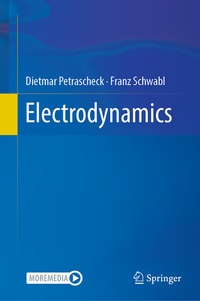
Electrodynamics
Description
This textbook covers classical electrodynamics, including the special theory of relativity, as far as it concerns electrodynamics. In addition, several peripheral areas such as solid-state physics, geometric and wave optics, X-ray scattering and dynamical diffraction, Lagrangian formalism and field quantization are touched upon. The notation may be unusual, as it was chosen to apply to 'all' unit systems. This not only makes it easier to compare textbooks with different unit systems, but also to access the original literature. The book provides end-of-chapter exercises and solutions as electronic supplementary material. A comprehensive summary of the necessary mathematical basics is also provided. Therefore the textbook is aimed to students at the level of undergraduate and graduate studies in physics.
The English translation of this book, originally in German, was facilitated by artificial intelligence. The content was later revised by the author for accuracy.
More details
Other editions
Additional editions
Persons
Dietmar Petrascheck studied physics at the University of Vienna where he also received his doctorate. In 1987 he completed his habilitation at the University of Linz and has been an associate professor since 1997.
Franz Schwabl (deceased) was full professor of theoretical physics at the Technical University of Munich and retired in 2003. He conducted research in the field of magnetic materials and investigated structure formation in driven, dissipative nonequilibrium systems. He is the author of the very well-known textbooks on Quantum Mechanics and Statistical Mechanics.
Content
Lorentz Force and Maxwell's Equations.- Stationary Electric Charges and the Distribution of Electricity on Conductors.- Boundary Value problems in Electrostatics.- Magnetostatics in Vacuum.- Electromagnetic Processes in Matter.- Electrostatics in Matter.- Magnetostatics in Matter.- Fields of Moving Charges.- Quasi-Stationary Currents.- Electromagnetic Waves.- X-Ray Scattering.- Special Theory of Relativity.- Covariant Electrodynamics.- Relativistic Mechanics.- Vectors, Vector Analysis and Integral Theorems.- Mathematical Tools.- Systems of Units in Electrodynamics.- Compilation of Formulas for Electrodynamics.