

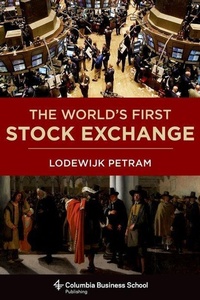
The World's First Stock Exchange
Will be published approx. on 27. May 2014
Book
Hardback
304 pages
978-0-231-16378-1 (ISBN)
Description
The launch of the Dutch East India Company in 1602 initiated Amsterdam's transformation from a regional market town into a dominant financial center. The Company introduced easily transferable shares, and within days buyers had begun to trade them. Soon the public was engaging in a variety of complex transactions, including forwards, futures, options, and bear raids, and by 1680 the techniques deployed in the Amsterdam market were as sophisticated as any we practice today. Lodewijk Petram's eye-opening history demystifies financial instruments by linking today's products to yesterday's innovations, tying the market's operation to the behavior of individuals and the workings of the world around them. Traveling back to seventeenth-century Amsterdam, Petram visits the harbor and other places where merchants met to strike deals. He bears witness to the goings-on at a notary's office and sits in on the consequential proceedings of a courtroom. He describes in detail the main players, investors, shady characters, speculators, and domestic servants and other ordinary folk, who all played a role in the development of the market and its crises.
His history clarifies concerns that investors still struggle with today, such as fraud, the value of information, trust and the place of honor, managing diverging expectations, and balancing risk, and does so in a way that is vivid, relatable, and critical to understanding our contemporary financial predicament.
His history clarifies concerns that investors still struggle with today, such as fraud, the value of information, trust and the place of honor, managing diverging expectations, and balancing risk, and does so in a way that is vivid, relatable, and critical to understanding our contemporary financial predicament.
Reviews / Votes
This is an extremely accessible and clear description of a fascinating topic. Lodewijk Petram writes with the general reader in mind and carefully conveys the intricate details of the issues addressed in an admirably lucid way. It is one of the best explanations I have seen of various aspects of securities trading that are still relevant today. -- Ailsa Roell, professor of international and public affairs, Columbia University Petram's book is a very good example of that rare specimen, a financial history book for a popular audience. The reader gets a very good feeling of atmosphere, of time and place, and of the specific society that gave rise to our contemporary financial structure. -- Joost Jonker, NEHA Professor of Business History, University of Amsterdam This book is a wonderfully textured account of the rise of stock trading in seventeenth-century Amsterdam. It is replete with the personalities, circumstances, wisdom, and folly of the men who fashioned from nothing our modern world of derivatives, repos, and naked short selling. It can be read for pleasure as well as instruction. -- Gregory Clark, University of California, Davis, and author of The Son Also Rises The inventions of shares of stock and of a stock exchange are arguably as formative to the development of the world we live in as the discovery of the telescope or of the laws of motion. And those financial innovations were born in Amsterdam. Lodewijk Petram takes us back to 1602, when it all began, and shows how the major elements of the financial life of our time came into being. A clear and vital book. -- Russell Shorto, author of Amsterdam: A History of the World's Most Liberal City Petram's informed and lively account of Amsterdam's 17th-century securities market demonstrates that when it comes to investing and speculating we have not progressed much in four centuries. Although a company's dividend may sometimes have been paid in East Indian spices as well as cash, in most respects Dutch financial markets were surprisingly modern, with not just shares and bonds, but also forward contracts, derivatives, even repo financing with haircuts. And, of course, the Dutch experienced frauds, bankruptcies, crises, and corporate governance problems. While modern Wall Street may have succeeded Amsterdam as the leading market, what goes on there is hardly new. -- Richard Sylla, New York University Stern School of Business A fascinating book... I can recommend unequivocally to anyone with even a modicum of interest in the history of financial markets. -- Brenda Jubin Investing.com ... Petram does a fine job of bringing history to life and showing its relevance to modern financial crisis. Recommended for readers interested in the origins of the stock market. Library Journal ... In its focus on the 17th century Dutch stock market, this book gives a fascinating look at a remarkable episode in financial history. Financial History Fascinating. Finance Professionals PostMore details
Language
English
Place of publication
New York
United States
Target group
Professional and scholarly
Product notice
Trade binding
Illustrations
20 illustrations
Dimensions
Height: 236 mm
Width: 159 mm
Thickness: 30 mm
Weight
554 gr
ISBN-13
978-0-231-16378-1 (9780231163781)
Copyright in bibliographic data and cover images is held by Nielsen Book Services Limited or by the publishers or by their respective licensors: all rights reserved.
Schweitzer Classification
Other editions
Additional editions
E-Book
07/2015
1st Edition
De Gruyter
from
€15.95
Available for download
Persons
Lodewijk Petram is an economist and historian and regularly publishes on financial history in Dutch journals and newspapers. The Dutch edition of this book won the Dirk Jacob Veegens Prize from the Royal Holland Society of Sciences and Humanities.
Content
1. A World-Famous Book 2. A New Company 3. Early Share Trading 4. Angry Shareholders 5. Fraud 6. The First Boom 7. Jewish Traders 8. Information 9. Trading Clubs 10. Speculation 11. Crisis 12. The World-Famous Book Again Epilogue Acknowledgments and Overview of Literature and Sources Notes Glossary Bibliography Index
Read the chapter, "A New Company":