

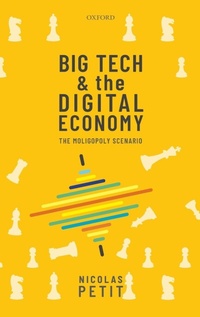
Big Tech and the Digital Economy
The Moligopoly Scenario
Published on 8. October 2020
Book
Hardback
320 pages
978-0-19-883770-1 (ISBN)
Description
This book asks a simple question: are the tech giants monopolies? In the current environment of suspicion towards the major technology companies as a result of concerns about their power and influence, it has become commonplace to talk of Google, Facebook, Amazon, Apple, Microsoft, or Netflix as the modern day version of the 19th century trusts. In turn, the tech giants are vilified for a whole range of monopoly harms towards consumers, workers and even the democratic process. In the US and the EU, antitrust, and regulatory reform is on the way.
Using economics, business and management science as well legal reasoning, this book offers a new perspective on big tech. It builds a theory of "moligopoly". The theory advances that the tech giants, or at least some of them, coexist both as monopolies and oligopoly firms that compete against each other in an environment of substantial uncertainty and economic dynamism.
With this, the book assesses ongoing antitrust and regulatory policy efforts. It demonstrates that it is counterproductive to pursue policies that introduce more rivalry in moligopoly markets subject to technological discontinuities. And that non-economic harms like privacy violations, fake news, or hate speech are difficult issues that belong to the realm of regulation, not antimonopoly remediation.
Using economics, business and management science as well legal reasoning, this book offers a new perspective on big tech. It builds a theory of "moligopoly". The theory advances that the tech giants, or at least some of them, coexist both as monopolies and oligopoly firms that compete against each other in an environment of substantial uncertainty and economic dynamism.
With this, the book assesses ongoing antitrust and regulatory policy efforts. It demonstrates that it is counterproductive to pursue policies that introduce more rivalry in moligopoly markets subject to technological discontinuities. And that non-economic harms like privacy violations, fake news, or hate speech are difficult issues that belong to the realm of regulation, not antimonopoly remediation.
Reviews / Votes
Petit makes innovative use of securities filings and other business documents to substantiate his hypothesis, and in the process paints a vivid and gripping picture of the different cultures and business models of the six Big Tech companies he focuses on. * Sam Bowman, International Center for Law and Economics, History of Economic Ideas * With his 'moligopoly hypothesis' Nicolas Petit has set forth a fresh and insightful perspective on the tech giants that will challenge the preconceptions of the firms' populist critics, their Chicago School defenders, and competition law officials as well. * A.Douglas Melamed, Professor of the Practice of Law, Stanford Law School * Petit documents intense levels of broad based competition faced (and delivered) by big tech firms and he tries to reconcile this with the moniker of monopoly that some antitrust scholar and regulators ('Neostructuralists') attach to Facebook, Apple, Amazon, Netflix, and Google. He finds the confusion stems less from ideology than from analytical framework used. Petit offers new and refreshing ways to think about competition in environments when there is deep uncertainty. The book is a must read for anyone interested in competition policy towards big tech. His framework challenges received wisdom and is much welcomed. * David Teece, Professor, University of California, Berkeley * This is an unusual and extraordinary book. It combines law, economics, textual analysis, critical thinking and a fair amount of philosophy. Its thesis is bound to be polemical, but it is damn well argued; defended with passion and zeal but also with data and logic. I hope it attracts as much attention as it deserves and causes as much debate and controversy as it merits. * Jorge Padilla, Compass Lexecon, Senior Managing Director, Europe * Nicolas Petit reads widely! He synthesizes a broad range of economic insight, legal analysis, and popular perception into a sweeping and penetrating book. He focuses on the key question: would any intervention reduce or increase innovative behavior by the largest technology firms in comparison to what they already do in response to real and perceived competitive pressure? This book grapples with the tensions between the approaches of the European Union and the various US antitrust schools of thought. Petit brings the reader right to the frontier of modern understanding, and illustrates with detailed examples. Every reader will learn from his clear exposition of contrasting perspectives. * Shane Greenstein, Martin Marshall Professor of Business Administration, Harvard Business School * Introducing the concept of "moligopoly" Petit shows how firms with big market shares - even so-called "entrenched monopolists" - still face vigorous competition in adjacent markets. Weaving together insights from industrial organization economics, strategic management, and theories of dynamic competition and building on thinkers from Joseph Schumpeter to David Teece, Petit provides not only an overview of key issues related to digital markets and technologies but also a provocative and useful guide for making competition policy better. Highly recommended! * Peter G. Klein, W. W. Caruth Chair and Professor of Entrepreneurship, Baylor University * The Moligopoly Scenario is an ambitious monograph that discusses the nature of competition in digital markets and explores the role of competition law and regulation. It is a provocative read that is full of ideas cutting across disciplines and legal regimes and challenging many of the tools and intuitions that are too often taken for granted. It will spark lively debates and is a valuable reminder that complex emerging phenomena require us to think hard, not to rush to ready-made answers. * Pablo Ibanez, Professor, London School of Economics *More details
Edition
1
Language
English
Place of publication
Oxford
United Kingdom
Target group
Professional and scholarly
Dimensions
Height: 240 mm
Width: 161 mm
Thickness: 21 mm
Weight
637 gr
ISBN-13
978-0-19-883770-1 (9780198837701)
Copyright in bibliographic data and cover images is held by Nielsen Book Services Limited or by the publishers or by their respective licensors: all rights reserved.
Schweitzer Classification
Other editions
Additional editions
E-Book
10/2020
1st Edition
OUP eBook
€69.49
Available for download
E-Book
10/2020
1st Edition
OUP eBook
€68.99
Available for download
Person
Nicolas Petit is Professor of Competition Law at the European University Institute (EUI) in Florence. Nicolas Petit is also invited Professor at the College of Europe in Bruges. Prior to joining the EUI, Nicolas Petit was Professor at the University of Liege. Nicolas Petit has also held a public office positionas a part time judge with the Belgian competition authority, and has worked in private practice with a leading US law firm in Brussels.
Content
Introduction
1: Policy Conversation on Big Tech
2: The "Moligopoly" Hypothesis
3: Economics of Big Tech: Monopoly V Uncertainty
4: A Concrete Theory of Moligopoly
5: Antitrust in Moligopoly Markets
6: Big Tech's Novel Harms: Antitrust or Regulation?
Conclusion
1: Policy Conversation on Big Tech
2: The "Moligopoly" Hypothesis
3: Economics of Big Tech: Monopoly V Uncertainty
4: A Concrete Theory of Moligopoly
5: Antitrust in Moligopoly Markets
6: Big Tech's Novel Harms: Antitrust or Regulation?
Conclusion