

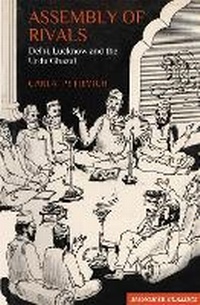
Assembly of Rivals
Delhi Lucknow and the Urdu Ghazal
Published on 25. July 2023
Book
Hardback
225 pages
978-93-88540-79-7 (ISBN)
Description
Urdu critics have described the traditions of poetry of Delhi and Lucknow as rival 'Schools' and argued that their literary differences reflected differing social conditions in the two primary centers of Muslim culture in north India during eighteenth and nineteenth centuries. Assembly of Rivals challenges this Two School theory, arguing that a careful examination of Dihlavi and Lakhnavi ghazal texts does not support the distinctions drawn by critics between the two bodies of poetry, and that Delhi-Lucknow distinctions are better understood in the context of a fierce competition for cultural authority which rages between the two centers during a time of political flux. The author first traces how the Two School theory developed from impressionistic, oblique comments in Urdu's earliest critical works by Muhammad Husain Azad and Altaf Husain Hali into a full-blown, formal classification of separate Delhi and Lucknow schools in Abdus Salam Nadvi's Sherul Hind (1926). Next, the literary definitions of the Two School theory are challenged in a detailed comparison of verses by Dihlavi and Lakhnavi masters written in the same meter and rhyme-scheme.
More details
Language
English
Place of publication
New Delhi
India
Dimensions
Height: 250 mm
Width: 200 mm
Thickness: 50 mm
ISBN-13
978-93-88540-79-7 (9789388540797)
Copyright in bibliographic data and cover images is held by Nielsen Book Services Limited or by the publishers or by their respective licensors: all rights reserved.
Schweitzer Classification
Person
Carla Petievich is a retired professor of History, Urdu and Women's Studies now affiliated with the South Asia Center at the University of Texas at Austin.
Content
Acknowledgments VI
Preface VII
I Introduction to Conventions of the Urdu Ghazal 1
II. Literary Tenets of the Two School Theory 13
III. Tracing the Genesis of the Two Schools: Dihlaviyat and Lakhnaviyat 18
IV. Cultural and Historical Background to the Two School Theory 26
V. Origins of the Delhi-Lucknow Differentiation in Azad's Ab-i Hayat 34
VI. Lakhnavi Poetry in. Hall's Muqaddma-i She' r-o Sha' id 48
VII. Assessing NadVI's Exposition of the Two Schools 63 VIII. Andalib Shadani's ""Lakhnavi iri ki Chand Khutyllytycit"" 84
IX. Zaidi's Challenge to the Two School Theory 89
X. Comparison of Lakhnavi and Dihlavi Poetry in the same Zamin 100
XI. Comparison of Nasikh and Atish 149
XII. Cultural Identification and Literary Principles 181
Bibliography 213
Index 223
Preface VII
I Introduction to Conventions of the Urdu Ghazal 1
II. Literary Tenets of the Two School Theory 13
III. Tracing the Genesis of the Two Schools: Dihlaviyat and Lakhnaviyat 18
IV. Cultural and Historical Background to the Two School Theory 26
V. Origins of the Delhi-Lucknow Differentiation in Azad's Ab-i Hayat 34
VI. Lakhnavi Poetry in. Hall's Muqaddma-i She' r-o Sha' id 48
VII. Assessing NadVI's Exposition of the Two Schools 63 VIII. Andalib Shadani's ""Lakhnavi iri ki Chand Khutyllytycit"" 84
IX. Zaidi's Challenge to the Two School Theory 89
X. Comparison of Lakhnavi and Dihlavi Poetry in the same Zamin 100
XI. Comparison of Nasikh and Atish 149
XII. Cultural Identification and Literary Principles 181
Bibliography 213
Index 223