

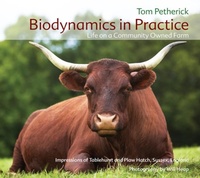
Biodynamics in Practice
Life on a Community Owned Farm - Impressions of Tablehurst and Plawhatch, Sussex, England
Published on 19. November 2010
Book
Hardback
128 pages
978-1-85584-250-2 (ISBN)
Description
'Biodynamics seeks the holistic and interrelated health of the diverse creatures and beings composing a farm, including human beings and the wider, surrounding community. It is not just a "method" but a whole approach to life - one which could have far-reaching benefits for the health of the soil, plants, animals and human beings across the globe...' Born from a series of eight lectures delivered by scientist and philosopher Rudolf Steiner in 1924, the movement for biodynamic agriculture today encompasses many hundreds of farms and millions of consumers worldwide. Much has been written about biodynamics' unique perspectives on farming, nutrition, the world of nature and the wider cosmos. But how does it work in practise? What is it like to run a farm based on its principles? England's Tablehurst and Plaw Hatch farms form a co-operative venture in which the local community plays a crucial role. As successful, commercial enterprises with high outputs, they have a growing reputation for the excellence of their produce. Through interviews, commentary and dozens of full colour photos, Biodynamics in Practise gives a guided tour of the farms from the viewpoint of a sympathetic visitor.
It illustrates how biodynamic farms work, how they differ from conventional and organic farms, and why that difference is important. In short and accessible vignettes, the book looks at many aspects of farm life, including animal rearing and welfare - cattle, sheep, pigs and poultry - crop growth, dairy and cheesemaking, and even bee-keeping and caring for people with special needs. It also gives an introduction to biodynamics itself and brief histories of both farms. Farms are sometimes regarded simply as food-producing factories, but this book shows that they can be much more, offering spiritually-sustaining focal points of community cohesion and participation.
It illustrates how biodynamic farms work, how they differ from conventional and organic farms, and why that difference is important. In short and accessible vignettes, the book looks at many aspects of farm life, including animal rearing and welfare - cattle, sheep, pigs and poultry - crop growth, dairy and cheesemaking, and even bee-keeping and caring for people with special needs. It also gives an introduction to biodynamics itself and brief histories of both farms. Farms are sometimes regarded simply as food-producing factories, but this book shows that they can be much more, offering spiritually-sustaining focal points of community cohesion and participation.
More details
Language
English
Place of publication
East Sussex
United Kingdom
Product notice
sewn/stitched
Paper over boards
Illustrations
col. Illustrations
Dimensions
Height: 230 mm
Width: 253 mm
Thickness: 18 mm
Weight
816 gr
ISBN-13
978-1-85584-250-2 (9781855842502)
Copyright in bibliographic data and cover images is held by Nielsen Book Services Limited or by the publishers or by their respective licensors: all rights reserved.
Schweitzer Classification
Persons
TOM PETHERICK has worked variously as a jockey, a horticulturalist and an author. He has written two books about the Lost Gardens of Heligan and a further book on organic smallholding, and has presented a series of DVDs on horticulture. In 2009 Tom joined the biodynamic and organic certification body Demeter as a farm inspector. He lives with his family in Dartington, Devon, on a small farm.