

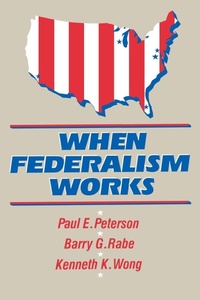
When Federalism Works
Published on 1. November 1986
Book
Paperback/Softback
262 pages
978-0-8157-7019-0 (ISBN)
Description
Twenty years ago cooperative federalism, in the form of federal grant-in-aid programs administered by state and local governments, was applauded almost without reservation as the best means of helping the handicapped, the educationally disadvantaged, the poor, and other groups with special needs. More recently these same programs have been criticized for excessive regulations and red tape, bureaucratic ineptitude, and high cost. The criticisms have been used to justify efforts to curb federal domestic spending and terminate many grants-in-aid.
In When Federalism Works, Paul E. Peterson, Barry G. Rabe, and Kenneth K. Wong examine the new conventional wisdom about federal grants. Through documentary research and hundreds of interviews with local, state, and federal administrators and elected officials, they consider the implementation and operation of federal programs for education, health care, and housing in four urban areas to learn which programs worked, when, and why. Why did rent subsidy programs encounter seemingly endless difficulties, while special education was a notable success? Why did compensatory education fare better in Milwaukee than in Baltimore? Among the factors the authors find significant are the extent to which a program is directed toward groups in need, the political and economic circumstances of the area in which it is implemented, and the degree of professionalism among those who administer it at all levels of government.
When Federalism Works provides a solid introduction to the most important grant-in-aid programs of the past twenty years and a thoughtful assessment of where they might be going.
In When Federalism Works, Paul E. Peterson, Barry G. Rabe, and Kenneth K. Wong examine the new conventional wisdom about federal grants. Through documentary research and hundreds of interviews with local, state, and federal administrators and elected officials, they consider the implementation and operation of federal programs for education, health care, and housing in four urban areas to learn which programs worked, when, and why. Why did rent subsidy programs encounter seemingly endless difficulties, while special education was a notable success? Why did compensatory education fare better in Milwaukee than in Baltimore? Among the factors the authors find significant are the extent to which a program is directed toward groups in need, the political and economic circumstances of the area in which it is implemented, and the degree of professionalism among those who administer it at all levels of government.
When Federalism Works provides a solid introduction to the most important grant-in-aid programs of the past twenty years and a thoughtful assessment of where they might be going.
More details
Language
English
Place of publication
United States
Publishing group
Bloomsbury Publishing Plc
Target group
Professional and scholarly
Dimensions
Height: 229 mm
Width: 152 mm
Thickness: 16 mm
Weight
430 gr
ISBN-13
978-0-8157-7019-0 (9780815770190)
Copyright in bibliographic data and cover images is held by Nielsen Book Services Limited or by the publishers or by their respective licensors: all rights reserved.
Schweitzer Classification
Other editions
Additional editions
Paul E. Peterson | Barry G. Rabe | Kenneth K. Wong
When Federalism Works
E-Book
12/2010
Bloomsbury eBooks US
€20.99
Available for download
Paul E. Peterson | Barry G. Rabe | Kenneth K. Wong
When Federalism Works
E-Book
12/2010
1st Edition
Brookings Institution
€20.99
Available for download
Persons
Paul E. Peterson is the Henry Lee Shattuck Professor of Government at Harvard, the director of PEPG, and a senior fellow at the Hoover Institution. He is author or editor of numerous books, including The Education Gap: Vouchers and Urban Schools, with William G. Howell (Brookings, 2004 and 2006). He is coeditor (with Martin West) of No Child Left Behind? The Practice and Politics of School Accountability (Brookings, 2003).Barry G. Rabe is a professor of environmental policy in the School of Natural Resources and Environment and professor of public policy in the Gerald R. Ford School of Public Policy at the University of Michigan. He also directs the university's new Program in Environment. Rabe is the author of Beyond NIMBY.Kenneth K. Wong is assistant professor of political science at the University of Oregon.