

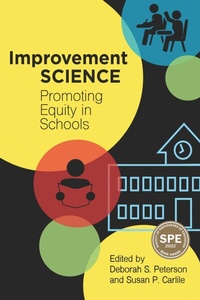
Improvement Science
Promoting Equity in Schools
Will be published approx. on 30. September 2021
Book
Paperback/Softback
125 pages
978-1-9755-0467-0 (ISBN)
Description
Improvement Science: Promoting Equity in Schools is intended for classroom teachers, school leaders, and district leaders charged with leading improvement efforts in schools. From questions such as "how do I develop a love of reading in my classroom?" to "how can I better manage student behavior during independent learning time?" to "what should we do to make sure kids of all races read at grade level by third grade" to "how could we include families of all backgrounds as partners in learning" or "how do we increase our graduation rate among underserved students" or even "how do we reduce theft during lunchtime," this book shares real-life examples from those who are currently leading equity-focused improvement in our classrooms and schools. If you are curious about how Improvement Science has been used, or how others have succeeded--or failed--at equity-focused improvement efforts in our classrooms and in our schools, or if you're wondering how to spur discussions in school districts, universities, and communities about leading equity-focused improvement, this book is for you. Teachers, students, family members, community members, principals and superintendents will be inspired to embrace Improvement Science as a method to improve equity in their schools.
The book helps people new to Improvement Science to understand the basic steps to implement the process. If you're a beginner, it provides some basic steps and a resource (https://www.carnegiefoundation.org/our-ideas/six-core-principles-improvement/) to help you understand the process better; for those with some experience, the book will be an excellent refresher and tool with functional suggestions to take your practice further.
The book helps people new to Improvement Science to understand the basic steps to implement the process. If you're a beginner, it provides some basic steps and a resource (https://www.carnegiefoundation.org/our-ideas/six-core-principles-improvement/) to help you understand the process better; for those with some experience, the book will be an excellent refresher and tool with functional suggestions to take your practice further.
More details
Series
Language
English
Place of publication
Gorham
United States
Target group
Professional and scholarly
Product notice
Paperback (trade)
Unsewn / adhesive bound
Dimensions
Height: 225 mm
Width: 151 mm
Thickness: 21 mm
Weight
448 gr
ISBN-13
978-1-9755-0467-0 (9781975504670)
Copyright in bibliographic data and cover images is held by Nielsen Book Services Limited or by the publishers or by their respective licensors: all rights reserved.
Schweitzer Classification
Other editions
Additional editions

Book
08/2021
Stylus Publishing
€158.95
The article will not be published
Persons
Deborah Peterson (MA, Portland State University; EdD, Lewis and Clark College) is an associate professor at Portland State University. In her previous career as a school leader, she was known for increasing equity, community engagement, and student voice while dramatically improving student outcomes. Her teaching and research focus on preparing current and future school leaders to serve as anti-racist, culturally responsive leaders for equity. Her work has been published in numerous journals. The recipient of numerous grants for her work on equity, her current research includes examining the experiences of women leaders and leaders of color in numerous professions.
Susan Carlile (MA, University of Oregon; graduate work in education, University of Washington and Harvard University) is a professor of practice and program lead for the Educational Leadership and Policy Program. She has facilitated the leadership development of over 600 school leaders, received 18 grants for her work, and presented and published in dozens of state, national and international forums of leadership. Most recently, her research has focused on examining the issues facing women in leadership positions and strategies for navigating the workplace to ensure gender, racial, ethnic, linguistic and socio-economic equity in education.
Susan Carlile (MA, University of Oregon; graduate work in education, University of Washington and Harvard University) is a professor of practice and program lead for the Educational Leadership and Policy Program. She has facilitated the leadership development of over 600 school leaders, received 18 grants for her work, and presented and published in dozens of state, national and international forums of leadership. Most recently, her research has focused on examining the issues facing women in leadership positions and strategies for navigating the workplace to ensure gender, racial, ethnic, linguistic and socio-economic equity in education.
Content
List of Tables and Figures
Acknowledgments
Foreword
Chapter 1. Introduction
Deborah S. Peterson and Susan P. Carlile
Part I: Reading
Chapter 2. Impact by Design: Promoting Equity Through Reading Achievement of Students of Color
Naichen Zhao, Erin Anderson, Sandy Lochhead, and Laura Vasta
Chapter 3. University Academy Lab Schools: Closing the Gaps in Literacy
Jennifer Rasberry, Michael Odell, Teresa Kennedy, Kelly Dyer, Jaclyn Pedersen, and Jo Ann Simmons
Chapter 4. Equity Matters: Witnessing the Stories of Students and Families
Lynda Tredway, Matthew Militello, Moraima Machado, and Jolia Bossette
Chapter 5. Increasing Reading Engagement in Middle Level Learners: How to Reverse the Decline
Rhiannon Young
Part II: Writing
Chapter 6. Small-Group Instruction in Writer's Workshop: A Surprising Obstacle
Daniel F. Barnard
Chapter 7. Improving Gender Equity in Written Language
Frauke Meyer and Linda Bendikson
Chapter 8. Expressive Writing: Students With Disabilities
Adrienne Stimson Clark
Part III: Math and Science
Chapter 9. Improvement Science Models Used for Achievement in Mathematics
Jaclyn Pedersen, Michael Odell, Teresa Kennedy, Kelly Dyer, Jo Ann Simmons, and Yanira Oliveras-Ortiz
Chapter 10. Access Versus Ability: Advanced Mathematics for Every Child
Anne Larkin and Corey Jenks
Chapter 11. Increasing Fourth-Grade Math Achievement for Historically Underserved Populations Utilizing Targeted Intervention Groups
Dr. Holly Altiero
Chapter 12. Improving Math Growth Indicators for Elementary Students With Disabilities
Shane Brown
Chapter 13
Equity in STEM Programs
Keith Grosse
Part IV: Health, Wellness, and Physical Education
Chapter 14. Physical Education and Indigenous Youth: Middle School Physical Education and Indigenous Youth
Jarod Milko
Conclusion
Chapter 15. Moving Forward
Cassandra Thonstad, Susan P. Carlile, and Deborah S. Peterson
About the Authors
Index
Acknowledgments
Foreword
Chapter 1. Introduction
Deborah S. Peterson and Susan P. Carlile
Part I: Reading
Chapter 2. Impact by Design: Promoting Equity Through Reading Achievement of Students of Color
Naichen Zhao, Erin Anderson, Sandy Lochhead, and Laura Vasta
Chapter 3. University Academy Lab Schools: Closing the Gaps in Literacy
Jennifer Rasberry, Michael Odell, Teresa Kennedy, Kelly Dyer, Jaclyn Pedersen, and Jo Ann Simmons
Chapter 4. Equity Matters: Witnessing the Stories of Students and Families
Lynda Tredway, Matthew Militello, Moraima Machado, and Jolia Bossette
Chapter 5. Increasing Reading Engagement in Middle Level Learners: How to Reverse the Decline
Rhiannon Young
Part II: Writing
Chapter 6. Small-Group Instruction in Writer's Workshop: A Surprising Obstacle
Daniel F. Barnard
Chapter 7. Improving Gender Equity in Written Language
Frauke Meyer and Linda Bendikson
Chapter 8. Expressive Writing: Students With Disabilities
Adrienne Stimson Clark
Part III: Math and Science
Chapter 9. Improvement Science Models Used for Achievement in Mathematics
Jaclyn Pedersen, Michael Odell, Teresa Kennedy, Kelly Dyer, Jo Ann Simmons, and Yanira Oliveras-Ortiz
Chapter 10. Access Versus Ability: Advanced Mathematics for Every Child
Anne Larkin and Corey Jenks
Chapter 11. Increasing Fourth-Grade Math Achievement for Historically Underserved Populations Utilizing Targeted Intervention Groups
Dr. Holly Altiero
Chapter 12. Improving Math Growth Indicators for Elementary Students With Disabilities
Shane Brown
Chapter 13
Equity in STEM Programs
Keith Grosse
Part IV: Health, Wellness, and Physical Education
Chapter 14. Physical Education and Indigenous Youth: Middle School Physical Education and Indigenous Youth
Jarod Milko
Conclusion
Chapter 15. Moving Forward
Cassandra Thonstad, Susan P. Carlile, and Deborah S. Peterson
About the Authors
Index