

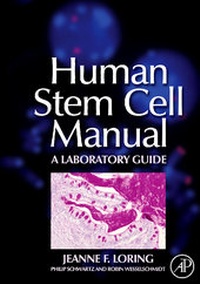
Human Stem Cell Manual
A Laboratory Guide
Published on 11. July 2007
Book
Hardback
488 pages
978-0-12-370465-8 (ISBN)
Description
Stem cells are self-replicating and undifferentiated, meaning their function is not yet cell, tissue, or organ-specific. Due to the unique nature of these cells, research into their biology and function holds great promise for therapeutic applications through replacement or repair of diseased and damaged cells. This reader-friendly manual provides a practical "hands on" guide to the culture of human embryonic and somatic stem cells. By presenting methods for embryonic and adult lines side-by-side, the authors lay out an elegant and unique path to understanding the science of stem cell practice. The authors begin with a broad-based introduction to the field, and also review legal and regulatory issues and patents. Each experimental strategy is presented with an historical introduction, detailed method, discussion of alternative methods, and common pitfalls. This lab guide for researchers also serves as a textbook for undergraduate and graduate students in laboratory courses.
More details
Language
English
Place of publication
San Diego
United States
Publishing group
Elsevier Science Publishing Co Inc
Target group
Professional and scholarly
Scientists engaged in any aspect of stem cell research, as well as undergraduate and graduate students enrolled in laboratory courses.
Illustrations
Illustrated
Dimensions
Height: 254 mm
Width: 178 mm
Weight
1150 gr
ISBN-13
978-0-12-370465-8 (9780123704658)
Copyright in bibliographic data and cover images is held by Nielsen Book Services Limited or by the publishers or by their respective licensors: all rights reserved.
Schweitzer Classification
Other editions
New editions

Book
10/2018
2nd Edition
Academic Press
€75.51
The article will not be published
Book
11/2012
2nd Edition
Academic Press
€91.60
Article exhausted; check for reprint
Additional editions
Suzanne Peterson | Jeanne F. Loring | Robin L. Wesselschmidt
Human Stem Cell Manual
A Laboratory Guide
E-Book
10/2011
1st Edition
Academic Press
€74.95
Available for download
Persons
Suzanne Peterson received her doctoral degree from USC and immediately moved back to her home town of San Diego to pursue her Post-Doctoral work. A long-time member and the only native San Diegan of the Loring Laboratory at Scripps Research Institute, this summer Dr. Peterson followed her mentor Dr. Loring to Aspen Neuroscience and will serve as a senior scientist in the new founded lab. Her specialty is hematopoietic stem cells and she will continue to serve as co-editor of Human Stem Cell Manual: A Laboratory Guide with Dr. Jeanne Loring. Jeanne Loring is a world renown stem cell biologist, developmental neurobiologist, and geneticist. Dr. Loring's 3+ decades have spanned embryology and neurobiology, gene editing and stem cells, ultimately landing in regenerative medicine. Her decades of experience ranges from biotech, to pharma to bioscience and of course academia. She was the director for the Center for Regenerative Medicine and professor at Scripps Research Institute in La Jolla, CA for 12+ years. In June 2019 she founded Aspen Neuroscience, in La Jolla, where she and her staff will continue her work in regenerative medicine for those with currently untreatable neurological diseases. Their first target is a patient-specific neuron replacement therapy for Parkinson's disease. She will continue as Professor Emeritus and remains on the faculty of Scripps Research Institute. Dr. Loring has received numerous awards and accolades, including the 2015 Stem Cell Action Advocacy Award and 2015 Stem Cell Person of the Year.
Content
Foreword by James Battey
Foreword by Jeannie Fontana
Preface
Part I: Basic methods: Maintenance of stem cell cultures
1.Human Embryonic Stem Cell Culture
2.Feeder layers and feeder-free culture
3.Mouse Embryonic Fibroblast Feeder Cells
4.Cryopreservation of hESC
Part II: Basic methods: Characterization of stem cells
5.Classical Cytogenetics: Karyotyping
6.Spectral Karyotyping and Fluorescent in situ Hybridization
7.Using SNP Genotyping to Identify Cell Lines, Determine Genomic Abnormalities and Monitor DNA Methylation Patterns
8.FACS/Cell sorting
9.Fluorescence Immunocytochemical Analysis of Stem Cells
10.Characterization of Stem Cells Using RT-PCR
11.Gene Expression Profiling of Stem Cells by Microarray
12.Teratomas produced from Human Embryonic Stem Cells Xenografted into Immunodeficient Mice
13.Generation of HESC-Derived Teratomas
Part III: Differentiation of stem cells
14."Embryoid Body? Formation and Neuroepithelia Differentiation
15.Motor Neuron and Dopamine Neuron Differentiation
16.Oligodendrocyte Differentiation from hESC
17.Cardiac
18.Hematopoietic
Part IV: Genetic manipulation of stem cells
19.Genetic Manipulation of hESC: Lentivirus Vectors
20.Methods developed for mouse ES cells
Part V: Advanced methods
21.Derivation of human ES cells
22.Neural Stem Cell Culture
23.Transplantation of stem cells
24.In vitro fertilization
25.Functional characterization-neural cells
Part VI: Practical issues in establishing a human ES cell laboratory
26.Setting Up a Facility for hESC Research
Part VII: Essays on stem cell biology
27.Intellectual Property: Owning the Stem Cell
28.Ethical Concerns for Stem Cell Research
29.Guidelines for hESC Research Oversight (ESCRO) Committees
Foreword by Jeannie Fontana
Preface
Part I: Basic methods: Maintenance of stem cell cultures
1.Human Embryonic Stem Cell Culture
2.Feeder layers and feeder-free culture
3.Mouse Embryonic Fibroblast Feeder Cells
4.Cryopreservation of hESC
Part II: Basic methods: Characterization of stem cells
5.Classical Cytogenetics: Karyotyping
6.Spectral Karyotyping and Fluorescent in situ Hybridization
7.Using SNP Genotyping to Identify Cell Lines, Determine Genomic Abnormalities and Monitor DNA Methylation Patterns
8.FACS/Cell sorting
9.Fluorescence Immunocytochemical Analysis of Stem Cells
10.Characterization of Stem Cells Using RT-PCR
11.Gene Expression Profiling of Stem Cells by Microarray
12.Teratomas produced from Human Embryonic Stem Cells Xenografted into Immunodeficient Mice
13.Generation of HESC-Derived Teratomas
Part III: Differentiation of stem cells
14."Embryoid Body? Formation and Neuroepithelia Differentiation
15.Motor Neuron and Dopamine Neuron Differentiation
16.Oligodendrocyte Differentiation from hESC
17.Cardiac
18.Hematopoietic
Part IV: Genetic manipulation of stem cells
19.Genetic Manipulation of hESC: Lentivirus Vectors
20.Methods developed for mouse ES cells
Part V: Advanced methods
21.Derivation of human ES cells
22.Neural Stem Cell Culture
23.Transplantation of stem cells
24.In vitro fertilization
25.Functional characterization-neural cells
Part VI: Practical issues in establishing a human ES cell laboratory
26.Setting Up a Facility for hESC Research
Part VII: Essays on stem cell biology
27.Intellectual Property: Owning the Stem Cell
28.Ethical Concerns for Stem Cell Research
29.Guidelines for hESC Research Oversight (ESCRO) Committees