

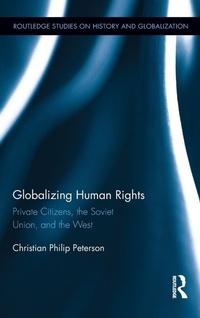
Globalizing Human Rights
Private Citizens, the Soviet Union, and the West
1st Edition
Published on 19. September 2011
Book
Hardback
294 pages
978-0-415-88511-9 (ISBN)
Description
Globalizing Human Rights explores the complexities of the role human rights played in U.S.-Soviet relations during the 1970s and 1980s. It will show how private citizens exploited the larger effects of contemporary globalization and the language of the Final Act to enlist the U.S. government in a global campaign against Soviet/Eastern European human rights violations. A careful examination of this development shows the limitations of existing literature on the Reagan and Carter administrations' efforts to promote internal reform in USSR. It also reveals how the Carter administration and private citizens, not Western European governments, played the most important role in making the issue of human rights a fundamental aspect of Cold War competition. Even more important, it illustrates how each administration made the support of non-governmental human rights activities an integral element of its overall approach to weakening the international appeal of the USSR.
In addition to looking at the behavior of the U.S. government, this work also highlights the limitations of arguments that focus on the inherent weakness of Soviet dissent during the early to mid 1980s. In the case of the USSR, it devotes considerable attention to why Soviet leaders failed to revive the international reputation of their multinational empire in face of consistent human rights critiques. It also documents the crucial role that private citizens played in shaping Mikhail Gorbachev's efforts to reform Soviet-style socialism.
In addition to looking at the behavior of the U.S. government, this work also highlights the limitations of arguments that focus on the inherent weakness of Soviet dissent during the early to mid 1980s. In the case of the USSR, it devotes considerable attention to why Soviet leaders failed to revive the international reputation of their multinational empire in face of consistent human rights critiques. It also documents the crucial role that private citizens played in shaping Mikhail Gorbachev's efforts to reform Soviet-style socialism.
More details
Series
Language
English
Place of publication
London
United Kingdom
Publishing group
Taylor & Francis Ltd
Target group
College/higher education
Product notice
sewn/stitched
Cloth over boards
Dimensions
Height: 231 mm
Width: 152 mm
Thickness: 23 mm
Weight
522 gr
ISBN-13
978-0-415-88511-9 (9780415885119)
Copyright in bibliographic data and cover images is held by Nielsen Book Services Limited or by the publishers or by their respective licensors: all rights reserved.
Schweitzer Classification
Other editions
Additional editions
E-Book
03/2012
1st Edition
Routledge
€60.49
Available for download
E-Book
03/2012
1st Edition
Routledge
€60.49
Available for download
Person
Christian Peterson holds a Ph.D. in history from Ohio University and has authored Ronald Reagan and Antinuclear Movements in the United States and Western Europe, 1981-1987 (2003). He is currently a Visiting Assistant Professor at Ferris State University and teaches a wide variety of courses in U.S and World history.
Content
1. Introduction 2. The Human Rights Weapon Emerges: Private Citizens and the U.S. Congress, 1975-1977 3. Setting the Stage for a Superpower Confrontation: Jimmy Carter, the Soviet Union, and Human Rights, 1975-1976 4. The Carter Administration Wields the Human Rights Weapon, January 1977-August 1978 5. The Soviet Government, Private Citizens, and Human Rights, January 1977-August 1978 6. A Delicate Balancing Act Topples: The Carter Administration, Human Rights, and Private Citizens, September 1978-January 1981 7. The Soviet Government, Private Citizens, and Human Rights, September 1978-January 1981 8. The Reagan Administration's "Conservative" and "Private" Human Rights Campaign, January 1981-November 1985 9. The Soviet Government and Dissenters: Human Rights, Peace, and Detente, January 1981-September 1986 10. Holding Mikhail Gorbachev and Soviet Bureaucrats Accountable: U.S.-Soviet Relations, Human Rights, and the Final Act, December 1985-January 1989 11. Revolutions from Above and Below: Mikhail Gorbachev, Soviet Bureaucrats, and Human Rights 12. Conclusion