

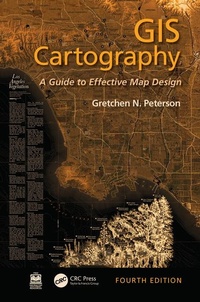
GIS Cartography
A Guide to Effective Map Design
4th Edition
Published on 3. February 2025
Book
Hardback
374 pages
978-1-032-87114-1 (ISBN)
Description
The new edition of this well-established introductory cartography textbook is updated to respond to the demand for critical engagement with new technologies, the passion for inclusive design, and for preparing students to build competence in fundamental skills. Written in a friendly style, it is enjoyable to read and includes over 200 figures and maps, explaining everything from layout design to dynamic cartography issues. A new chapter discusses the role of artificial intelligence (AI) in cartography, and a significant expansion to 3D cartography has been incorporated into existing chapters. A new chapter on accessibility provides a thorough understanding of universal design. Additional updates include placements and best practices for digital map elements, global labeling techniques including language support, hybrid map styling, multiscale map testing, and information on 4D mapping.
New in the Fourth Edition:
Exploration of geospatial AI and generative AI in cartography and how they can already make an impact on workflows.
New material on vision, motor, and cognitive accessibility techniques in map design.
Expanded discussion on 3D cartography.
All chapters are updated with new data and important new developments in cartography, including the importance of accessible design to ensure inclusivity for all users.
Updated study questions and exercises to enhance student engagement and comprehension.
New discussions of techniques such as aquarium cutaways, integrated north arrows, joy plots, hybrid satellite maps, crafted hachuring, as well as updated information on resolution and file types.
This book is written as a go-to guide for learning the art and science of mapmaking. It is for undergraduate and graduate students taking courses in GIS and cartography and studying fields such as geography, geophysics, environmental engineering, urban planning, and so on. It is also a valuable resource for professionals interested in learning techniques and technologies for creating maps and visualizing geospatial datasets.
New in the Fourth Edition:
Exploration of geospatial AI and generative AI in cartography and how they can already make an impact on workflows.
New material on vision, motor, and cognitive accessibility techniques in map design.
Expanded discussion on 3D cartography.
All chapters are updated with new data and important new developments in cartography, including the importance of accessible design to ensure inclusivity for all users.
Updated study questions and exercises to enhance student engagement and comprehension.
New discussions of techniques such as aquarium cutaways, integrated north arrows, joy plots, hybrid satellite maps, crafted hachuring, as well as updated information on resolution and file types.
This book is written as a go-to guide for learning the art and science of mapmaking. It is for undergraduate and graduate students taking courses in GIS and cartography and studying fields such as geography, geophysics, environmental engineering, urban planning, and so on. It is also a valuable resource for professionals interested in learning techniques and technologies for creating maps and visualizing geospatial datasets.
More details
Edition
4th edition
Language
English
Place of publication
London
United Kingdom
Publishing group
Taylor & Francis Ltd
Target group
College/higher education
Postgraduate and Undergraduate Core
Product notice
sewn/stitched
Cloth over boards
Illustrations
1 s/w Photographie bzw. Rasterbild, 75 Farbfotos bzw. farbige Rasterbilder, 199 farbige Abbildungen, 48 s/w Zeichnungen, 124 farbige Zeichnungen, 49 s/w Abbildungen
124 Line drawings, color; 48 Line drawings, black and white; 75 Halftones, color; 1 Halftones, black and white; 199 Illustrations, color; 49 Illustrations, black and white
Dimensions
Height: 242 mm
Width: 163 mm
Thickness: 22 mm
Weight
859 gr
ISBN-13
978-1-032-87114-1 (9781032871141)
Copyright in bibliographic data and cover images is held by Nielsen Book Services Limited or by the publishers or by their respective licensors: all rights reserved.
Schweitzer Classification
Other editions
Additional editions
E-Book
02/2025
4th Edition
CRC Press
€172.99
Available for download
E-Book
02/2025
4th Edition
CRC Press
€172.99
Available for download
Previous edition
Book
11/2020
3rd Edition
CRC Press
€136.40
Article exhausted; check for reprint
Person
Gretchen N. Peterson is a world-renowned geospatial professional who has crafted maps for some of the largest global audiences, including the Wikimedia Foundation, Snap, and Meta, as well as for more specialized uses like regional salmonid habitats and local wetland and floodplain mitigation. She is also the author of City Maps: A Coloring Book for Adults, Cartographer's Toolkit, and co-author of QGIS Map Design.
Content
1. Introduction. 2. Creative Inspiration. 3. Layout Design. 4. Fonts and Labels. 5. Color. 6. Features. 7. Static Maps. 8. Projections. 9. Multiscale Design. 10. Geospatial AI. 11. Accessibility.