

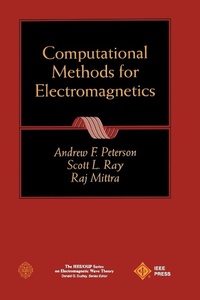
Computational Methods for Electromagnetics
1st Edition
Published on 12. December 1997
Book
Hardback
592 pages
978-0-7803-1122-0 (ISBN)
Description
Computational Methods for Electromagnetics is an indispensable resource for making efficient and accurate formulations for electromagnetics applications and their numerical treatment. Employing a unified coherent approach that is unmatched in the field, the authors detail both integral and differential equations using the method of moments and finite-element procedures. In addition, readers will gain a thorough understanding of numerical solution procedures. Topics covered include:
Two- and three-dimensional integral equation/method-of-moments formulations
Open-region finite-element formulations based on the scalar and vector Helmholtz equations
Finite difference time-domain methods
Direct and iterative algorithms for the solutions of linear systems
Error analysis and the convergence behavior of numerical results
Radiation boundary conditions
Acceleration methods for periodic Green's functions
Vector finite elements
Detail is provided to enable the reader to implement concepts in software and, in addition, a collection of related computer programs are available via the Internet. Computational Methods for Electromagnetics is designed for graduate-level classroom use or self-study, and every chapter includes problems. It will also be of particular interest to engineers working in the aerospace, defense, telecommunications, wireless, electromagnetic compatibility, and electronic packaging industries.
Two- and three-dimensional integral equation/method-of-moments formulations
Open-region finite-element formulations based on the scalar and vector Helmholtz equations
Finite difference time-domain methods
Direct and iterative algorithms for the solutions of linear systems
Error analysis and the convergence behavior of numerical results
Radiation boundary conditions
Acceleration methods for periodic Green's functions
Vector finite elements
Detail is provided to enable the reader to implement concepts in software and, in addition, a collection of related computer programs are available via the Internet. Computational Methods for Electromagnetics is designed for graduate-level classroom use or self-study, and every chapter includes problems. It will also be of particular interest to engineers working in the aerospace, defense, telecommunications, wireless, electromagnetic compatibility, and electronic packaging industries.
More details
Series
Language
English
Place of publication
United States
Publishing group
John Wiley & Sons Inc
Target group
College/higher education
Professional and scholarly
Product notice
sewn/stitched
Cloth over boards
Dimensions
Height: 260 mm
Width: 183 mm
Thickness: 36 mm
Weight
1288 gr
ISBN-13
978-0-7803-1122-0 (9780780311220)
Copyright in bibliographic data and cover images is held by Nielsen Book Services Limited or by the publishers or by their respective licensors: all rights reserved.
Schweitzer Classification
Persons
About the Authors...
Andrew F. Peterson is associate professor at the School of Electrical and Computer Engineering at Georgia Institute of Technology. His research interests center on the development of both integral and differential equation based numerical methods for electromagnetic applications.
Scott L. Ray is a research scientist at Dow AgroSciences, where he also serves as technical leader for the Applied Statistics Group. He previously contributed to time-domain computational electromagnetics at the Lawrence Livermore National Laboratory and was involved in the development of TSAR, a general-purpose FDTD modeling system.
Raj Mittra is professor in the Electrical Engineering Department and a senior research scientist at the Applied Research Laboratory of Pennsylvania State University. He has also published over 450 journal papers and 25 books or book chapters on various topics related to electromagnetics, antennas, microwaves, and electronic packaging.
Andrew F. Peterson is associate professor at the School of Electrical and Computer Engineering at Georgia Institute of Technology. His research interests center on the development of both integral and differential equation based numerical methods for electromagnetic applications.
Scott L. Ray is a research scientist at Dow AgroSciences, where he also serves as technical leader for the Applied Statistics Group. He previously contributed to time-domain computational electromagnetics at the Lawrence Livermore National Laboratory and was involved in the development of TSAR, a general-purpose FDTD modeling system.
Raj Mittra is professor in the Electrical Engineering Department and a senior research scientist at the Applied Research Laboratory of Pennsylvania State University. He has also published over 450 journal papers and 25 books or book chapters on various topics related to electromagnetics, antennas, microwaves, and electronic packaging.
Content
Preface.
Acknowledgments.
Electromagnetic Theory.
Integral Equation Methods for Scattering from Infinite Cylinders.
Differential Equation Methods for Scattering from Infinite Cylinders.
Algorithms for the Solution of Linear Systems of Equations.
The Discretization Process.
Basis/Testing Functions and Convergence.
Alternative Surface Integral Equation Formulations.
Strip Gratings and Other Two-Dimensional Structures with One-Dimensional Periodicity.
Three-Dimensional problems with Translational or Rotational Symmetry.
Subsectional Basis Functions for MultiDimensional and Vector Problems.
Integral Equation Methods for Three-Dimensional Bodies.
Frequency-Domain Differential Equation Formulations for Open Three-Dimensional Problems.
Finite-Difference Time-Domain Methods on Orthogonal Meshes.
Appendix A: Quadrature.
Appendix B: Source-Field Relationships for Cylinders Illuminated by an Obliquely Incident Field.
Appendix C: Fortran Codes for TM Scattering From Perfect Electric Conducting Cylinders.
Appendix D: Additional Software Available Via the Internet.
Index.
About the Authors.
Acknowledgments.
Electromagnetic Theory.
Integral Equation Methods for Scattering from Infinite Cylinders.
Differential Equation Methods for Scattering from Infinite Cylinders.
Algorithms for the Solution of Linear Systems of Equations.
The Discretization Process.
Basis/Testing Functions and Convergence.
Alternative Surface Integral Equation Formulations.
Strip Gratings and Other Two-Dimensional Structures with One-Dimensional Periodicity.
Three-Dimensional problems with Translational or Rotational Symmetry.
Subsectional Basis Functions for MultiDimensional and Vector Problems.
Integral Equation Methods for Three-Dimensional Bodies.
Frequency-Domain Differential Equation Formulations for Open Three-Dimensional Problems.
Finite-Difference Time-Domain Methods on Orthogonal Meshes.
Appendix A: Quadrature.
Appendix B: Source-Field Relationships for Cylinders Illuminated by an Obliquely Incident Field.
Appendix C: Fortran Codes for TM Scattering From Perfect Electric Conducting Cylinders.
Appendix D: Additional Software Available Via the Internet.
Index.
About the Authors.