

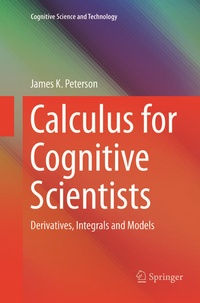
Calculus for Cognitive Scientists
Derivatives, Integrals and Models
Published on 9. December 2018
Book
Paperback/Softback
XXXI, 507 pages
978-981-13-5719-0 (ISBN)
Description
This book provides a self-study program on how mathematics, computer science and science can be usefully and seamlessly intertwined. Learning to use ideas from mathematics and computation is essential for understanding approaches to cognitive and biological science. As such the book covers calculus on one variable and two variables and works through a number of interesting first-order ODE models. It clearly uses MatLab in computational exercises where the models cannot be solved by hand, and also helps readers to understand that approximations cause errors - a fact that must always be kept in mind.
Reviews / Votes
"The introductory remarks in this book address the concern that many presentations of mathematics focus so heavily on traditional content that the usefulness of mathematics in other fields can be overlooked. . the approach is both demanding and thorough, but the brief exercise sets remain focused on providing opportunities for straightforward practice of the principles at hand. . Summing Up: Recommended. Lower- and upper-division undergraduates." (N. W. Schillow, Choice, Vol. 54 (4), December, 2016)More details
Series
Edition
Softcover reprint of the original 1st ed. 2016
Language
English
Place of publication
Singapore
Singapore
Target group
Professional and scholarly
Illustrations
105 farbige Abbildungen
XXXI, 507 p. 105 illus. in color.
Dimensions
Height: 235 mm
Width: 155 mm
Thickness: 29 mm
Weight
809 gr
ISBN-13
978-981-13-5719-0 (9789811357190)
DOI
10.1007/978-981-287-874-8
Schweitzer Classification
Other editions
Additional editions
Book
02/2016
Springer
€160.49
Shipment within 15-20 days
Person
Dr. James Peterson is an Associate Professor in Mathematical Sciences and Biological Sciences at Clemson University, USA. His formal training is in mathematics but he has worked as an aerospace engineer and a software engineer also. He enjoys working on very hard problems that require multiple disciplines to make sense out of and he reads, studies and plays in cutting edge areas a lot as part of his interests.
Content
Introductory Remarks.- Viability Selection.- Limits and Basic Smoothness.- Continuity and Derivatives.- Sin, Cos and All That.- Antiderivatives.- Substitutions.- Riemann Integration.- The Logarithm and Its Inverse.- Exponential and Logarithm Function Properties.- Simple Rate Equations.- Simple Protein Models.- Logistics Models.- Function Approximation.- Extreme Values.- Numerical Methods Order One ODEs.- Advanced Protein Models.- Matrices and Vectors.- A Cancer Model.- First Order Multivariable Calculus.- Second Order Multivariable Calculus.- Hamilton's Rule In Evolutionary Biology.- Final Thoughts.- Background Reading.