

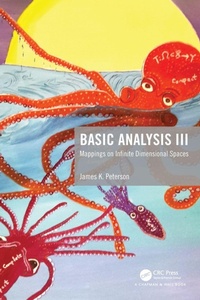
Basic Analysis III
Mappings on Infinite Dimensional Spaces
1st Edition
Published on 20. July 2020
Book
Hardback
468 pages
978-1-138-05508-7 (ISBN)
Description
Basic Analysis III: Mappings on Infinite Dimensional Spaces is intended as a first course in abstract linear analysis. This textbook cover metric spaces, normed linear spaces and inner product spaces, along with many other deeper abstract ideas such a completeness, operators and dual spaces. These topics act as an important tool in the development of a mathematically trained scientist.
Feature:
Can be used as a traditional textbook as well as for self-study
Suitable for undergraduates in mathematics and associated disciplines
Emphasizes learning how to understand the consequences of assumptions using a variety of tools to provide the proofs of propositions
Feature:
Can be used as a traditional textbook as well as for self-study
Suitable for undergraduates in mathematics and associated disciplines
Emphasizes learning how to understand the consequences of assumptions using a variety of tools to provide the proofs of propositions
Reviews / Votes
"Mathematics is fortunate to be populated by bright practitioners. Nonetheless, amongst these we are fortunate to have rare individuals who are wise. Professor Peterson is a member of this distinguished group. His works clearly demonstrate the importance of a long career of research and teaching where he combines the two perspectives of: (1) clearly understanding the needs of diverse readers for clear exposition that scaffolds their exposure to complex material with a transparency about both where they are going and what the utility is of what they are currently reading; and, (2) the benefits of having used the mathematics under consideration in so many diverse applications. The masterly synthesis of so much complex material by a single individual is a superb achievement which will reward serious readers with insight, surprise, and breadth as well as depth."-Professor John R. Jungck, University of Delaware
"Analysis is the bedrock of rigorous mathematical thinking and abstraction. Prof. Peterson's book does a fascinating job by taking a critical approach - highly recommended."
-Professor Nithin Nagaraj, National Institute of Advanced Studies "Mathematics is fortunate to be populated by bright practitioners. Nonetheless, amongst these we are fortunate to have rare individuals who are wise. Professor Peterson is a member of this distinguished group. His works clearly demonstrate the importance of a long career of research and teaching where he combines the two perspectives of: (1) clearly understanding the needs of diverse readers for clear exposition that scaffolds their exposure to complex material with a transparency about both where they are going and what the utility is of what they are currently reading; and, (2) the benefits of having used the mathematics under consideration in so many diverse applications. The masterly synthesis of so much complex material by a single individual is a superb achievement which will reward serious readers with insight, surprise, and breadth as well as depth."
- Professor John R. Jungck, University of Delaware
"Analysis is the bedrock of rigorous mathematical thinking and abstraction. Prof. Peterson's book does a fascinating job by taking a critical approach - highly recommended."
- Professor Nithin Nagaraj, National Institute of Advanced Studies
"Dr. Peterson's thoughtful and detailed explanations reflect his insights to a very fundamental but complex subject in Mathematics. The treatment in the book does justice to recent trends in Mathematical Analysis while staying true to the classical spirit of the subject. A thoroughly enjoyable read."
- Professor Snehanshu Saha, BITS PIlani (K K Birla Goa Campus)
More details
Language
English
Place of publication
London
United Kingdom
Publishing group
Taylor & Francis Ltd
Target group
College/higher education
Illustrations
8 s/w Abbildungen
8 Illustrations, black and white
Dimensions
Height: 260 mm
Width: 183 mm
Thickness: 30 mm
Weight
1072 gr
ISBN-13
978-1-138-05508-7 (9781138055087)
Copyright in bibliographic data and cover images is held by Nielsen Book Services Limited or by the publishers or by their respective licensors: all rights reserved.
Schweitzer Classification
Other editions
Additional editions
E-Book
07/2020
1st Edition
Chapman & Hall/CRC
€165.99
Available for download
E-Book
07/2020
1st Edition
Chapman & Hall/CRC
€165.99
Available for download
Person
James Peterson has been an associate professor in the School of Mathematical and Statistical Sciences
since 1990. He tries hard to build interesting models of complex phenomena using a blend of mathematics, computation and science. To this end, he has written four books on how to teach such things to biologists and cognitive scientists. These books grew out of his Calculus for Biologists courses offered to the biology majors from 2007 to 2016.
He has taught the analysis courses since he started teaching both at Clemson and at his previous post at Michigan Technological University. In between, he spent time as a senior engineer in various aerospace firms and even did a short stint in a software development company. The problems he was exposed to were very hard and not amenable to solution using just one approach. Using tools from many branches of mathematics, from many types of computational languages and from first principles analysis of natural phenomena was absolutely essential to make progress.
In both mathematical and applied areas, students often need to use advanced mathematics tools they have not
learned properly. So recently, he has written a series of books on analysis to help researchers with the problem
of learning new things after their degrees are done and they are practicing scientists. Along the way, he has also written papers in immunology, cognitive science and neural network technology in addition to having grants from NSF, NASA and the Army.
He also likes to paint, build furniture and write stories.
since 1990. He tries hard to build interesting models of complex phenomena using a blend of mathematics, computation and science. To this end, he has written four books on how to teach such things to biologists and cognitive scientists. These books grew out of his Calculus for Biologists courses offered to the biology majors from 2007 to 2016.
He has taught the analysis courses since he started teaching both at Clemson and at his previous post at Michigan Technological University. In between, he spent time as a senior engineer in various aerospace firms and even did a short stint in a software development company. The problems he was exposed to were very hard and not amenable to solution using just one approach. Using tools from many branches of mathematics, from many types of computational languages and from first principles analysis of natural phenomena was absolutely essential to make progress.
In both mathematical and applied areas, students often need to use advanced mathematics tools they have not
learned properly. So recently, he has written a series of books on analysis to help researchers with the problem
of learning new things after their degrees are done and they are practicing scientists. Along the way, he has also written papers in immunology, cognitive science and neural network technology in addition to having grants from NSF, NASA and the Army.
He also likes to paint, build furniture and write stories.
Content
I. Introduction II. Metric Spaces. 2. Metric Spaces. 3. Completing a Metric Space. III. Normed Linear Spaces. 4. Vector Spaces. 5. Normed Linear Spaces. 6. Linear Operators on Normed Spaces. IV. Inner Product Spaces. 7. Inner Product Spaces. 8. Hilbert Spaces. 9. Dual Spaces. 10. Hahn - Banach Results. 11. More About Dual Spaces. 12. Some Classical Results. V. Operators. 13. Sturm-Liouville Operators. 14. Self Adjoint Operators. VI. Topics in Applied Modeling. 15. Fields and Charges on a Set. 16. Games. VII. Summing It All Up. VIII. References. IX. Detailed Indices.