

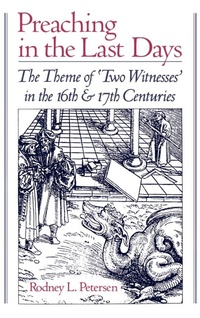
Preaching in the Last Days
The Theme of `Two Witnesses' in the Sixteenth and Seventeenth Centuries
Published on 19. August 1993
Book
Hardback
336 pages
978-0-19-507374-4 (ISBN)
Description
Among the enigmatic prophecies of the Book of Revelation is a passage (11.3-13) concerning `two witnesses' who will appear in the dark days of the church to preach or prophesy with powers like those of the prophets of ancient Israel. In this book Rodney Petersen presents an exhaustive examination of the treatment of this passage by interpreters from medieval times to the Protestant Reformation.
Petersen demonstrates that speculation on the identity and theological meaning of the two witnesss has abounded since the days of the early church. They have been linked to a time of culminating evil, the final proclamation of hope, and the end of history associated with divine judgement. Such speculation found ample expression in medieval literature, art and drama. In the writings of the reformers, however, the witnesses acquired increased social implications. The sixteenth and seventeenth centuries saw a proliferation of commentaries on the Apocalypse, in which reformist exegetes appropriated the image of the witnesses to their own movement, often identifying them with specific contemporary figures or using them to predict a future in tune with their hopes for the Protestant movement. Finally, Petersen shows, the theme of the two witnesses inspired and sustained those who carried the Puritan message into the New World, and features in the writings of such leading New England divines as Cotton Mather and Jonathan Edwards.
Petersen demonstrates that speculation on the identity and theological meaning of the two witnesss has abounded since the days of the early church. They have been linked to a time of culminating evil, the final proclamation of hope, and the end of history associated with divine judgement. Such speculation found ample expression in medieval literature, art and drama. In the writings of the reformers, however, the witnesses acquired increased social implications. The sixteenth and seventeenth centuries saw a proliferation of commentaries on the Apocalypse, in which reformist exegetes appropriated the image of the witnesses to their own movement, often identifying them with specific contemporary figures or using them to predict a future in tune with their hopes for the Protestant movement. Finally, Petersen shows, the theme of the two witnesses inspired and sustained those who carried the Puritan message into the New World, and features in the writings of such leading New England divines as Cotton Mather and Jonathan Edwards.
Reviews / Votes
`a valuable addition to our understanding of a theme that currently evokes a lot of attention.'Richard Pierard, Indiana State University The book has been thoroughly researched, contains a wealth of interesting detail and valuable observations... * Journal of Theological Studies Vol 46 no 1 * contains some fascinating information * Alastair Hamilton, University of Amsterdam, Heythrop Journal, July 1997, Vol. 38, No. 3 *More details
Language
English
Place of publication
New York
United States
Target group
Professional and scholarly
Illustrations
halftone
Dimensions
Height: 235 mm
Width: 157 mm
Thickness: 24 mm
Weight
697 gr
ISBN-13
978-0-19-507374-4 (9780195073744)
Copyright in bibliographic data and cover images is held by Nielsen Book Services Limited or by the publishers or by their respective licensors: all rights reserved.
Schweitzer Classification
Other editions
Additional editions
Rodney L. Petersen
Preaching in the Last Days
The Theme of "Two Witnesses" in the 16th and 17th Centuries
E-Book
06/1993
1st Edition
OUP eBook
€84.49
Available for download