

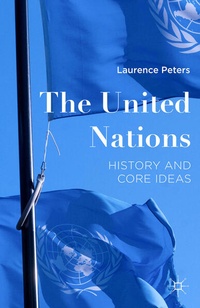
The United Nations
History and Core Ideas
Published on 29. September 2015
Book
Hardback
XIV, 185 pages
978-1-137-55736-0 (ISBN)
Description
Before the UN could be created the idea of a global body dedicated to the preservation of peace had first to be imagined. The book traces the evolution of a complex web of ideas that emerged from the ancient world concerning the need for a governing body to control the actions of sovereign nations.
More details
Edition
1st ed. 2015
Language
English
Place of publication
New York
United States
Target group
Professional and scholarly
Product notice
sewn/stitched
Cloth over boards
With dust jacket
Illustrations
XIV, 185 p.
Dimensions
Height: 216 mm
Width: 140 mm
Thickness: 13 mm
Weight
381 gr
ISBN-13
978-1-137-55736-0 (9781137557360)
DOI
10.1007/978-1-137-52866-7
Schweitzer Classification
Other editions
Additional editions
E-Book
04/2016
Palgrave MacMillan
€96.29
Available for download

Book
01/2014
Palgrave MacMillan
€85.59
The article will not be published
Person
Laurence Peters currently directs the United Nations Association's only graduate seminar on the United Nations in Washington DC where he also teaches Politics of Education at Johns Hopkins University School of Education. After studying for a doctorate at the University of Michigan, Peters gained a law degree and became a counsel to a congressional education subcommittee. As a Senior Policy Advisor to the US Department of Education he took a special interest in education technology and has authored several books on global education including, From Digital Divide to Digital Opportunity (with Kuttan) (2003), Scaling Up Success (with Dede and Honan) (2005), and Global Education: Using Technology to Bring the World to Your Students (2009). He currently serves as an advisor to Partners for Transparency and is married with three children.
Content
Contents Foreword Introduction Preface About the Author 1. Collective Security: The Classical Legacy 2. A Global Forum Dedicated to the Prevention of Conflict: The Visionary Architects 3. The Balance of Power: Kant's Decisive Contribution 4. The Rise of International Law: The Decisive Contribution of Hugo Grotius 5. Sovereignty: How the Peace of Westphalia Defined the UN's View of Nationhood 6. The UN and the Rise of the Humanitarian Tradition 7. The Peaceful Settlement of Disputes 8. The Development of the Universal Declaration of Human Rights Conclusion Endnotes Further Reading Important UN websites Index