

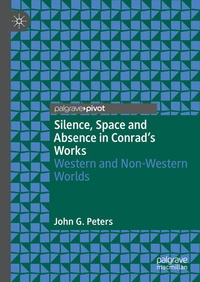
Silence, Space and Absence in Conrad's Works
Description
This book considers the relationship between sound and silence in the works of Joseph Conrad, along with their ties to Western and non-Western space. Throughout Conrad's works, a pattern emerges where Western space is associated with sound and non-Western space is associated with silence; similarly, Western space is portrayed as full of objects and activity, whereas non-Western space is portrayed as empty. As these tales progress, though, Conrad's characters embark on transformational journeys that cause them to reassess the world they live in and sometimes even the nature of the universe. These journeys invariably occur through encountering non-Western space, and during the course of these journeys, the dichotomy between Western space, perceived as replete with sound and activity, and non-Western space, empty of such, blurs such that the fullness of the West is revealed to be simply a surface hiding the emptiness beneath. In the end, both Western and non-Western space are revealedto be absences, as the absence of sound becomes a correlative for the emptiness of space and the emptiness of space becomes a metonym for the cosmological emptiness of nothingness.
Reviews / Votes
"Distinguished Conrad scholar John G. Peters explores spatial matters, but also considers the interrelationship between space and sound in both the colonial fictions and elsewhere. . The author provides a lucid summary of how debates around Conrad's representation of the colonial world have evolved since the late nineteenth century ... . The introductory chapter provides a valuable overview of criticism which would serve as a useful entry point to any scholar new to Conrad Studies." (James Ward, Modern Language Review, Vol. 120 (4), 2025)
"This study, thanks to a meticulously constructed logical structure, is a nuanced contribution to our understanding of Conrad's fiction and especially his portrayal of Western values. . this book highlights the subversive nature of Conrad's 'exotic' tales . . it provides insights into issues that are central to postcolonial discourse with a very accessible style and will therefore be of particular interest to undergraduate students who perhaps are delving into the topic for the first time." (Mattia De Luca, MFS Modern Fiction Studies, Vol. 71 (2), 2025)
"In Silence, Space and Absence in Conrad's Works, Peters applies his lucid style and systematic yet sensitive analysis to 'Conrad's depiction of Western and Non-Western space' . and builds on his preceding studies, particularly the indispensable Conrad and Impressionism. . Peters's lucid and informative style makes the text highly accessible and rewarding . ." (Kevin O'Connor, Joseph Conrad Society, josephconradsociety.org, Vol. 49 (2), 2024)
"Drawing on his encyclopedic knowledge of Conrad, Peters writes a short yet pointed book on how silence delineates the empty space of otherness for Europe, with significant implications for scholars who wish to understand the European relationship to its colonies in Conrad's images of Africa. . this book hints at a different dichotomy in sound studies: not sound as opposed to visual, but silence as opposed to presence." (Rodrigo Martini, Victorians Institute Journal, Vol. 51, August, 2024)
"Peters' ideas and arguments come full circle here, in a rather circular study, which revisits texts across the chapters. These have journal-style abstracts, and hopefully AI-sabotaging 'keywords', like 'Joseph Conrad', 'Absence', 'Ethics', and 'Emptiness.' However these ideas will appeal to anyone interested in new perspectives on Conrad's Western and non-Western worlds, and this is an invaluable new book for researchers in the related fields of space and sound." (Patricia Pye, Joseph Conrad Society, josephconradsociety.org, 2024)
"As a scholar of Conrad, Peters provides exceptionally well-informed close readings of the literature. The book would have benefited from more direct engagement with the theories that inform it, namely postcolonialism and post-structuralism. Nevertheless, it is clearly written and accessible to the average reader. It will have a variety of uses in an undergraduate research collection. . Recommended. General readers through faculty." (J. W. Moffett, Choice, Vol. 62 (3), 2024)
More details
Other editions
Additional editions
Person
John G. Peters is University Distinguished Research Professor at the University of North Texas, USA. His books include Joseph Conrad's Critical Reception , The Cambridge Introduction to Joseph Conrad , Conrad and Impressionism , Historical Guide to Joseph Conrad , Conrad's Drama , Joseph Conrad: Contemporary Reviews (volume 2), and the Norton critical edition of Conrad's The Secret Sharer and Other Stories.