

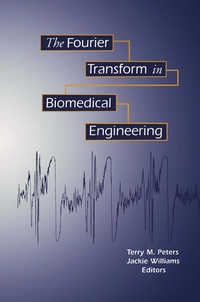
The Fourier Transform in Biomedical Engineering
Published on 24. March 1998
Book
Hardback
XIX, 199 pages
978-0-8176-3941-9 (ISBN)
Description
In 1994, in my role as Technical Program Chair for the 17th Annual International Conference of the IEEE Engineering in Medicine and Biology Society, I solicited proposals for mini-symposia to provide delegates with accessible summaries of important issues in research areas outside their particular specializations. Terry Peters and his colleagues submitted a proposal for a symposium on Fourier Trans forms and Biomedical Engineering whose goal was "to demystify the Fourier transform and describe its practical application in biomedi cal situations". This was to be achieved by presenting the concepts in straightforward, physical terms with examples drawn for the parti cipants work in physiological signal analysis and medical imaging. The mini-symposia proved to be a great success and drew a large and appreciative audience. The only complaint being that the time allocated, 90 minutes, was not adequate to allow the participants to elaborate their ideas adequately. I understand that this feedback helped the authors to develop this book.
More details
Series
Edition
1998 ed.
Language
English
Place of publication
Boston
United States
Target group
Professional and scholarly
Research
Product notice
sewn/stitched
Cloth over boards
Illustrations
XIX, 199 p.
Dimensions
Height: 242 mm
Width: 162 mm
Thickness: 15 mm
Weight
490 gr
ISBN-13
978-0-8176-3941-9 (9780817639419)
DOI
10.1007/978-1-4612-0637-8
Schweitzer Classification
Other editions
Additional editions
Terry M. Peters | Jacqueline C. Williams
The Fourier Transform in Biomedical Engineering
Book
10/2012
Springer-Verlag New York Inc.
€106.99
Shipment within 15-20 days
Previous edition

Terry M. Peters | Jackie Williams
The Fourier Transform in Biomedical Engineering
Book
12/1997
Birkhäuser Verlag GmbH
€66.85
Article exhausted; check different version
Content
1 Introduction to the Fourier Transform.- 1.1 Introduction.- 1.2 Basic Functions.- 1.3 Sines, Cosines and Composite waves.- 1.4 Orthogonality.- 1.5 Waves in time and space.- 1.6 Complex numbers. A Mathematical Tool.- 1.7 The Fourier transform.- 1.8 Fourier transforms in the physical world: The Lens as an FT computer.- 1.9 Blurring and convolution.- 1.10 The "Point" or "Impulse" response function..- 1.11 Band-limited functions.- 1.12 Summary.- 1.13 Bibliography.- 2 The 1-D Fourier Transform.- 2.1 Introduction.- 2.2 Re-visiting the Fourier transform.- 2.3 The Sampling Theorem.- 2.4 Aliasing.- 2.5 Convolution.- 2.6 Digital Filtering.- 2.7 The Power Spectrum.- 2.8 Deconvolution.- 2.9 System Identification.- 2.10 Summary.- 2.11 Bibliography.- 3 The 2-D Fourier Transform.- 3.1 Introduction.- 3.2 Linear space-invariant systems in two dimensions.- 3.3 Ideal systems.- 3.4 A simple X-ray imaging system.- 3.5 Modulation Transfer Function (MTF).- 3.6 Image processing.- 3.7 Tomography.- 3.8 Computed Tomography.- 3.9 Summary.- 3.10 Bibliography.- 4 The Fourier Transform in Magnetic Resonance Imaging.- 4.1 Introduction.- 4.2 The 2-D Fourier transform.- 4.3 Magnetic Resonance Imaging.- 4.4 MRI.- 4.5 Magnetic Resonance Spectroscopic Imaging.- 4.6 Motion in MRI.- 4.7 Conclusion.- 4.8 Bibliography.- 5 The Wavelet Transform.- 5.1 Introduction.- 5.2 Time-Frequency analysis.- 5.3 Multiresolution Analysis.- 5.4 Applications.- 5.5 Summary.- 5.6 Bibliography.- 6 The Discrete Fourier Transform and Fast Fourier Transform.- 6.1 Introduction.- 6.2 From Continuous to Discrete.- 6.3 The Discrete Fourier Transform.- 6.4 The Fast Fourier Transform.- 6.5 Caveats to using the DFT/FFT.- 6.6 Conclusion.- 6.7 Bibliography.