

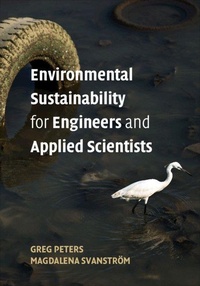
Environmental Sustainability for Engineers and Applied Scientists
Published on 14. March 2019
Book
Hardback
258 pages
978-1-107-16682-0 (ISBN)
Description
This textbook presents key theoretical approaches to understanding issues of sustainability and environmental management, perfectly bridging the gap between engineering and environmental science. It begins with the fundamentals of environmental modelling and toxicology, which are then used to discuss qualitative and quantitative risk assessment methods, and environmental assessments of product design. It discusses how business and government can work towards sustainability, focusing on managerial and legal tools, before considering ethics and how decisions on environmental management can be made. Students will learn quantitative methods while also gaining an understanding of qualitative, legal, and ethical aspects of sustainability. Practical applications are included throughout, and there are study questions at the end of each chapter. PowerPoint slides and jpegs of all the figures in the book are provided online. This is the perfect textbook on environmental studies for engineering and applied science students.
Reviews / Votes
'This book ... focuses on the pressing issue of encouraging engineers and applied scientists to consider sustainability in their designs. Hopefully, this text will get into the hands of all engineers and applied scientists who recognize that sustainability is everyone's responsibility, not just for those with 'environmental' in their titles.' B. Bero, ChoiceMore details
Language
English
Place of publication
Cambridge
United Kingdom
Target group
Professional and scholarly
College/higher education
Illustrations
2 Maps; 47 Halftones, black and white; 47 Line drawings, black and white
Dimensions
Height: 260 mm
Width: 183 mm
Thickness: 19 mm
Weight
690 gr
ISBN-13
978-1-107-16682-0 (9781107166820)
Copyright in bibliographic data and cover images is held by Nielsen Book Services Limited or by the publishers or by their respective licensors: all rights reserved.
Schweitzer Classification
Other editions
Additional editions
E-Book
03/2019
Cambridge University Press
€36.99
Available for download
Greg Peters | Magdalena Svanstroem
Environmental Sustainability for Engineers and Applied Scientists
Book
03/2019
Cambridge University Press
€57.50
Shipment within 15-20 days
Greg Peters | Magdalena Svanstroem
Environmental Sustainability for Engineers and Applied Scientists
E-Book
03/2019
Cambridge University Press
€44.49
Available for download
Persons
Greg Peters is a professor in the Division of Environmental Systems Analysis at Chalmers University of Technology, Gothenberg, Sweden. Before joining academia, he worked in the urban water sector as a practising environmental engineer. He is the author of many highly cited publications on the quantitative assessment of environmental impacts of water infrastructure, food production, resource consumption and biowaste management. He has served as President of the Australian Life Cycle Assessment Society and as a lead author for the Intergovernmental Panel on Climate Change (IPCC). Magdalena Svanstroem is a professor in the Division of Environmental Systems Analysis at Chalmers University of Technology, Gothenberg, Sweden. She performs research in environmental and sustainability assessment, in particular in the fields of wastewater and sludge management and biobased production, and also in engineering education for sustainable development. She was a post-doctoral researcher at Massachusetts Institute of Technology and recently taught life cycle assessment as a visiting professor at Brescia University, Italy. She has published a textbook on sustainable development in Swedish and has been a member of a United Nations Economic Commission for Europe (UNECE) expert group on education in sustainable development.
Content
Preface; Reader's guide: how is this all connected? 1. The engineer's role in environmental protection; 2. The Earth system: natural operation and human impacts; 3. Impacts of chemical pollution; 4. Modelling environmental transport and fate of pollutants; 5. Introduction to toxicology; 6. Qualitative and quantitative risk assessment; 7. Environmental assessment of products and processes; 8. Regulatory structures; 9. Decision-making; References; Index.