

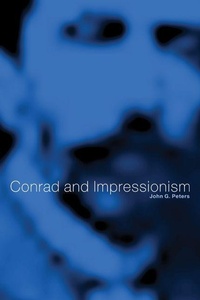
Conrad and Impressionism
Published on 18. January 2007
Book
Paperback/Softback
224 pages
978-0-521-03300-8 (ISBN)
Description
In this 2001 book, John Peters investigates the impact of Impressionism on Conrad and links this to his literary techniques as well as his philosophical and political views. Impressionism, Peters argues, enabled Conrad to encompass both surface and depth not only in visually perceived phenomena but also in his narratives and objects of consciousness, be they physical objects, human subjects, events or ideas. Though traditionally thought of as a sceptical writer, Peters claims that through Impressionism Conrad developed a coherent and mostly traditional view of ethical and political principles, a claim he supports through reference to a broad range of Conrad's texts. Conrad and Impressionism investigates the sources and implications of Conrad's impressionism in order to argue for a consistent link between his literary technique, philosophical presuppositions and socio-political views. The same core ideas concerning the nature of human experience run throughout his works.
Reviews / Votes
'Conrad and Impressionism is packed with intelligent ad hoc insights into Conrad's writing through a close examination of the techniques that characterize his narratives.' Modern Language Review 'This critical study deserves special attention.' Choice Choice 'An erudite enquiry into vital aspects of Conrad's art, an ambitiously synthesized survey of aesthetics, philosophy, and politics based on a profound knowledge of Conrad's work and the bosy of critical work it supports.' Joseph Conrad Today '... [Peters'] instructive and illuminating book, Conrad and Impressionism ... is an award-winning book and deservedly so ... Peters posits an 'impressionist' Conrad whose sensitive and self-critical philosophy informs the world he 'makes you see'; Jameson posits an 'impressionist Conrad whose visual pyrotechnics exist as a blinding compensation for the world he does not want to see. It is the greatest compliment one may pay to Peters to say that the future of Conrad studies may lie in the balance.' Modernism/Modernity 'Conrad and Impressionism is a first-rate study ...' Journal of Modern Literature 'Peters is ... admirably clear and systematic, and he writes interestingly about a large number of Conrad's novels and stories.' South Atlantic Review 'Conrad and Impressionism, a systematic and thorough study of the relationship between seeing and knowing in Conrad's work, perpetuates this tradition of excellence. ... Conrad and Impressionism is remarkable for its carefully composed logical structure and the precision of its arguments ... John G. Peters has made a valuable contribution to Conrad studies, one upon which future scholars can build with assurance.' The ConradianMore details
Language
English
Place of publication
Cambridge
United Kingdom
Target group
Professional and scholarly
Product notice
Paperback (trade)
Illustrations
Worked examples or Exercises
Dimensions
Height: 229 mm
Width: 152 mm
Thickness: 13 mm
Weight
371 gr
ISBN-13
978-0-521-03300-8 (9780521033008)
Copyright in bibliographic data and cover images is held by Nielsen Book Services Limited or by the publishers or by their respective licensors: all rights reserved.
Schweitzer Classification
Other editions
Additional editions
John G. Peters
Conrad and Impressionism
E-Book
01/2005
1st Edition
Cambridge University Press
€36.99
Available for download
Person
John G. Peters is Assistant Professor of English as University of Wisconsin-Superior. He won the Joseph Conrad Society of America's Young Scholar's Award for 1999. This is his first book.
Content
Preface; Acknowledgments; List of abbreviations; Introduction: objects of consciousness in Conrad's impressionist world; 1. Subject/object: science and the epistemological origins of literary impressionism; 2. Objects and events in the 'primitive eye': the epistemology of objectivity; 3. Other-like-self and other-unlike-self: the epistemology of subjectivity; 4. 'Sudden holes' in time: the epistemology of temporality; 5. Radical relativism, epistemological certainty and ethical absolutes: Conrad's impressionist response to solopsism and anarchy; Epilogue; Notes; Selected bibliography; Index.