

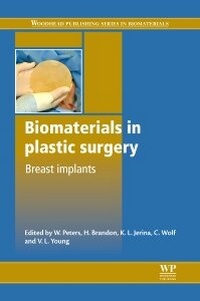
Biomaterials in Plastic Surgery
Breast Implants
Published on 2. July 2012
Book
Hardback
240 pages
978-1-84569-799-0 (ISBN)
Description
Employed for both cosmetic and reconstructive purposes, breast implants are one of the most widely-used and controversial prostheses available. The development of safe, reliable products is vital to the future of this important field of surgery. Biomaterials in plastic surgery reviews the history, materials and safety issues associated with breast implants.Beginning with an introduction to the history of biomaterials used for breast augmentation, Biomaterials in plastic surgery goes on to discuss development issues. It then discusses the chemistry and physical properties of biomedical silicones before reviewing cohesive gel and polyurethane foam implants. The book concludes by analysing the epidemiological evidence on the safety issues relating to breast implants, followed by a review of retrieval and analysis of breast implants emphasizing strength, durability and failure mechanisms.With its distinguished editors and international team of expert contributors, Biomaterials in plastic surgery is an important guide for surgeons, manufacturers and all those researching this important field.
Reviews / Votes
"This book should be essential reading for biomedical specialists in the field of breast reconstruction, particularly epidemiologists, research and development, regulation, enforcement and litigation, as well as policy-makers in government. It would also provide considerable assistance to reviewers of safety and performance of such products, since it balances important subjects successfully...The book is highly recommended." --Journal of Medical Device Regulation, February 2014"For the academic surgeon who desires a grouping of articles specifically related to breast implants in one place, this book fills the bill." --Doody's book reviews
More details
Series
Language
English
Place of publication
Cambridge
United Kingdom
Publishing group
Elsevier Science & Technology
Target group
College/higher education
Dimensions
Height: 234 mm
Width: 156 mm
Weight
530 gr
ISBN-13
978-1-84569-799-0 (9781845697990)
Copyright in bibliographic data and cover images is held by Nielsen Book Services Limited or by the publishers or by their respective licensors: all rights reserved.
Schweitzer Classification
Other editions
Additional editions
Biomaterials in Plastic Surgery
Breast Implants
E-Book
08/2012
Woodhead Publishing Ltd
€165.00
Available for download
Persons
Walter Peters is Professor of Plastic Surgery at the University of Toronto, Canada. Harold Brandon is a Professor of Practice in the Department of Mechanical Engineering and Materials Science at Washington University in St Louis, USA. Kenneth Jerina is the Earl E. And Myrtle E. Walker Professor of Engineering in the Department of Mechanical Engineering and Materials Science at Washington University in St Louis. Clarence Wolf is a former Professor (now retired) in the Department of Chemical Engineering at Washington University at St Louis. V. L. Young is former Chief of Surgical Services at Barnes-Jewish West County Hospital, Missouri, USA, and is a founding partner of the BodyAesthetic Plastic Surgery and Skincare Center.
Content
Contributor contact details
Woodhead Publishing Series in Biomaterials
Introduction
Chapter 1: The history of biomaterials used for breast augmentation
Abstract:
1.1 Introduction
1.2 Injectable materials
1.3 Sponges
1.4 Breast implants
1.5 Other forms of texturing
1.6 Inflatable implants
1.7 Trilucent (LipoMatrix) implants - 1995 to 2000
1.8 Acknowledgements
Chapter 2: The development of breast implants
Abstract:
2.1 Introduction
2.2 Breast implant evolution
2.3 Alternative types of implant and safety aspects
2.4 Future trends
Chapter 3: The chemistry and physical properties of biomedical silicones
Abstract:
3.1 Introduction
3.2 Properties of silicones
3.3 The main forms of silicones/siloxanes
3.3.3 Silicone gels
3.3.4 Formulation of silicones
3.4 Silicones in breast implants
Chapter 4: Cohesive gel breast implants
Abstract:
4.1 Introduction
4.2 Available form stable breast implants
4.3 Selection of the appropriate form stable breast implant
4.4 Preoperative planning
4.5 Incisions and surgical technique
4.6 Problems and complications
Chapter 5: Polyurethane foam covered breast implants
Abstract:
5.1 Introduction
5.2 Capsular contracture and the role of polyurethane foam in its prevention
5.3 Comparison of polyurethane foam covered implants with smooth and textured surfaced implants
5.4 Safety when using polyurethane foam breast implants
5.5 Use in secondary procedures
5.6 Disadvantages of polyurethane foam breast implants
5.7 Conclusions
Chapter 6: The safety of breast implants: epidemiologic studies
Abstract:
6.1 Introduction
6.2 Connective tissue disease
6.3 Offspring effects
6.4 Neurological disease
6.5 Implant rupture
6.6 Local complications
6.7 Incidence of cancer
6.8 Occurrence of suicide
6.9 Conclusion
Chapter 7: Retrieval and analysis of breast implants emphasizing strength, durability, and failure mechanisms
Abstract:
7.1 Introduction
7.2 Silicone gel explants with longest implantation times
7.3 Shell properties of silicone gel implants as a function of implantation time
7.4 Lot-matched control study
7.5 Effect of implantation time on shell properties of saline implants
7.6 Breast implant rupture
7.7 Rupture rates and reoperation rates
Index
Woodhead Publishing Series in Biomaterials
Introduction
Chapter 1: The history of biomaterials used for breast augmentation
Abstract:
1.1 Introduction
1.2 Injectable materials
1.3 Sponges
1.4 Breast implants
1.5 Other forms of texturing
1.6 Inflatable implants
1.7 Trilucent (LipoMatrix) implants - 1995 to 2000
1.8 Acknowledgements
Chapter 2: The development of breast implants
Abstract:
2.1 Introduction
2.2 Breast implant evolution
2.3 Alternative types of implant and safety aspects
2.4 Future trends
Chapter 3: The chemistry and physical properties of biomedical silicones
Abstract:
3.1 Introduction
3.2 Properties of silicones
3.3 The main forms of silicones/siloxanes
3.3.3 Silicone gels
3.3.4 Formulation of silicones
3.4 Silicones in breast implants
Chapter 4: Cohesive gel breast implants
Abstract:
4.1 Introduction
4.2 Available form stable breast implants
4.3 Selection of the appropriate form stable breast implant
4.4 Preoperative planning
4.5 Incisions and surgical technique
4.6 Problems and complications
Chapter 5: Polyurethane foam covered breast implants
Abstract:
5.1 Introduction
5.2 Capsular contracture and the role of polyurethane foam in its prevention
5.3 Comparison of polyurethane foam covered implants with smooth and textured surfaced implants
5.4 Safety when using polyurethane foam breast implants
5.5 Use in secondary procedures
5.6 Disadvantages of polyurethane foam breast implants
5.7 Conclusions
Chapter 6: The safety of breast implants: epidemiologic studies
Abstract:
6.1 Introduction
6.2 Connective tissue disease
6.3 Offspring effects
6.4 Neurological disease
6.5 Implant rupture
6.6 Local complications
6.7 Incidence of cancer
6.8 Occurrence of suicide
6.9 Conclusion
Chapter 7: Retrieval and analysis of breast implants emphasizing strength, durability, and failure mechanisms
Abstract:
7.1 Introduction
7.2 Silicone gel explants with longest implantation times
7.3 Shell properties of silicone gel implants as a function of implantation time
7.4 Lot-matched control study
7.5 Effect of implantation time on shell properties of saline implants
7.6 Breast implant rupture
7.7 Rupture rates and reoperation rates
Index