

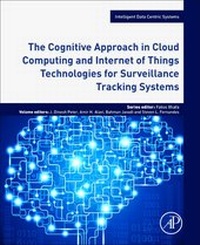
The Cognitive Approach in Cloud Computing and Internet of Things Technologies for Surveillance Tracking Systems
Published on 17. March 2020
Book
Paperback/Softback
202 pages
978-0-12-816385-6 (ISBN)
Description
The Cognitive Approach in Cloud Computing and Internet of Things Technologies for Surveillance Tracking Systems discusses the recent, rapid development of Internet of things (IoT) and its focus on research in smart cities, especially on surveillance tracking systems in which computing devices are widely distributed and huge amounts of dynamic real-time data are collected and processed. Efficient surveillance tracking systems in the Big Data era require the capability of quickly abstracting useful information from the increasing amounts of data. Real-time information fusion is imperative and part of the challenge to mission critical surveillance tasks for various applications.
This book presents all of these concepts, with a goal of creating automated IT systems that are capable of resolving problems without demanding human aid.
This book presents all of these concepts, with a goal of creating automated IT systems that are capable of resolving problems without demanding human aid.
More details
Series
Language
English
Place of publication
San Diego
United States
Publishing group
Elsevier Science Publishing Co Inc
Target group
Professional and scholarly
Systems designers, biomedical engineers, biomedical researchers and policy makers in health care and medicine.
Dimensions
Height: 235 mm
Width: 191 mm
Weight
590 gr
ISBN-13
978-0-12-816385-6 (9780128163856)
Copyright in bibliographic data and cover images is held by Nielsen Book Services Limited or by the publishers or by their respective licensors: all rights reserved.
Schweitzer Classification
Other editions
Additional editions
Dinesh Peter | Amir Hossein Alavi | Bahman Javadi
The Cognitive Approach in Cloud Computing and Internet of Things Technologies for Surveillance Tracking Systems
E-Book
03/2020
Academic Press
€105.00
Available for download
Persons
J. Dinesh Peter is Program Coordinator for the Department of Computer Sciences Technology at Karunya University, and author of more than 25 academic articles/chapters/conference papers. He has been active in government and industry as the developer of new technologies including Digital Image Processing, Virtual Reality Technology, Medical Image Processing, Computer Vision, and Optimization. He has been Guest Editor of a special issue of the Elsevier journal Computers and Electrical Engineering, and Guest Editor of special issues of the Journal of Cloud Computing and Journal of Big Data Intelligence. Dr. Peter received his Ph.D. in Computer Science and Engineering from National Institute of Technology Calicut, India. Amir Hossein Alavi is an Assistant Professor in the Department of Civil and Environmental Engineering, and holds courtesy appointments in the Department of Bioengineering and Department of Mechanical Engineering and Materials Science, at the University of Pittsburgh, United States. His multidisciplinary scientific studies are organized around three research thrusts: 1) mechanics and electronics of multifunctional materials and structures, 2) embedded self-powered sensing systems, and 3) data-driven characterization, design and discovery of engineering systems.
Bahman Javadi is a Senior Lecturer in Networking and Cloud Computing at the Western Sydney University, Australia. Prior to this appointment, he was a Research Fellow at the University of Melbourne, Australia. From 2008 to 2010, he was a Postdoctoral Fellow at the INRIA Rhone-Alpes, France. He received his MS and PhD degrees in Computer Engineering from the Amirkabir University of Technology in 2001 and 2007, respectively. He has been a Research Scholar at the School of Engineering and Information Technology, Deakin University, Australia during his PhD course. He is co-founder of the Failure Trace Archive, which serves as a public repository of failure traces and algorithms for distributed systems. He has published more than 90 research papers and received numerous Best Paper Awards at IEEE/ACM conferences for his papers. He served as a program committee of many international conferences and workshops. His research interests include Cloud computing, performance evaluation of large scale distributed computing systems, and reliability and fault tolerance. He is a member of ACM and senior member of IEEE. Steven L. Ferandes is a post-doctoral researcher in the Department of Electrical and Computer Engineering, University of Alabama at Birmingham, and author of more than 35 academic articles/chapters/conference papers. He has been active in industry as the developer of new technologies including Socket Development for Validation of Standard Cll Automation Tool Used in Test Chip Design, Automation Framework for Web Services, Automation Framework for Mobile Applications (Android, iOS, Windows), Python programming for Computer Vision, Machine Learning, and Deep Learning. Dr. Fernandes received his Ph.D. in Computer Vision and Machine Learning from Karunya University, Coimbatore, India.
Bahman Javadi is a Senior Lecturer in Networking and Cloud Computing at the Western Sydney University, Australia. Prior to this appointment, he was a Research Fellow at the University of Melbourne, Australia. From 2008 to 2010, he was a Postdoctoral Fellow at the INRIA Rhone-Alpes, France. He received his MS and PhD degrees in Computer Engineering from the Amirkabir University of Technology in 2001 and 2007, respectively. He has been a Research Scholar at the School of Engineering and Information Technology, Deakin University, Australia during his PhD course. He is co-founder of the Failure Trace Archive, which serves as a public repository of failure traces and algorithms for distributed systems. He has published more than 90 research papers and received numerous Best Paper Awards at IEEE/ACM conferences for his papers. He served as a program committee of many international conferences and workshops. His research interests include Cloud computing, performance evaluation of large scale distributed computing systems, and reliability and fault tolerance. He is a member of ACM and senior member of IEEE. Steven L. Ferandes is a post-doctoral researcher in the Department of Electrical and Computer Engineering, University of Alabama at Birmingham, and author of more than 35 academic articles/chapters/conference papers. He has been active in industry as the developer of new technologies including Socket Development for Validation of Standard Cll Automation Tool Used in Test Chip Design, Automation Framework for Web Services, Automation Framework for Mobile Applications (Android, iOS, Windows), Python programming for Computer Vision, Machine Learning, and Deep Learning. Dr. Fernandes received his Ph.D. in Computer Vision and Machine Learning from Karunya University, Coimbatore, India.
Editor
Associate Professor, Department of Computer Sciences Technology, Karunya University, India
Department of Civil and Environmental Engineering, Department of Bioengineering, University of Pittsburgh, Pittsburgh, USA
School of Computing, Engineering and Mathematics, Western Sydney University, Australia
Department of Electrical and Computer Engineering, University of Alabama at Birmingham, USA
Content
SECTION I: Cognitive Computing Theory, Architectures and Approaches
SECTION II: Cognitive Computing and Artificial Intelligence
SECTION III: Complex Analytics and Machine Learning for Cognitive Computing
SECTION IV: Design of a Symbiotic Agent for Recognizing Real Space in Ubiquitous Environments
SECTION V: Intelligent Adaptation and the Nature of Software Changes
SECTION VI: The Reactive-Causal Cognitive Agent Architecture
SECTION VII: Cognitive Computing for Internet of Things
SECTION VIII: Google's DeepMind and Other AI Programs
SECTION IX: Cognitive Computing Applications in Surveillance Tracking Systems
SECTION X: Cognitive Computing in Big Data Applications
SECTION II: Cognitive Computing and Artificial Intelligence
SECTION III: Complex Analytics and Machine Learning for Cognitive Computing
SECTION IV: Design of a Symbiotic Agent for Recognizing Real Space in Ubiquitous Environments
SECTION V: Intelligent Adaptation and the Nature of Software Changes
SECTION VI: The Reactive-Causal Cognitive Agent Architecture
SECTION VII: Cognitive Computing for Internet of Things
SECTION VIII: Google's DeepMind and Other AI Programs
SECTION IX: Cognitive Computing Applications in Surveillance Tracking Systems
SECTION X: Cognitive Computing in Big Data Applications