

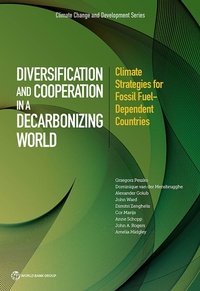
Crossroads
Climate Strategies for Fossil Fuel-Dependent Countries
Published on 28. July 2020
Book
Paperback/Softback
150 pages
978-1-4648-1340-5 (ISBN)
Description
This book is the first stocktaking of what the decarbonization of the world economy means for fossil fuel-dependent countries. These countries are the most exposed to the impacts of global climate policies and, at the same time, are often unprepared to manage them. They depend on the export of oil, gas, or coal; the use of carbon-intensive infrastructure (for example, refineries, petrochemicals, and coal power plants); or both. Fossil fuel-dependent countries face financial, fiscal, and macro-structural risks from the transition of the global economy away from carbon-intensive fuels and the value chains based on them. This book focuses on managing these transition risks and harnessing related opportunities. Diversification and Cooperation in a Decarbonizing World identifies multiple strategies that fossil fuel-dependent countries can pursue to navigate the turbulent waters of a low-carbon transition. The policy and investment choices to be made in the next decade will determine these countries' degree of exposure and overall resilience. Abandoning their comfort zones and developing completely new skills and capabilities in a time frame consistent with the Paris Agreement on climate change is a daunting challenge and requires long-term revenue visibility and consistent policy leadership. This book proposes a constructive framework for climate strategies for fossil fuel-dependent countries based on new approaches to diversification and international climate cooperation. Climate policy leaders share responsibility for creating room for all countries to contribute to the goals of the Paris Agreement, taking into account the specific vulnerabilities and opportunities each country faces.
More details
Series
Language
English
Place of publication
Washington
United States
Target group
Professional and scholarly
Product notice
Paperback (trade)
Unsewn / adhesive bound
Dimensions
Height: 254 mm
Width: 178 mm
Thickness: 8 mm
Weight
272 gr
ISBN-13
978-1-4648-1340-5 (9781464813405)
Copyright in bibliographic data and cover images is held by Nielsen Book Services Limited or by the publishers or by their respective licensors: all rights reserved.
Schweitzer Classification
Persons
The World Bank came into formal existence in 1945 following the international ratification of the Bretton Woods agreements. It is a vital source of financial and technical assistance to developing countries around the world. The organization's activities are focused on education, health, agriculture and rural development, environmental protection, establishing and enforcing regulations, infrastructure development, governance and legal institutions development. The World Bank is made up of two unique development institutions owned by its 185 Member Countries. The International Bank for Reconstruction and Development (IBRD) focuses on middle income and creditworthy poor countries and the International Development Association (IDA), which focuses on the poorest countries in the world.