

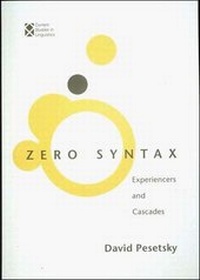
Zero Syntax
Experiencers and Cascades
Published on 31. October 1996
Book
Paperback/Softback
370 pages
978-0-262-66100-3 (ISBN)
Description
The analysis and theory developed in Zero Syntax is an important contribution to the understanding of Universal Grammar. The overriding theme is the notion that the availability and syntactic positioning of arguments is not a matter of chance but arises from laws governing the structure of lexical entries and from laws governing syntactic structures themselves. Along the way, Zero Syntax also examines issues of broad significance to current theoretical linguistic research in syntax and lexical semantics. Zero Syntax develops two main topics: a simple view of syntactic linking regularities that it defends in the domain of Experiencer predicates (predicates such as "annoy"), and a theory of syntactic constituency that involves two parallel modes of structural organization (one of which is the Cascade syntax). The theme that ties these issues together is the supposition that phonologically null ("zero") morphology is present in structure, detectable through its syntactic and morphological consequences. The arguments inZero Syntax will be relevant to debates about such issues as empty elements in syntax and morphology, whether syntactic structures should be binary branching, the structure of double-object constructions, and whether verbs have multiple meanings related by lexical rules or abstract/general meanings that are ambiguated in particular constructions. Current Studies in Linguistics No. 27
More details
Series
Language
English
Place of publication
Cambridge, Mass.
United States
Publishing group
MIT Press Ltd
Target group
College/higher education
Professional and scholarly
US School Grade: College Graduate Student and over
Product notice
Paperback (trade)
Dimensions
Height: 229 mm
Width: 152 mm
Thickness: 23 mm
Weight
522 gr
ISBN-13
978-0-262-66100-3 (9780262661003)
Copyright in bibliographic data and cover images is held by Nielsen Book Services Limited or by the publishers or by their respective licensors: all rights reserved.
Schweitzer Classification