

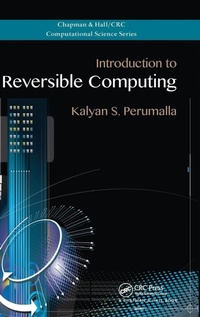
Introduction to Reversible Computing
1st Edition
Published on 10. September 2013
Book
Hardback
326 pages
978-1-4398-7340-3 (ISBN)
Description
Few books comprehensively cover the software and programming aspects of reversible computing. Filling this gap, Introduction to Reversible Computing offers an expanded view of the field that includes the traditional energy-motivated hardware viewpoint as well as the emerging application-motivated software approach.
Collecting scattered knowledge into one coherent account, the book provides a compendium of both classical and recently developed results on reversible computing. It explores up-and-coming theories, techniques, and tools for the application of reversible computing-the logical next step in the evolution of computing systems.
The book covers theory, hardware and software aspects, fundamental limits, complexity analyses, practical algorithms, compilers, efficiency improvement techniques, and application areas. The topics span several areas of computer science, including high-performance computing, parallel/distributed systems, computational theory, compilers, power-aware computing, and supercomputing.
The book presents sufficient material for newcomers to easily get started. It provides citations to original articles on seminal results so that readers can consult the corresponding publications in the literature. Pointers to additional resources are included for more advanced topics. For those already familiar with a certain topic within reversible computing, the book can serve as a one-stop reference to other topics in the field.
Collecting scattered knowledge into one coherent account, the book provides a compendium of both classical and recently developed results on reversible computing. It explores up-and-coming theories, techniques, and tools for the application of reversible computing-the logical next step in the evolution of computing systems.
The book covers theory, hardware and software aspects, fundamental limits, complexity analyses, practical algorithms, compilers, efficiency improvement techniques, and application areas. The topics span several areas of computer science, including high-performance computing, parallel/distributed systems, computational theory, compilers, power-aware computing, and supercomputing.
The book presents sufficient material for newcomers to easily get started. It provides citations to original articles on seminal results so that readers can consult the corresponding publications in the literature. Pointers to additional resources are included for more advanced topics. For those already familiar with a certain topic within reversible computing, the book can serve as a one-stop reference to other topics in the field.
More details
Series
Language
English
Place of publication
Oxford
United States
Publishing group
Taylor & Francis Inc
Target group
College/higher education
Researchers in high-performance computing, supercomputing, and computational science; compiler developers, language developers, hardware designers, and applied mathematicians.
Illustrations
50 s/w Abbildungen, 29 s/w Tabellen
29 Tables, black and white; 50 Illustrations, black and white
Dimensions
Height: 240 mm
Width: 161 mm
Thickness: 22 mm
Weight
655 gr
ISBN-13
978-1-4398-7340-3 (9781439873403)
Copyright in bibliographic data and cover images is held by Nielsen Book Services Limited or by the publishers or by their respective licensors: all rights reserved.
Schweitzer Classification
Other editions
Additional editions
Kalyan S. Perumalla
Introduction to Reversible Computing
E-Book
09/2013
1st Edition
Chapman and Hall
€225.99
Available for download
Kalyan S. Perumalla
Introduction to Reversible Computing
E-Book
09/2013
1st Edition
Chapman & Hall/CRC
€225.99
Available for download
Person
Kalyan Perumalla, PhD, is a senior R&D staff member and manager at Oak Ridge National Laboratory and an adjunct professor at the Georgia Institute of Technology. Dr. Perumalla is a winner of the prestigious U.S. Department of Energy Career Award in Advanced Scientific Computing Research (2010-2015). He has published over 100 articles in computing and serves on the editorial boards and program committees of leading journals and conferences in computing. He earned a PhD in computer science from the Georgia Institute of Technology. His areas of interest include reversible computing, high-performance computing, parallel discrete event simulation, and parallel combinatorial optimization.
Content
INTRODUCTION: Scope. Application Areas. The Reversible Computing Spectrum. THEORY: Systems and Principles. Reversibility-Related Paradoxes. Theoretical Computing Models. Relaxing Forward-Only Execution into Reversible Execution. SOFTWARE: Reversible Programming Languages. Adding Reversibility to Irreversible Programs. Reverse C Compiler. Reversal of Linear Codes. Reversible Random Number Generation. Reversible Memory Allocation and Deallocation. Reversible Numerical Computation. Reversing a Sorting Procedure. Implementing Undo-Redo-Do. HARDWARE: Reversible Logic Gates. Reversible Instruction Set Architectures. SUMMARY: Future Directions. REFERENCES: Bibliography. Index.