

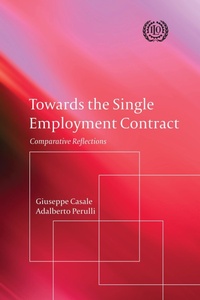
Towards the Single Employment Contract
Comparative Reflections
1st Edition
Published on 17. December 2013
Book
Paperback/Softback
108 pages
978-1-84946-581-6 (ISBN)
Description
This book examines the concept of the single employment contract, tracing it from its genesis and evaluating its pros and cons in the context of the current labour market problems in selected European countries.
The book adopts a comparative approach to examining the single employment contract, highlighting its virtues and revealing its inherent contradictions. The authors set out the general framework within which the current debate has developed by outlining the origins that gave rise to the proposal of a single employment contract. They then review the debate on labour market segmentation and the flexicurity proposal, and examine the key characteristics of the single employment contract as well as the arguments put forward both for and against it. Case studies show how the idea has been taken up in France, Italy and Spain. The book concludes with a concise review of contractual arrangements in EU labour markets and of possible future projections and developments.
The book is aimed at academics and practitioners interested in labour market and labour legislation reforms.
The book is a co-publication between Hart Publishing and the International Labour Organization.
The book adopts a comparative approach to examining the single employment contract, highlighting its virtues and revealing its inherent contradictions. The authors set out the general framework within which the current debate has developed by outlining the origins that gave rise to the proposal of a single employment contract. They then review the debate on labour market segmentation and the flexicurity proposal, and examine the key characteristics of the single employment contract as well as the arguments put forward both for and against it. Case studies show how the idea has been taken up in France, Italy and Spain. The book concludes with a concise review of contractual arrangements in EU labour markets and of possible future projections and developments.
The book is aimed at academics and practitioners interested in labour market and labour legislation reforms.
The book is a co-publication between Hart Publishing and the International Labour Organization.
Reviews / Votes
This compact publication offers a very good introduction to the debate concerning the single employment contract. It is recommended reading for comparative lawyers in the field of labour law and also those who are active in the field of social policy because it contains important stimuli for political discussion. (translated from the original German) -- Martin Risak * Zeitschrift fur Arbeit und Sozialrecht, Number 5, 2014 *More details
Language
English
Place of publication
Oxford
United Kingdom
Publishing group
Bloomsbury Publishing PLC
Target group
Professional and scholarly
College/higher education
Dimensions
Height: 234 mm
Width: 156 mm
Thickness: 6 mm
Weight
181 gr
ISBN-13
978-1-84946-581-6 (9781849465816)
Copyright in bibliographic data and cover images is held by Nielsen Book Services Limited or by the publishers or by their respective licensors: all rights reserved.
Schweitzer Classification
Other editions
Additional editions
E-Book
07/2014
1st Edition
Hart Publishing
€36.49
Available for download
E-Book
07/2014
1st Edition
Hart Publishing
€36.49
Available for download
Persons
Giuseppe Casale is currently heading the Labour Administration, Labour Inspection and Occupational Safety and Health Branch at the International Labour Office in Geneva. He is a visiting professor in comparative and international labour law at the universities of Bari and Venice, and is the Secretary-General of the International Society for Labour and Social Security Law (ISLSSL). He serves on several editorial boards of labour law reviews, is the author of numerous publications and editor of The Employment Relationship: A Comparative Overview (Hart Publishing and ILO, 2011).
Adalberto Perulli is Professor of Labour Law at Ca Foscari University of Venice. He is the Director of the Master's Programme in Labour Law and of the Global Economic and Social Affairs Master's Programme (GESAM) at the University of Venice. He serves on a number of advisory boards of labour law reviews and is the author of many publications.
Adalberto Perulli is Professor of Labour Law at Ca Foscari University of Venice. He is the Director of the Master's Programme in Labour Law and of the Global Economic and Social Affairs Master's Programme (GESAM) at the University of Venice. He serves on a number of advisory boards of labour law reviews and is the author of many publications.
Content
Introduction. The New Frontier of Labour Law: Between Freedom and Security
1. Flexibility
1.1 The Origins of the Issue: The Demand for Labour Market Flexibility
1.2 Different Kinds of Flexibility
1.3 From the Standard Employment Contract to a Plurality of Types
2. Segmentation
2.1 Segmentation in EU Labour Markets
2.2 Contractual Arrangements and Segmentation in EU Labour Markets
3. The Single Employment Contract: Origins and Presuppositions
3.1 The Origins of the Single Employment Contract: 'Re-Thinking' Work
3.2 The Presuppositions of the Single Employment Contract
3.3 The European Commission Perspective
4. An Outline of the Single Employment Contract
4.1 Basic Structure and Application
4.2 Monetary Compensation
4.3 Legal Norms
4.4 Other Rights
4.5 The Anticipated Benefits of the Single Employment Contract
5. Contrasting Views of the Single Employment Contract
5.1 Introducing the Single Employment Contract
5.2 Criticisms of the Proposal and Some Responses
6. Selected Proposals for Introducing the Single Employment Contract
6.1 Italy: The Debate about Flexicurity
6.2 France: The Contrat de Travail Unique (CTU)
6.3. Spain: The Debate on the Single Employment Contract
7. Contractual Arrangements in EU Labour Markets
7.1 Types of Protection Offered
7.2 Incentives to Convert Temporary Contracts into Open-Ended Contracts
7.3 Cost Structures and Financial Incentives in Choice of Contract Type
8. Further Developments
Conclusions
1. Flexibility
1.1 The Origins of the Issue: The Demand for Labour Market Flexibility
1.2 Different Kinds of Flexibility
1.3 From the Standard Employment Contract to a Plurality of Types
2. Segmentation
2.1 Segmentation in EU Labour Markets
2.2 Contractual Arrangements and Segmentation in EU Labour Markets
3. The Single Employment Contract: Origins and Presuppositions
3.1 The Origins of the Single Employment Contract: 'Re-Thinking' Work
3.2 The Presuppositions of the Single Employment Contract
3.3 The European Commission Perspective
4. An Outline of the Single Employment Contract
4.1 Basic Structure and Application
4.2 Monetary Compensation
4.3 Legal Norms
4.4 Other Rights
4.5 The Anticipated Benefits of the Single Employment Contract
5. Contrasting Views of the Single Employment Contract
5.1 Introducing the Single Employment Contract
5.2 Criticisms of the Proposal and Some Responses
6. Selected Proposals for Introducing the Single Employment Contract
6.1 Italy: The Debate about Flexicurity
6.2 France: The Contrat de Travail Unique (CTU)
6.3. Spain: The Debate on the Single Employment Contract
7. Contractual Arrangements in EU Labour Markets
7.1 Types of Protection Offered
7.2 Incentives to Convert Temporary Contracts into Open-Ended Contracts
7.3 Cost Structures and Financial Incentives in Choice of Contract Type
8. Further Developments
Conclusions