

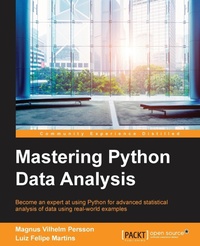
Mastering Python Data Analysis
Become an expert at using Python for advanced statistical analysis of data using real-world examples
Published on 27. June 2016
Book
Paperback/Softback
284 pages
978-1-78355-329-7 (ISBN)
Description
Become an expert at using Python for advanced statistical analysis of data using real-world examples
Key Features
[*] Clean, format, and explore data using graphical and numerical summaries
[*] Leverage the IPython environment to efficiently analyze data with Python
[*] Packed with easy-to-follow examples to develop advanced computational skills for the analysis of complex data
Book DescriptionPython, a multi-paradigm programming language, has become the language of choice for data scientists for data analysis, visualization, and machine learning. Ever imagined how to become an expert at effectively approaching data analysis problems, solving them, and extracting all of the available information from your data? Well, look no further, this is the book you want!
Through this comprehensive guide, you will explore data and present results and conclusions from statistical analysis in a meaningful way. You'll be able to quickly and accurately perform the hands-on sorting, reduction, and subsequent analysis, and fully appreciate how data analysis methods can support business decision-making.
You'll start off by learning about the tools available for data analysis in Python and will then explore the statistical models that are used to identify patterns in data. Gradually, you'll move on to review statistical inference using Python, Pandas, and SciPy. After that, we'll focus on performing regression using computational tools and you'll get to understand the problem of identifying clusters in data in an algorithmic way. Finally, we delve into advanced techniques to quantify cause and effect using Bayesian methods and you'll discover how to use Python's tools for supervised machine learning.
What you will learn
[*] Read, sort, and map various data into Python and Pandas
[*] Recognise patterns so you can understand and explore data
[*] Use statistical models to discover patterns in data
[*] Review classical statistical inference using Python, Pandas, and SciPy
[*] Detect similarities and differences in data with clustering
[*] Clean your data to make it useful
[*] Work in Jupyter Notebook to produce publication ready figures to be included in reports
Who this book is forIf you are a competent Python developer who wants to take your data analysis skills to the next level by solving complex problems, then this advanced guide is for you. Familiarity with the basics of applying Python libraries to data sets is assumed.
Key Features
[*] Clean, format, and explore data using graphical and numerical summaries
[*] Leverage the IPython environment to efficiently analyze data with Python
[*] Packed with easy-to-follow examples to develop advanced computational skills for the analysis of complex data
Book DescriptionPython, a multi-paradigm programming language, has become the language of choice for data scientists for data analysis, visualization, and machine learning. Ever imagined how to become an expert at effectively approaching data analysis problems, solving them, and extracting all of the available information from your data? Well, look no further, this is the book you want!
Through this comprehensive guide, you will explore data and present results and conclusions from statistical analysis in a meaningful way. You'll be able to quickly and accurately perform the hands-on sorting, reduction, and subsequent analysis, and fully appreciate how data analysis methods can support business decision-making.
You'll start off by learning about the tools available for data analysis in Python and will then explore the statistical models that are used to identify patterns in data. Gradually, you'll move on to review statistical inference using Python, Pandas, and SciPy. After that, we'll focus on performing regression using computational tools and you'll get to understand the problem of identifying clusters in data in an algorithmic way. Finally, we delve into advanced techniques to quantify cause and effect using Bayesian methods and you'll discover how to use Python's tools for supervised machine learning.
What you will learn
[*] Read, sort, and map various data into Python and Pandas
[*] Recognise patterns so you can understand and explore data
[*] Use statistical models to discover patterns in data
[*] Review classical statistical inference using Python, Pandas, and SciPy
[*] Detect similarities and differences in data with clustering
[*] Clean your data to make it useful
[*] Work in Jupyter Notebook to produce publication ready figures to be included in reports
Who this book is forIf you are a competent Python developer who wants to take your data analysis skills to the next level by solving complex problems, then this advanced guide is for you. Familiarity with the basics of applying Python libraries to data sets is assumed.
More details
Language
English
Place of publication
Birmingham
United Kingdom
Target group
Professional and scholarly
US School Grade: College Graduate Student
Dimensions
Height: 235 mm
Width: 191 mm
Thickness: 15 mm
Weight
536 gr
ISBN-13
978-1-78355-329-7 (9781783553297)
Copyright in bibliographic data and cover images is held by Nielsen Book Services Limited or by the publishers or by their respective licensors: all rights reserved.
Schweitzer Classification
Other editions
Additional editions
Magnus Vilhelm Persson | Luiz Felipe Martins
Mastering Python Data Analysis
Become an expert at using Python for advanced statistical analysis of data using real-world examples
E-Book
07/2025
Packt Publishing
from
€41.99
Available for download
Persons
Magnus Vilhelm Persson is a scientist with a passion for Python and open source software usage and development. He obtained his PhD in Physics/Astronomy from Copenhagen Universitys Centre for Star and Planet Formation (StarPlan) in 2013. Since then, he has continued his research in Astronomy at various academic institutes across Europe. In his research, he uses various types of data and analysis to gain insights into how stars are formed. He has participated in radio shows about Astronomy and also organized workshops and intensive courses about the use of Python for data analysis. You can check out his web page at http://vilhelm.nu. Luiz Felipe Martins holds a PhD in applied mathematics from Brown University and has worked as a researcher and educator for more than 20 years. His research is mainly in the field of applied probability. He has been involved in developing code for the open source homework system, WeBWorK, where he wrote a library for the visualization of systems of differential equations. He was supported by an NSF grant for this project. Currently, he is an Associate Professor in the Department of Mathematics at Cleveland State University, Cleveland, Ohio, where he has developed several courses in applied mathematics and scientific computing. His current duties include coordinating all first-year calculus sessions.
Content
Table of Contents
Tools of the Trade
Exploring data
Learning about Models
Regression
Clustering
Delving into Bayesian Methods
Using Python for Machine learning
Time Series Analysis
Appendix
Tools of the Trade
Exploring data
Learning about Models
Regression
Clustering
Delving into Bayesian Methods
Using Python for Machine learning
Time Series Analysis
Appendix