

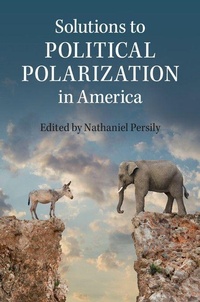
Solutions to Political Polarization in America
Published on 27. April 2015
Book
Paperback/Softback
318 pages
978-1-107-45191-9 (ISBN)
Description
Political polarization dominates discussions of contemporary American politics. Despite widespread agreement that the dysfunction in the political system can be attributed to political polarization, commentators cannot come to a consensus on what that means. The coarseness of our political discourse, the ideological distance between opposing partisans, and, most of all, an inability to pass much-needed and widely supported policies all stem from the polarization in our politics. This volume assembles several top analysts of American politics to focus on solutions to polarization. The proposals range from constitutional change to good-government reforms to measures to strengthen political parties. Each tackles one or more aspects of America's polarization problem. This book begins a serious dialogue about reform proposals to address the obstacles that polarization poses for contemporary governance.
More details
Language
English
Place of publication
Cambridge
United Kingdom
Target group
Professional and scholarly
Product notice
Paperback (trade)
Illustrations
3 Tables, unspecified; 35 Line drawings, unspecified
Dimensions
Height: 229 mm
Width: 152 mm
Thickness: 18 mm
Weight
463 gr
ISBN-13
978-1-107-45191-9 (9781107451919)
Copyright in bibliographic data and cover images is held by Nielsen Book Services Limited or by the publishers or by their respective licensors: all rights reserved.
Schweitzer Classification
Other editions
Additional editions
Nathaniel Persily
Solutions to Political Polarization in America
Book
04/2015
Cambridge University Press
€129.70
Shipment within 15-20 days
Nathaniel Persily
Solutions to Political Polarization in America
E-Book
04/2015
Cambridge University Press
€26.49
Available for download
Person
Nathaniel Persily is the James B. McClatchy Professor of Law at Stanford Law School. He is an award-winning teacher and a nationally recognized constitutional law expert who focuses on the law of democracy, addressing issues such as voting rights, political parties, campaign finance, and redistricting. He has served as a special master or court-appointed nonpartisan expert to draw redistricting plans for several states, including New York, Maryland, Georgia, and Connecticut. In 2014, he served as the senior research director for the bipartisan Presidential Commission on Election Administration.
Content
1. Introduction Nathaniel Persily; 2. Causes and consequences of polarization Michael Barber and Nolan McCarty; 3. Confronting asymmetric polarization Jacob Hacker and Paul Pierson; Part I. Reforming the Electoral System: 4. Polarization and democratization Arend Lijphart; 5. Eroding the electoral foundations of partisan polarization Gary C. Jacobson; 6. Solutions to polarization Elaine C. Kamarck; 7. Geography and gridlock in the United States Jonathan Rodden; Part II. Strengthening Parties: 8. Parties as the solution to polarization Nathaniel Persily; 9. Reducing polarization by making parties stronger Nolan McCarty; 10. Focus on political fragmentation, not polarization: re-empower party leadership Richard H. Pildes; 11. Two approaches to lessening the effects of partisanship Bruce Cain; Part III. Empowering and Informing Moderate Voters: 12. Data science for the people Adam Bonica; 13. Using mobilization, media, and motivation to curb political polarization Markus Prior and Natalie Jomini Stroud; Part IV. Lowering Barriers to Policy Making: 14. Beyond confrontation and gridlock: making democracy work for the American people Alan I. Abramowitz; 15. American political parties: exceptional no more David Karol; 16. Partisan polarization and the Senate syndrome Steven S. Smith; 17. Finding the center Russell Muirhead; Part V. Fostering Negotiation: 18. Making deals in Congress Sarah A. Binder and Frances E. Lee; 19. Helping Congress negotiate Jane Mansbridge; 20. Staying private George C. Edwards, III.