

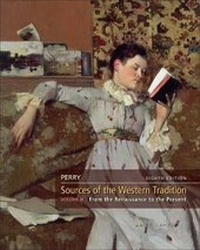
Sources of the Western Tradition, Volume 2
8th Edition
Will be published approx. on 1. January 2011
Book
Paperback/Softback
560 pages
978-0-495-91321-4 (ISBN)
Description
With a collection of over 350 sources, each accompanied by an introductory essay and review questions, this two-volume primary source reader emphasizes the intellectual history and values of the Western tradition. Sources are grouped around important themes in European history--such as religion, education, and art and culture--so that readers can analyze and compare multiple documents. The Eighth Edition features additional sources by and about women, completely revised chapters on modern Europe and its place in the contemporary world, and updates to introductions and review questions.
More details
Edition
8th edition
Language
English
Place of publication
Belmont, CA
United States
Publishing group
Cengage Learning, Inc
Target group
College/higher education
Dimensions
Height: 22 mm
Width: 185 mm
Thickness: 231 mm
Weight
816 gr
ISBN-13
978-0-495-91321-4 (9780495913214)
Copyright in bibliographic data and cover images is held by Nielsen Book Services Limited or by the publishers or by their respective licensors: all rights reserved.
Schweitzer Classification
Person
Marvin Perry, now retired, taught history at Baruch College, City University of New York. He has published several successful Cengage Learning texts, including WESTERN CIVILIZATION: IDEAS, POLITICS, AND SOCIETY (senior author and general editor); WESTERN CIVILIZATION: A BRIEF HISTORY; the leading Western Civilization reader, SOURCES OF THE WESTERN TRADITION; AN INTELLECTUAL HISTORY OF MODERN EUROPE; SOURCES OF EUROPEAN HISTORY SINCE 1900 (senior editor); HUMANITIES IN THE WESTERN TRADITION (senior author and general editor); and WORLD WAR II IN EUROPE: A CONCISE HISTORY. His scholarly work includes ARNOLD TOYNBEE AND THE WESTERN TRADITION (1996); ANTISEMITISM: MYTH AND HATE FROM ANTIQUITY TO THE PRESENT (coauthor, 2002); ANTISEMITIC MYTHS: A HISTORICAL AND CONTEMPORARY ANTHOLOGY (coeditor, 2008); and THE THEORY AND PRACTICE OF ISLAMIC TERRORISM: AN ANTHOLOGY (coeditor, 2008). Dr. Perry's scholarly work focuses on the history of ideas.
Content
Part I: EARLY MODERN EUROPE.
1. The Rise of Modernity.
1. The Humanists' Fascination with Antiquity: Petrarch, The Father of Humanism; Leonardo Bruni, Study of Greek Literature and A Humanist Educational Program. 2. Human Dignity: Pico della Mirandola, Oration on the Dignity of Man. 3. Break with Medieval Political Theory: Niccolo Machiavelli, The Prince. 4. The Lutheran Reformation: Martin Luther, On Papal Power, Justification by Faith, the Interpretation of the Bible, and The Nature of the Clergy. 5. Justification of Absolute Monarchy by Divine Right: Bishop Jacques-Benigne Bossuet, Politics Drawn from the Very Words of Holy Scripture. 6. A Secular Defense of Absolutism: Thomas Hobbes, Leviathan. 7. The Triumph of Constitutional Monarchy in England: The Glorious Revolution: The English Declaration of Rights.
2. The Scientific Revolution.
1. The Copernican Revolution: Nicolaus Copernicus, On the Revolutions of the Heavenly Spheres; Cardinal Bellarmine, Attack on the Copernican Theory. 2. Galileo: Confirming the Copernican System: Galileo Galilei, Letter to the Grand Duchess Christina and Dialogue Concerning the Two Chief World Systems--Ptolemaic and Copernican; Galileo Before the Inquisition. 3. Prophet of Modern Science: Francis Bacon, Attack on Authority and Advocacy of Experimental Science. 4. The Circulation of the Blood: Validating the Empirical Method: William Harvey, The Motion of the Heart and Blood in Animals. 5. The Autonomy of the Mind: Rene Descartes, Discourse on Method. 6. The Mechanical Universe: Isaac Newton, Principia Mathematica.
3. The Enlightenment.
1. The Enlightenment Outlook: Immanuel Kant, What is Enlightenment? 2. Political Liberty: John Locke, Second Treatise on Government; Thomas Jefferson, Declaration of Independence. 3. Attack on Religion: Voltaire, A Plea for Tolerance and Reason; Thomas Paine, The Age of Reason; Baron d'Holbach, Good Sense. 4. Epistemology: John Locke, Essay Concerning Human Understanding; Claude Helvetius, Essays on the Mind and A Treatise on Man. 5. Compendium of Knowledge: Denis Diderot, Encyclopedia. 6. Rousseau: Political Reform: Jean Jacques Rousseau, The Social Contract. 7. Humanitarianism: Caesare Beccaria, On Crimes and Punishments; John Howard, Prisons in England and Wales; Denis Diderot, Encyclopedia "Men and Their Liberty are Not Objects of Commerce..."; Marquis de Condorcet, The Evils of Slavery. 8. Literature as Satire: Critiques of European Society: Voltaire, Candide; Denis Diderot, Supplement to the Voyage of Bougainville; Montesquieu, The Persian Letters. 9. On the Progress of Humanity: Marquis de Condorcet, Progress of the Human Mind.
Part II: MODERN EUROPE.
4. Era of the French Revolution.
1. Abuses of the Old Regime: Grievances of the Third Estate; Emmanuel Sieyes, What is the Third Estate? 2. The Role of the Philosophes: Alexis de Tocqueville, Critique of the Old Regime. 3. Liberty, Equality, Fraternity: Declaration of the Rights of Man and the Citizen. 4. Expansion of Human Rights: Mary Wollstonecraft, A Vindication of the Rights of Women; Society of the Friends of Blacks, Address to the National Assembly in Favor of the Abolition of the Slave Trade; Petition of the Jews of Paris, Alsace, and Lorraine to the National Assembly, January 28, 1790. 5. The Jacobin Regime: Maximilien Robespierre, Republic of Virtue; General Louis de Lignieres Turreau, Uprising in the Vendee. 6. Demands for Economic Justice: Gracchus Babeuf, Conspiracy of the Equals. 7. Napoleon: Destroyer and Preserver of the Revolution: Napoleon Bonaparte, Leader, General, Tyrant, Reformer.
5. The Industrial Revolution.
1. Early Industrialization: Edward Baines, Britain's Industrial Advantages and the Factory System; Adam Smith, The Division of Labor. 2. The New Science of Political Economy: Adam Smith, The Wealth of Nations; Thomas R. Malthus, On the Principle of Population. 3. The Dark Side of Industrialization: Sadler Commission, Report on Child Labor; James Phillips Kay, Moral and Physical Dis
1. The Rise of Modernity.
1. The Humanists' Fascination with Antiquity: Petrarch, The Father of Humanism; Leonardo Bruni, Study of Greek Literature and A Humanist Educational Program. 2. Human Dignity: Pico della Mirandola, Oration on the Dignity of Man. 3. Break with Medieval Political Theory: Niccolo Machiavelli, The Prince. 4. The Lutheran Reformation: Martin Luther, On Papal Power, Justification by Faith, the Interpretation of the Bible, and The Nature of the Clergy. 5. Justification of Absolute Monarchy by Divine Right: Bishop Jacques-Benigne Bossuet, Politics Drawn from the Very Words of Holy Scripture. 6. A Secular Defense of Absolutism: Thomas Hobbes, Leviathan. 7. The Triumph of Constitutional Monarchy in England: The Glorious Revolution: The English Declaration of Rights.
2. The Scientific Revolution.
1. The Copernican Revolution: Nicolaus Copernicus, On the Revolutions of the Heavenly Spheres; Cardinal Bellarmine, Attack on the Copernican Theory. 2. Galileo: Confirming the Copernican System: Galileo Galilei, Letter to the Grand Duchess Christina and Dialogue Concerning the Two Chief World Systems--Ptolemaic and Copernican; Galileo Before the Inquisition. 3. Prophet of Modern Science: Francis Bacon, Attack on Authority and Advocacy of Experimental Science. 4. The Circulation of the Blood: Validating the Empirical Method: William Harvey, The Motion of the Heart and Blood in Animals. 5. The Autonomy of the Mind: Rene Descartes, Discourse on Method. 6. The Mechanical Universe: Isaac Newton, Principia Mathematica.
3. The Enlightenment.
1. The Enlightenment Outlook: Immanuel Kant, What is Enlightenment? 2. Political Liberty: John Locke, Second Treatise on Government; Thomas Jefferson, Declaration of Independence. 3. Attack on Religion: Voltaire, A Plea for Tolerance and Reason; Thomas Paine, The Age of Reason; Baron d'Holbach, Good Sense. 4. Epistemology: John Locke, Essay Concerning Human Understanding; Claude Helvetius, Essays on the Mind and A Treatise on Man. 5. Compendium of Knowledge: Denis Diderot, Encyclopedia. 6. Rousseau: Political Reform: Jean Jacques Rousseau, The Social Contract. 7. Humanitarianism: Caesare Beccaria, On Crimes and Punishments; John Howard, Prisons in England and Wales; Denis Diderot, Encyclopedia "Men and Their Liberty are Not Objects of Commerce..."; Marquis de Condorcet, The Evils of Slavery. 8. Literature as Satire: Critiques of European Society: Voltaire, Candide; Denis Diderot, Supplement to the Voyage of Bougainville; Montesquieu, The Persian Letters. 9. On the Progress of Humanity: Marquis de Condorcet, Progress of the Human Mind.
Part II: MODERN EUROPE.
4. Era of the French Revolution.
1. Abuses of the Old Regime: Grievances of the Third Estate; Emmanuel Sieyes, What is the Third Estate? 2. The Role of the Philosophes: Alexis de Tocqueville, Critique of the Old Regime. 3. Liberty, Equality, Fraternity: Declaration of the Rights of Man and the Citizen. 4. Expansion of Human Rights: Mary Wollstonecraft, A Vindication of the Rights of Women; Society of the Friends of Blacks, Address to the National Assembly in Favor of the Abolition of the Slave Trade; Petition of the Jews of Paris, Alsace, and Lorraine to the National Assembly, January 28, 1790. 5. The Jacobin Regime: Maximilien Robespierre, Republic of Virtue; General Louis de Lignieres Turreau, Uprising in the Vendee. 6. Demands for Economic Justice: Gracchus Babeuf, Conspiracy of the Equals. 7. Napoleon: Destroyer and Preserver of the Revolution: Napoleon Bonaparte, Leader, General, Tyrant, Reformer.
5. The Industrial Revolution.
1. Early Industrialization: Edward Baines, Britain's Industrial Advantages and the Factory System; Adam Smith, The Division of Labor. 2. The New Science of Political Economy: Adam Smith, The Wealth of Nations; Thomas R. Malthus, On the Principle of Population. 3. The Dark Side of Industrialization: Sadler Commission, Report on Child Labor; James Phillips Kay, Moral and Physical Dis