

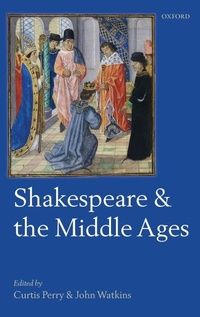
Shakespeare and the Middle Ages
Published on 7. May 2009
Book
Hardback
310 pages
978-0-19-955817-9 (ISBN)
Description
Shakespeare and the Middle Ages brings together a distinguished, multidisciplinary group of scholars to rethink the medieval origins of modernity. Shakespeare provides them with the perfect focus, since his works turn back to the Middle Ages as decisively as they anticipate the modern world: almost all of the histories depict events during the Hundred Years War, and King John glances even further back to the thirteenth-century Angevins; several of the comedies, tragedies, and romances rest on medieval sources; and there are important medieval antecedents for some of the poetic modes in which he worked as well.
Several of the essays reread Shakespeare by recovering aspects of his works that are derived from medieval traditions and whose significance has been obscured by the desire to read Shakespeare as the origin of the modern. These essays, taken cumulatively, challenge the idea of any decisive break between the medieval period and early modernity by demonstrating continuities of form and imagination that clearly bridge the gap. Other essays explore the ways in which Shakespeare and his contemporaries constructed or imagined relationships between past and present. Attending to the way these writers thought about their relationship to the past makes it possible, in turn, to read against the grain of our own teleological investment in the idea of early modernity. A third group of essays reads texts by Shakespeare and his contemporaries as documents participating in social-cultural transformation from within. This means attending to the way they themselves grapples with the problem of change, attempting to respond to new conditions and pressures while holding onto customary habits of thought and imagination. Taken together, the essays in this volume revisit the very idea of transition in a refreshingly non-teleological way.
Several of the essays reread Shakespeare by recovering aspects of his works that are derived from medieval traditions and whose significance has been obscured by the desire to read Shakespeare as the origin of the modern. These essays, taken cumulatively, challenge the idea of any decisive break between the medieval period and early modernity by demonstrating continuities of form and imagination that clearly bridge the gap. Other essays explore the ways in which Shakespeare and his contemporaries constructed or imagined relationships between past and present. Attending to the way these writers thought about their relationship to the past makes it possible, in turn, to read against the grain of our own teleological investment in the idea of early modernity. A third group of essays reads texts by Shakespeare and his contemporaries as documents participating in social-cultural transformation from within. This means attending to the way they themselves grapples with the problem of change, attempting to respond to new conditions and pressures while holding onto customary habits of thought and imagination. Taken together, the essays in this volume revisit the very idea of transition in a refreshingly non-teleological way.
Reviews / Votes
Together the essays give fresh consideration to precisely articulated specific aspects of continuity and discontinuity between the medieval and the early modern in a wide range of Shakespeare's work. * David Fuller, Medium Aevum 2010 *More details
Language
English
Place of publication
Oxford
United Kingdom
Target group
College/higher education
Professional and scholarly
Illustrations
3 black-and-white halftones
Dimensions
Height: 240 mm
Width: 161 mm
Thickness: 21 mm
Weight
631 gr
ISBN-13
978-0-19-955817-9 (9780199558179)
Copyright in bibliographic data and cover images is held by Nielsen Book Services Limited or by the publishers or by their respective licensors: all rights reserved.
Schweitzer Classification
Other editions
Additional editions
Curtis Perry | John Watkins
Shakespeare and the Middle Ages
E-Book
05/2009
OUP eBook
€68.99
Available for download
Persons
Curtis Perry is Professor of English at the University of Illinois, Urbana Champaign. In addition to numerous articles on early modern English literature and culture he is the author of The Making of Jacobean Culture: James I and the Renegotiation of Elizabethan Literary Practice (1997) and Literature and Favoritism in Early Modern England (2006), and the editor of Material Culture and Cultural Materialisms in the Middle Ages and the Renaissance (2001) and of Eros and Power in English Renaissance Drama: Five Plays by Marlowe, Davenant, Massinger, Ford, and Shakespeare (2008).
John Watkins is Professor of English, Medieval Studies, and Italian Studies at the University of Minnesota. He is the author of The Specter of Dido: Spenser and the Virgilian Epic Tradition (1995) and Representing Elizabeth in Stuart England: Literature, History, Sovereignty (2002). With Carole Levin, he is the author of Shakespeare's Foreign Worlds: National and Transnational Identities in the Elizabethan Age (2009). He is currently Associate Editor of The Journal of British Studies.
John Watkins is Professor of English, Medieval Studies, and Italian Studies at the University of Minnesota. He is the author of The Specter of Dido: Spenser and the Virgilian Epic Tradition (1995) and Representing Elizabeth in Stuart England: Literature, History, Sovereignty (2002). With Carole Levin, he is the author of Shakespeare's Foreign Worlds: National and Transnational Identities in the Elizabethan Age (2009). He is currently Associate Editor of The Journal of British Studies.
Content
PART 1: TEXTS IN TRANSITION ; PART 2: MEDIEVALISM IN SHAKESPEAREAN ENGLAND ; PART 3: SHAKESPEARE AND THE RESOURCES OF MEDIEVAL CULTURE