

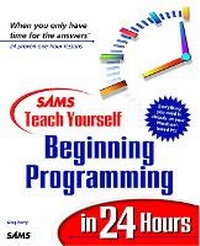
Sams Teach Yourself Beginning Programming in 24 Hours
Published on 1. October 1998
Book
Paperback/Softback
512 pages
978-0-672-31355-4 (ISBN)
Description
Sams Teach Yourself Programming in 24 Hours explains the basics of programming in the successful 24 Hours format. Greg uses his proven techniques from many years of college programming instruction and his best-selling programming books. The book begins with the absolute basics of programming: Why program? What tools? How does a program tell the computer what to do? It then moves on to teach you how to program the computer, pointing you in the direction of the best programming tools for your needs. The text covers computers as tools, their history, and the hardware unmasked. It also covers programs from definition through design and process. You'll learn techniques, programming languages, and much more.
More details
Language
English
Place of publication
Indianapolis
United States
Publishing group
Pearson Education (US)
Target group
College/higher education
Dimensions
Height: 230 mm
Width: 185 mm
Thickness: 30 mm
Weight
857 gr
ISBN-13
978-0-672-31355-4 (9780672313554)
Copyright in bibliographic data and cover images is held by Nielsen Book Services Limited or by the publishers or by their respective licensors: all rights reserved.
Schweitzer Classification
Other editions
New editions
Book
11/2001
2nd Edition
Sams Publishing
€30.34
Article exhausted; check for reprint
Person
Greg Perry has written more than 45 books, many of which are Macmillan bestsellers. He has been a programmer, trainer, and speaker for the past 19 years. Greg was a professor of computer science at Tulsa Junior College teaching advanced programming courses. He also lectures at programming conferences across the country and is fluent in 9 computer languages. Among the bestselling books he has written are Teach Yourself Visual Basic in 24 Hours, Teach Yourself Office in 24 Hours, and Teach Yourself Windows ?95 in 24 Hours.
Content
Introduction. Introduction to Programming. Who Should Use This Book? What This Book Will Do For You. Can This Book Really Teach Programming in 24 Hours? Conventions Used in This Book. I. WELCOME TO PROGRAMMING. Hour 1. Computers as Tools. What a Computer Does. Common Misconceptions. Computer Programs Benefit Many. People and Computers. Using Programs Takes More Than a Computer. Summary. Q&A. Workshop. Hour 2. Computer Hardware Unmasked. The Computers Background. Todays Computers. The Types of Computers. Hardware from the Programmers Perspective. The Operating System. Hardware and Programs. Is It Too Late to Start? Summary. Q&A. Workshop. Hour 3. What Is a Program? Understanding the Need for Programs. Programs, Programs, Everywhere. Programs as Directions. Speak the Language. The Language Translator. Accuracy Is Everything. Summary. Q&A. Workshop. Hour 4. The Programs Design. Understanding the Need for Design. Program Design. Summary. Q&A. Workshop. II. FUNDAMENTALS OF PROGRAMMING. Hour 5. The Programming Process and Structured Techniques. Using an Editor. Structured Programming. Testing the Program. Learning the Program Language. Summary. Q&A. Workshop. Hour 6. Programming Languages: The Early Years. Storing Programs and Data. Understanding Binary Arithmetic. Remembering the First Programs. Simplifying Machine Language. Getting Closer to English. Other Languages Through the Years. Summary. Q&A. Workshop. Hour 7. Programming Languages: Modern Day. Structured Programming with Pascal. Reviewing the Background of C. Learning the BASICs. Games Are the Exceptions. Which Language Is Best? Summary. Q&A. Workshop. III. HANDS-ON PROGRAMMING. Hour 8. Your First Language: QBasic. Getting Started. Using the QBasic Editor. Delving into QBasic. Assigning Values. Looking at Values. Clearing the Screen. Performing Math with QBasic. Summary. Q&A. Workshop. Hour 9. Input and Output. Advanced Printing. Getting Keyboard Data with INPUT. Inputting Strings and Multiple Variables. Summary. Q&A. Workshop. Hour 10. Data Processing with QBasic. Comparing Data with IF. Writing the Relational Test. Using the SELECT CASE Statement. Looping Statements. Summary. Q&A. Workshop. Hour 11. Managing Data and Disk Files. Understanding the Importance of Disk Storage and Arrays. Introduction to Arrays. Introduction to Disk Files. Creating Output Files. Reading the Disk File. Appending to a Data File. Two or More Files Open. Advanced Data Files. Summary. Q&A. Workshop. Hour 12. Having Fun with QBasic. Beeping the Speaker. Using the SOUND Command. Using the PLAY Command. Introduction to Graphics. Using the SCREEN Command. Turning Pixels On and Off. Drawing Lines and Boxes. Drawing Circles. Textual Graphs. Changing the PRINT Location. Summary. Q&A. Workshop. IV. PROGRAMMING IN VARIOUS ENVIRONMENTS. Hour 13. Windows Programming Considerations. Visual Programming Issues. Controls Offer User Interaction. Event-Driven Programs. Event-Handling Methods. Summary. Q&A. Workshop. Hour 14. Programming with Visual Basic. Reviewing the Visual Basic Screen. Visual Basic Programming Wizard. Creating a Simple Application from Scratch. Other Visual Basic Programming Considerations. Your Next Step. Summary. Q&A. Workshop. Hour 15. Programming with C. Introducing C. What You Need. Looking at C. C Data. C Comments. Declaring Variables. C Functions. C Operators. C Control Statements. Summary. Q&A. Workshop. Hour 16. Programming with C++. Learning C++. Object Terminology. Fundamental Differences Between C and C++. Introducing Objects. Defining Classes. Things to Come. Summary. Q&A. Workshop. Hour 17. Programming Algorithms. Counters and Accumulators. Swapping Values. Sorting. Searching Arrays. Subroutines. Nested Loops. Summary. Q&A. Workshop. Hour 18. Batch, Macro, and Scripting Languages. Batch: The One That Started Everything. Macro Languages. Visual Basic for Applications (VBA). Scripting in Windows. Summary. Q&A. Workshop. Hour 19. Internet Programming Concepts. Internet Programming Considerations. The Need for Simple Navigation. HTML Programming. The New ActiveX Control. Scripting in Internet Applications. Summary. Q&A. Workshop. Hour 20. Programming with Java. Introducing Java. Java Provides Executable Content. Multi-Platform Executable Content. Java Usage Summary. Security Issues. Give Java a Spin. Visual J++: A Sample Java System. Java Language Specifics. Summary. Q&A. Workshop. V. THE BUSINESS OF PROGRAMMING. Hour 21. How Companies Program. Data Processing and Other Departments. Paying for the Data Processing Department. Computer Jobs. Job Titles. Structured Walkthroughs. Putting a Program into Production. Consulting. Summary. Q&A. Workshop. Hour 22. Debugging Tools. Practice Debugging with QBasic. Other Debugging Tools. Summary. Q&A. Workshop. Hour 23. Distributing Your Applications. Issues Surrounding Software Distribution. QBasic Is Too Easy. Windows Application Distribution. Your First Step: Compilation. Deploying Your Application. After Generating the Setup. Uninstalling the Application. Summary. Q&A. Workshop. Hour 24. The Future of Programming. Some Helpful Tools. Will Programming Go Away? Y2Ks Implications. Your Training Needs. Summary. Q&A. Workshop. Appendix A. Answers to End of Chapter Questions. Index.