

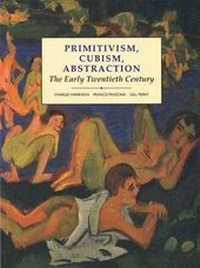
Primitivism, Cubism, Abstraction
The Early Twentieth Century
Published on 26. May 1993
Book
Paperback/Softback
276 pages
978-0-300-05516-0 (ISBN)
Description
This volume presents a survey of art from the first two decades of the twentieth century. The authors begin by exploring how aspects of the primitive were invoked by the rural artists' colonies formed in France and Germany at the end of the nineteenth century and by the work of the Fauves and the German Expressionists a few years later. The book then develops an analysis of Cubist works based on semiotic theory, considering the social and cultural values encoded in such signifying systems, and investigating the relationship between representation and ideology. The final chapter considers some problems of interpretation and evolution posed by specific examples of abstract art ranging from Malevich to Mondrian.
More details
Series
Language
English
Place of publication
United States
Target group
College/higher education
Professional and scholarly
Illustrations
182 b&w illustrations, 48 colour illustrations
Dimensions
Height: 256 mm
Width: 255 mm
Thickness: 25 mm
Weight
800 gr
ISBN-13
978-0-300-05516-0 (9780300055160)
Copyright in bibliographic data and cover images is held by Nielsen Book Services Limited or by the publishers or by their respective licensors: all rights reserved.
Schweitzer Classification
Persons
Francis Frascina and Gill Perry are Lecturers in Art History, Nigel Blake is Lecturer in Educational Technology, and Charles Harrison is Staff Tutor and Reader in Art History at the Open University. Briony Fer and Tamar Garb are Lecturers in Art History at University College, London University.
Content
Contents: Chapter 1: Primitivism and the 'Modern' by Gill Perry Introduction: Primitivism in art-historical debate Part 1: 'The Going Away' - a preparation for the 'modern' 'Clogs and granite' Brittany and Pont-Aven 'Pillaging the savages of Oceania': Gauguin and Tahid Primitivism and Kulturkritik: Worpswede in the 1890s Part 2: The decorative, the expressive and the primitive The decorative and the 'culte de la vie': Matisse and Fauvism The expressive and the Expressionist Conclusion References Chapter 2: Realism and Ideologue An introduction to semiotics and cubism by Francis Frascina Introduction Representation: language, signs, realism Art and semiotics Realism, ideology and the 'discursive' in Cubism Artistic subcultures: signs and meaning Conclusion References Chapter 3: Abstraction by Charles Harrison Abstraction, figuration and representation On interpretation Autonomy Kazirnir Malevich Piet Mondrian References.